No Flavor Anisotropy in the High-Energy Neutrino Sky Upholds Lorentz Invariance

Standard

Do neutrinos of different flavors have different preferred directions? If so, this would mean that Lorentz invariance is violated, something that is posited by some theories of quantum gravity. In them, Lorentz-invariance violation (LIV) would become more prominent the higher the energies involved.

Motivated by this, we look for signs of this flavor-dependent LIV using the high-energy astrophysical neutrinos seen by IceCube, with energies in the TeV-PeV range.

If LIV exists, the neutrinos would be affected by their interaction with a pervasive LIV field that couples differently to different neutrino flavors. As a result, the sky distributions of high-energy astrophysical electron, muon, and tau neutrinos arriving at Earth would be anisotropic.

In a new paper led by PhD student Bernanda Telalovic, we look for these high-energy neutrino flavor anisotropies in IceCube data, specifically, in the public 7.5-year sample of High-Energy Starting Events (HESE). We do this using the methods introduced in an earlier paper of ours (2310.15224).

We find no evidence for the patterns of flavor anisotropy expected from LIV, and so we place new upper limits on hundreds of parameters regulating Lorentz-invariance violation within the Standard Model Extension. We explore LIV operator dimensions from 2 to 8, each with a different dependence on neutrino energy and introducing different forms of flavor anisotropy.

For many of them, we improve upon existing limits—on account of using higher energies—or place limits for the first time ever:

Our new upper limits on the LIV parameters are available in digital form for download at 68%, 95%, and 99% C.L. GitHub, here.

Read more at:

No Flavor Anisotropy in the High-Energy Neutrino Sky Upholds Lorentz Invariance
Bernanda Telalovic, Mauricio Bustamante
2503.15468 astro-ph

Discovering Majorons from the neutrinos of the next galactic supernova

Standard

In the hot, dense cores of core-collapse supernova, neutrinos could coalesce to make new, heavy particles, like Majoron-like bosons, with masses from tens of MeV to more than 100 MeV. After escaping the supernova, these Majorons would decay into energies comparable to the parent Majoron mass, far more energetic than the standard supernova neutrinos emitted from the neutrinosphere, and arriving at Earth later than them.

Thanks to large upcoming neutrino detectors, we might observe these high-energy neutrinos from the next galactic core-collapse supernova. Combining all available detection channels provides us with information on the energy, flavor, and arrival times of these neutrinos.

In a new paper, led by NBI PhD student Bernanda Telalovic, we have shown for the first time that we can combine this information use to clearly distinguish neutrinos from Majoron decay from the standard neutrinos of the next galactic supernova.

And, on top of that, we fold in the large uncertainty that exists in supernova physics by using two sophisticated supernova simulations (hot and cold) from the Garching group, obtained for two different assumptions for the mass of the proto-neutron star. However, our results do not hinge on us knowing what the real model, since we marginalize over it.

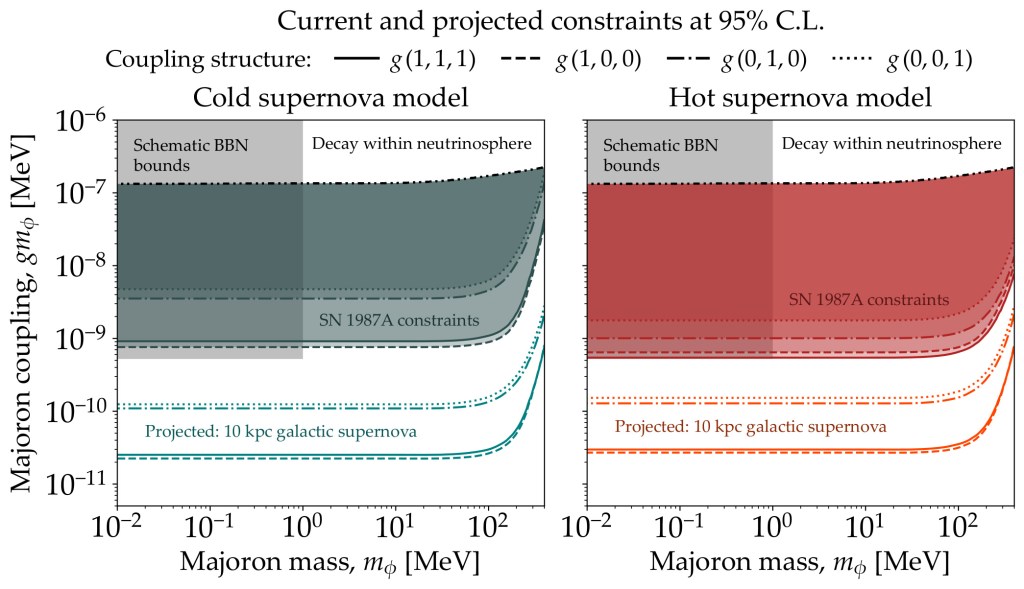
Should we detect no high-energy neutrinos, we will be able to place upper bounds on the Majoron coupling to neutrinos that are more than an order of magnitude stronger than the ones inferred from the observation of neutrinos from SN 1987A:

We show explicitly how the bounds are different depending on the flavor texture of the Majoron.

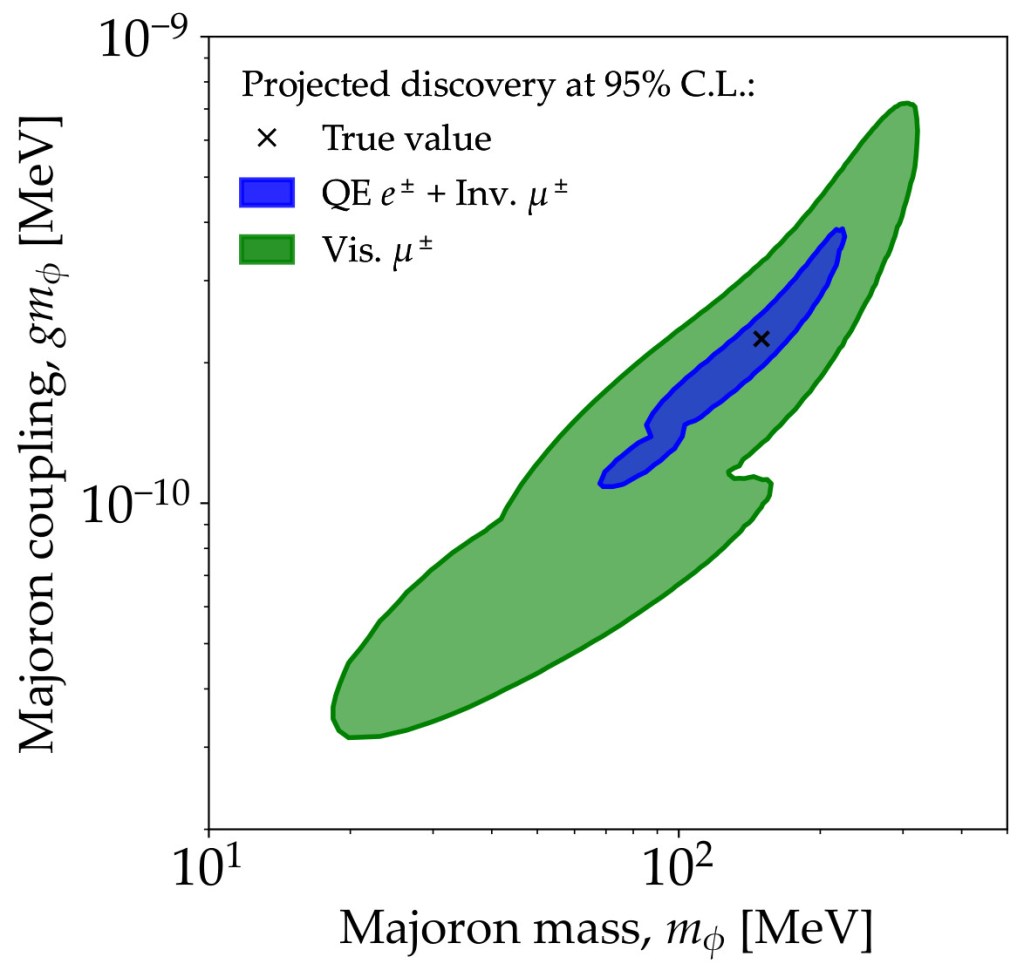
Conversely, should we detect high-energy neutrinos with late arrival times (tens of seconds post-bounce), we will be able to measure the mass and flavor-universal coupling of the Majoron:

Read more at:

The next galactic supernova can uncover mass and couplings of particles decaying to neutrinos
Bernanda Telalovic, Damiano F.G. Fiorillo, Pablo Martíinez-Miravé, Edoardo Vitagliano, Mauricio Bustamante
2406.15506 astro-ph

New limits on neutrino decay from high-energy astrophysical neutrinos

Standard

In the Standard Model, neutrinos are effectively stable, their lifetimes orders of magnitude longer than the age of the Universe. In proposed extensions of the Standard Model, however, neutrinos might decay faster, and so observing them decay would constitute evidence of new neutrino physics.

Regardless, neutrino lifetimes, even augmented by new physics, are likely very long, and the effects of decay are likely manifest only in neutrinos that travel a long distance, during which the chances of them decaying becomes appreciable even if they are long-lived.

In a new paper, we have searched for signs of neutrino decay using the neutrinos from farthest away: the high-energy astrophysical neutrinos detected by IceCube, which travel cosmological-scale distances of Mpc-Gpc from their sources to Earth. Neutrino decay, in principle, alters the shape of the neutrino energy spectrum—introducing a step-like jump—and the flavor composition of the neutrinos upon reaching Earth—taking it outside the region expected from standard oscillations alone.

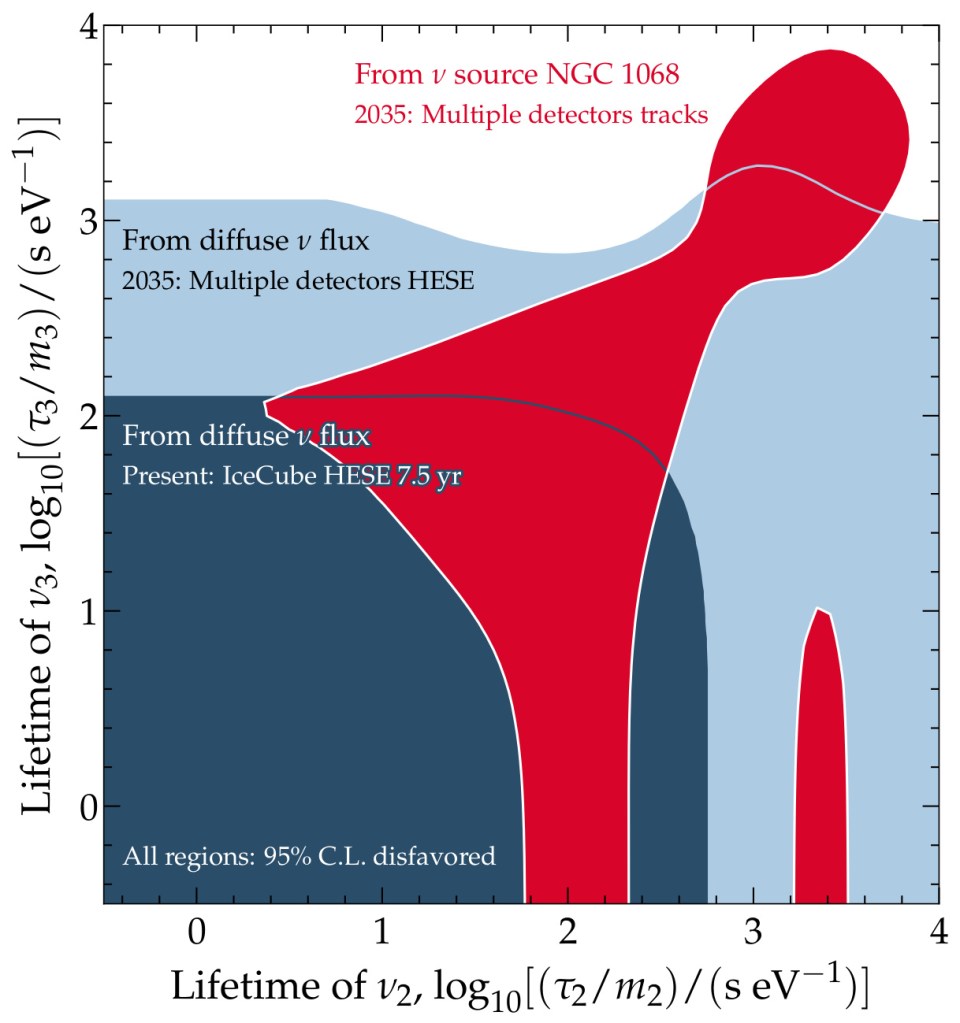
We find no signs of decay in present-day IceCube data, but place new, competitive lower limits on the lifetimes of the nu_2 and nu_3 neutrino mass eigenstates. We report, for the first time, limits inferred using the neutrinos from the first candidate steady-state astrophysical source of high-energy neutrinos, the active galaxy NGC 1068, and limits inferred from the diffuse flux of high-energy neutrinos.

These are arguably the most robust neutrino lifetime bounds garnered from high-energy astrophysical neutrinos so far! In addition, we make forecasts for the year 2035, combining multiple upcoming neutrino telescopes.

While similar studies have been performed before, ours brings two new perspectives, often overlooked or understudied, that make our results robust.

First, we consider broadly the large astrophysical uncertainties that plague the prediction of the flux of high-energy astrophysical neutrinos. This includes the size and shape of the neutrino energy spectrum, the flavor composition of the neutrino flux, the number or source populations and their distribution in redshift, and whether we have prior constraints on the size of the neutrino flux normalization. The impact of considering these uncertainties ranges from appreciable to critical. In some cases, they nearly make the sensitivity to neutrino decay vanish! Surprisingly, with present data, it is not possible to constrain neutrino decay using neutrinos from NGC 1068 due to the astrophysical unknowns!

Second, we model in detail the detection of neutrinos in IceCube and other neutrino telescopes. Their limited resolution to measure the energy, direction, and flavor of detected neutrinos blurs potential signs of neutrino decay in the flux of high-energy astrophysical neutrinos. We model experimental nuance using either tools provided publicly by the IceCube Collaboration (for the diffuse flux, using High Energy Starting Events), or using the PLEnuM (for the flux from NGC 1068, using tracks).

Read more at:

New limits on neutrino decay from high-energy astrophysical neutrinos
Victor B. Valera, Damiano F. G. Fiorillo, Ivan Esteban, Mauricio Bustamante
2405.14826 astro-ph

Download our digitized two-dimensional lifetime limits from this GitHub repository.

A plethora of long-range neutrino interactions probed by DUNE and T2HK

Standard

If there are new neutrino interactions with matter, and if they affect neutrinos of different flavor differently, then they could impact neutrino oscillations. Long-baseline neutrino experiments are well-suited to look for them, thanks to their use of intense, well-characterized neutrino beams.

If the new interactions have a long range—i.e., if they are mediated by a new, ultra-light mediator—then neutrinos on Earth may experience a matter potential sourced by the vast amount of faraway matter elsewhere inside the Earth, Moon, Sun, Milky Way, and in the cosmological matter distribution, as pointed out in 1808.02042 [Universe’s Worth of Electrons to Probe Long-Range Interactions of High-Energy Astrophysical Neutrinos, by MB & Sanjib Agarwalla, PRL 2019]. This boosts the chances of discovering the new interaction even if it is supremely feeble.

In a recent paper (2305.05184 [Flavor-dependent long-range neutrino interactions in DUNE & T2HK: alone they constrain, together they discover, by Masoom Singh, MB, and Sanjib Agarwalla, JHEP 2023]), we explored the prospects of constraining or discovering these new, long-range neutrino interactions in the upcoming long-baseline experiments DUNE and T2HK. We found promising prospects. However, we explored only three different possible forms of the interaction, introduced by gauging three of the accidental global lepton-number U(1) symmetries of the Standard Model.

In a new paper (2404.02775), led by PhD students Masoom Singh and Pragyanprasu Swain, we now extend this to many other symmetries—a plethora of them!—that introduce new neutrino interactions with electrons, neutrons, and protons. Each symmetry affects oscillations differently.

Our new results cement and extend our original findings: DUNE and T2HK should be able to probe the existence of new interactions—and possibly discover and distinguish between alternatives—regardless of which symmetry is responsible for inducing them. The reach of DUNE and T2HK to probe new neutrino interactions is not only deep, but also broad!

Read more at

A plethora of long-range neutrino interactions probed by DUNE and T2HK
Sanjib Kumar Agarwalla, Mauricio Bustamante, Masoom Singh, Pragyanprasu Swain
2404.02775 hep-ph

Download the digitized data from out plots from this GitHub repository.

Measuring the ultra-high-energy neutrino flavor composition in in-ice radio detectors

Standard

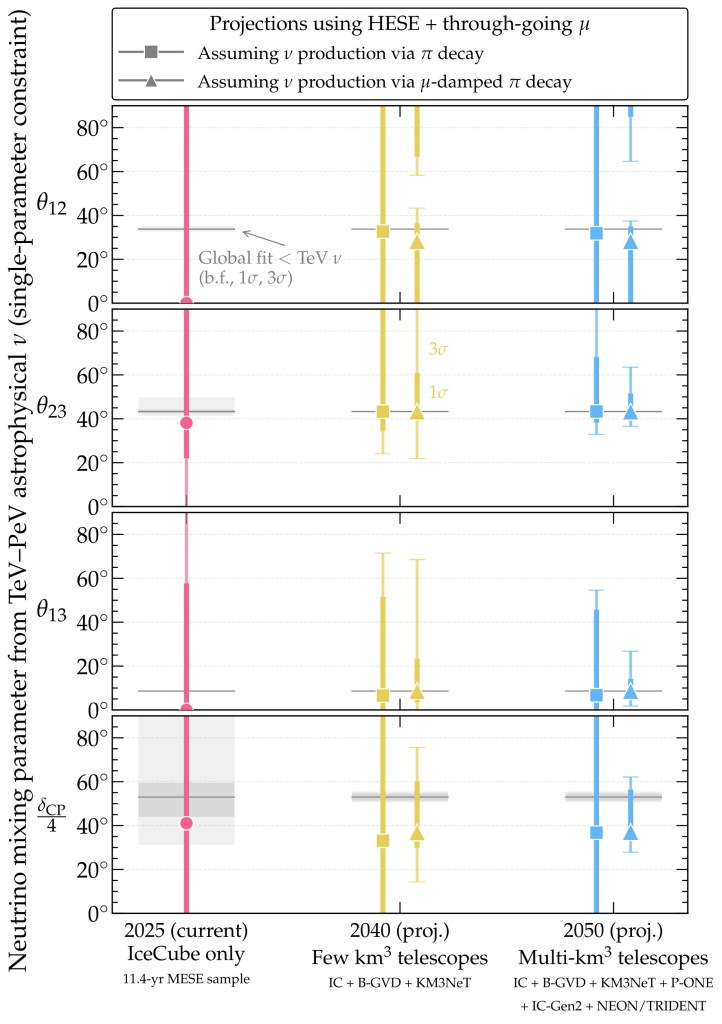
The flavor composition of high-energy cosmic neutrinos—i.e., the proportion of electron, muon, and tau neutrinos in the flux—is a versatile probe of neutrino physics and astrophysics (see, e.g., here, here, and here). So far, all measurements of it, by IceCube, have been in the TeV-PeV energy range. In the next decade, new neutrino telescopes might discover ultra-high-energy (UHE) neutrinos, with EeV-scale energies, opening up new possibilities. Yet, so far, the measurement of their flavor composition has remained largely unexplored (see, however, our recent paper here).

In a new paper led by postdoc Alan Coleman we propose new methods to measure the flavor composition of UHE neutrinos in upcoming large in-ice radio-detection neutrino telescopes, like RNO-G, under construction, and the planned radio array of IceCube-Gen2. 

The measurement is based on two flavor-sensitive channels: one sensitive to electron neutrinos, by looking for the elongation of radio Askaryan emission due to the Landau-Pomeranchuk-Migdal effect, and one sensitive mainly to muon and tau neutrinos, by looking for events that contain multiple showers, triggered by the stochastic losses of final-state muons and taus.

Our results, based on state-of-the-art simulations of IceCube-Gen2, show promising prospects. If the UHE neutrino flux is large (as in, informed by cosmic-ray measurements by the Telescope Array), we should achieve sensitivity enough to confirm standard predictions of the flavor composition and disfavor extreme deviations from them:

This would allow us, for instance, to infer the flavor composition at the point of production of the UHE neutrinos and thus indirectly probe their production mechanism and possibly the identity of the neutrino sources:

Read more at:

The flavor composition of ultra-high-energy cosmic neutrinos: measurement forecasts for in-ice radio-based EeV neutrino telescopes
Alan Coleman, Oscar Ericsson, Mauricio Bustamante, Christian Glaser
2402.02432 astro-ph