Geoneutrinos (and reactor neutrinos) do not visibly decay

Standard

Do neutrinos decay on their way through the Earth?

Neutrinos come in three states of definite mass, ν1, ν2, and ν3. The heavier states could decay into lighter ones if neutrinos interact with a new, very light particle. A neutrino that decays on its way to a detector turns into a lighter one, with less energy, that the detector may not see. Time dilation lengthens the lifetime of a moving neutrino by the ratio of its energy to its mass. Therefore, experiments test the ratio of lifetime to mass, τ/m. Low-energy neutrinos that travel far reach the largest values.

Geoneutrinos are such neutrinos. They are electron antineutrinos made in the radioactive decays of uranium and thorium inside the Earth. They have energies of a few MeV and reach a detector from anywhere in the Earth, from rock a few kilometers away to the far side of the planet, 12,742 km away. Therefore, they can test τ/m up to about 10−8 s eV−1, a range that reactor and accelerator neutrinos cannot reach.

In a new paper, I use geoneutrinos to test neutrino decay for the first time. I compute the geoneutrino signal at four detectors, Borexino, KamLAND, SNO+, and JUNO, for visible decay, in which the lighter antineutrinos that the decays produce can also be detected. The same detectors see antineutrinos from nuclear reactors, which would decay too, so I include them. I fit the published data of each experiment with a model built to match that experiment’s own analysis, then combine the four.
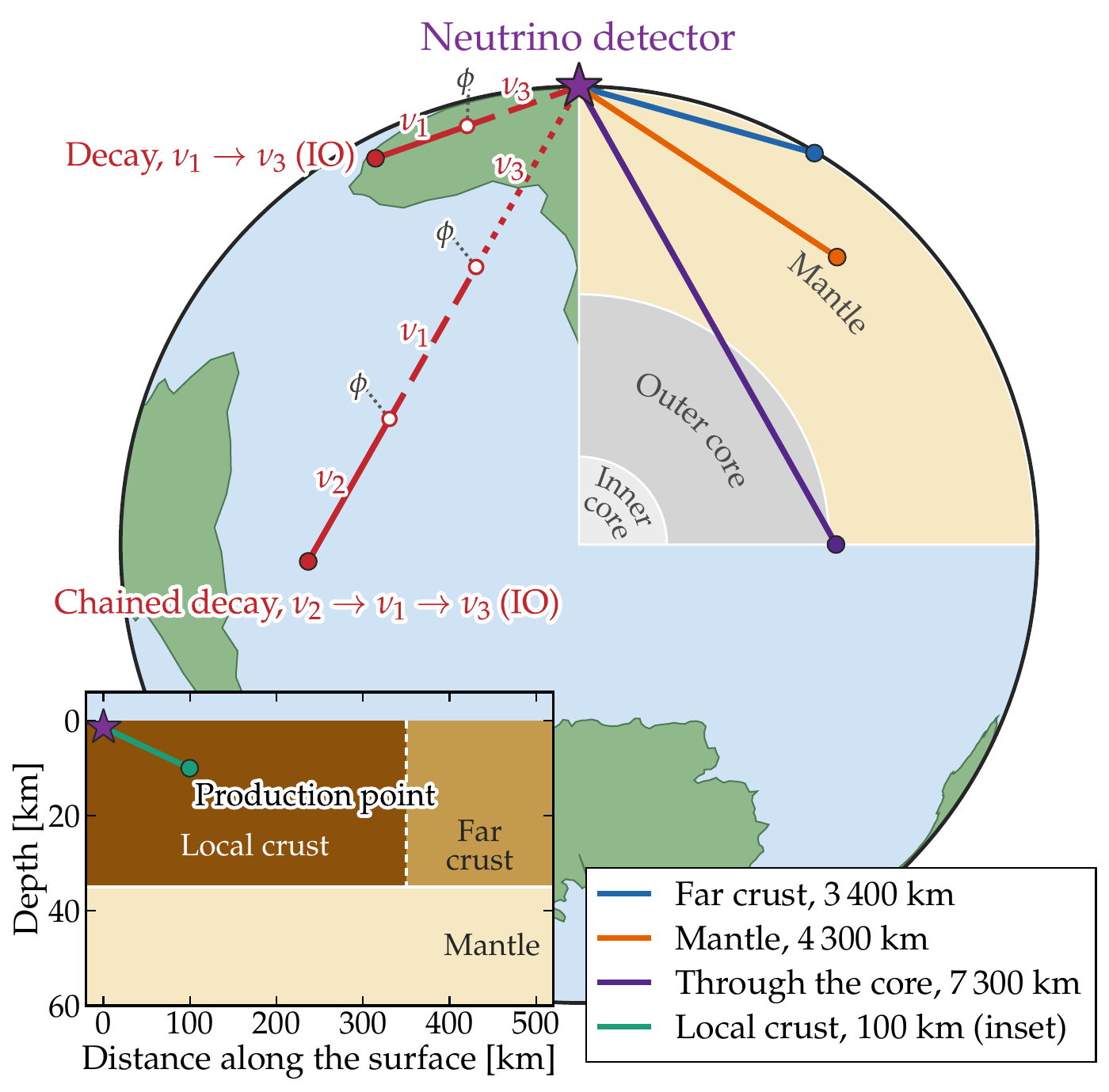
A cross section of the Earth with a neutrino detector at Gran Sasso; lines run from production points in the crust and the mantle to the detector, and two red lines show a geoneutrino decaying on its way.
Where geoneutrinos come from. They are made in the crust and the mantle; the colored lines join typical production points to the detector, at the site of Borexino, in Italy. On the red lines, a geoneutrino decays on its way into a lighter one, emitting the new particle, φ. IO denotes the inverted mass ordering, explained below. About three quarters of the geoneutrinos that reach Borexino travel hundreds to thousands of kilometers, far enough for decay to act.
The animation follows one geoneutrino from the mantle to Borexino, decaying on its way. It then adds the reactor antineutrinos, the four detectors, and the limits.

How many geoneutrinos the Earth emits depends on how much uranium and thorium it holds, on which models of the Earth disagree by a factor of three. I either take this amount from one of these models or leave it free. The data show no evidence of decay that holds across these choices. Geoneutrinos and reactor antineutrinos set the first terrestrial limits on the visible decay of ν1. Combining the four experiments, I find τ1/m1 > 3.7 × 10⁻⁹ s eV−1 at 90% C.L. with the amount of uranium and thorium free, and up to 1.6 × 10⁻⁸ s eV−1 with a model of the Earth.
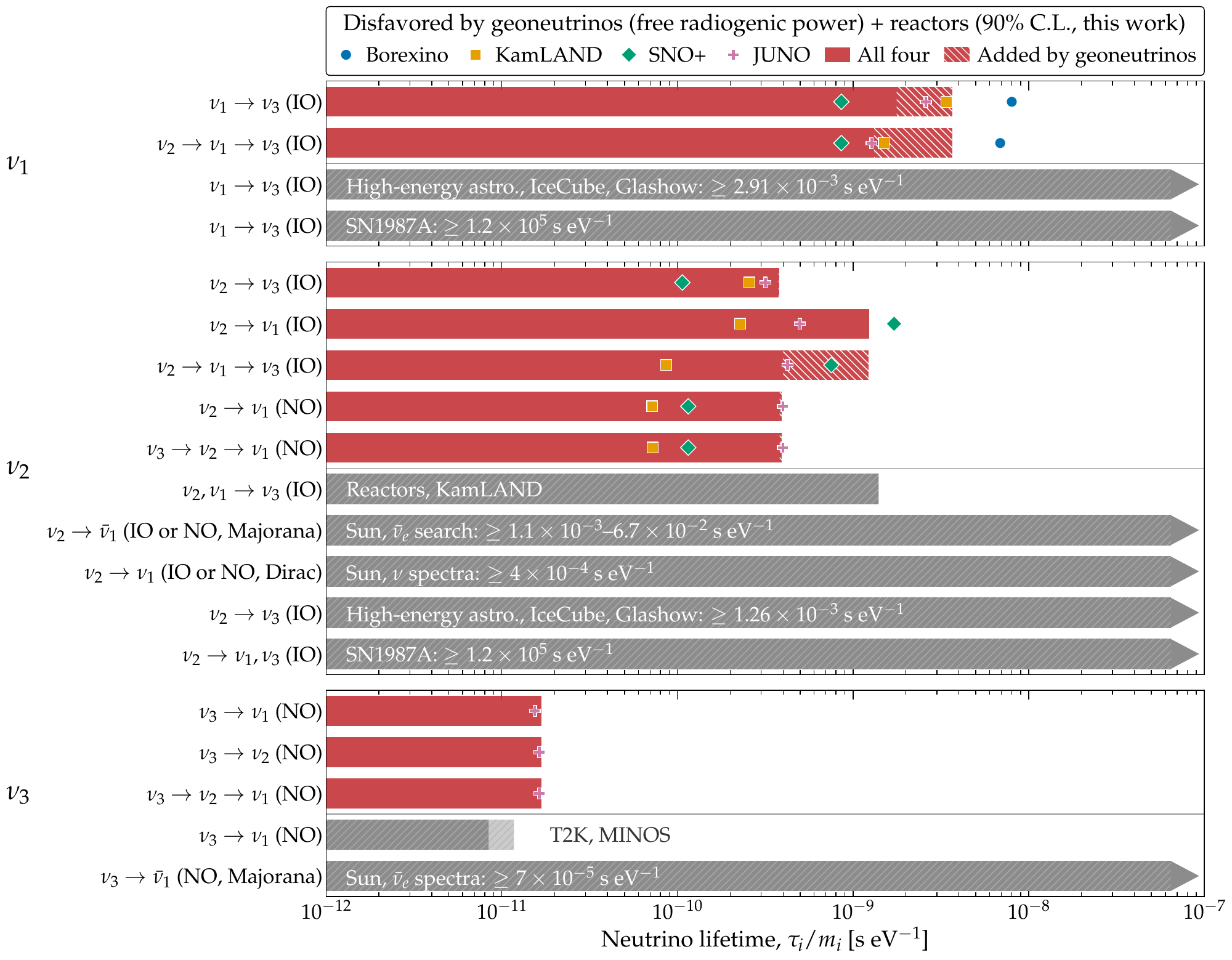
Lower limits on the lifetime-to-mass ratio of each neutrino for each decay channel, from Borexino, KamLAND, SNO+, and JUNO combined, compared with published limits from reactor, accelerator, solar, supernova, and high-energy astrophysical neutrinos.
Lower limits on the ratio of lifetime to mass of the neutrinos ν1, ν2, and ν3, from visible decay. IO and NO are the inverted and normal mass orderings, in which the lightest neutrino is ν3 or ν1, respectively. Gray bars are published limits. On the rows of ν1, the limit of Borexino alone is stronger than that of the four experiments combined. Borexino detected more geoneutrinos than predicted, which strengthens its limit. KamLAND detected fewer, which weakens the combined limit.

My strongest limits are on ν1, for two reasons. First, detectors see antineutrinos only through their electron flavor, of which ν1 carries the most, about two thirds. Second, ν1 can decay only into ν3, which is just 2% electron flavor, so a decaying ν1 is nearly lost to the detector. This decay is possible only if ν3 is the lightest state, an ordering of the masses called inverted.

Reactor antineutrinos matter too. When the amount of uranium and thorium is left free, the fit can raise it to replace the geoneutrinos lost to decay. It cannot do the same for reactor antineutrinos, whose number is fixed by the power of each reactor. Therefore, with the amount free, reactor antineutrinos count as much as geoneutrinos in the limit.

The most similar existing limit comes from an analysis of JUNO’s reactor antineutrinos, which treats the decay of ν1 as invisible, with daughters that escape detection. Compared at 95% C.L., it is 12 times weaker than mine. Neutrinos from the Sun, the supernova SN1987A, and distant cosmic sources travel much farther, so their limits are many orders of magnitude stronger.

More data will strengthen these limits. JUNO and SNO+ keep taking data. In its first 207 days, JUNO detected more geoneutrinos than the other three experiments combined. Every limit at 90% and 95% C.L., the numbers behind each figure, and the code that draws them are public on GitHub.

Read more at:

Geoneutrinos (and reactor neutrinos) do not visibly decay
Mauricio Bustamante
2611.23978 hep-ph
Earth-sized tests of long-range neutrino interactions

Standard

Do neutrinos feel a new long-range force, sourced by ordinary matter, that tells their flavors apart?

Neutrinos come in three flavors (electron, muon, and tau) and change from one flavor to another as they travel. Such a force would be carried by a new, very light particle, the Z′ boson of a new U(1)′ gauge symmetry. The electrons, protons, and neutrons of the Earth would create a potential that acts differently on each flavor and changes how neutrinos oscillate. For the Z′ masses that we study, from 10−15 to 10−9 eV, the force has a range of about 200 m to 30 Earth radii.

In a new paper led by Dyer F. Cardenas (PUCP, Lima, Peru), now an MSc student, who took part through the REPU program, we look for this force with atmospheric neutrinos that cross the Earth on their way to the IceCube DeepCore detector, at the South Pole. Inside the Earth, the potential changes along the path of each neutrino, more so the shorter the range of the force. Earlier analyses of the same data held the potential at its value at the detector. We compute it at every point of each path and use it to analyze eight years of public DeepCore data, with the systematic uncertainties of IceCube’s own analysis.

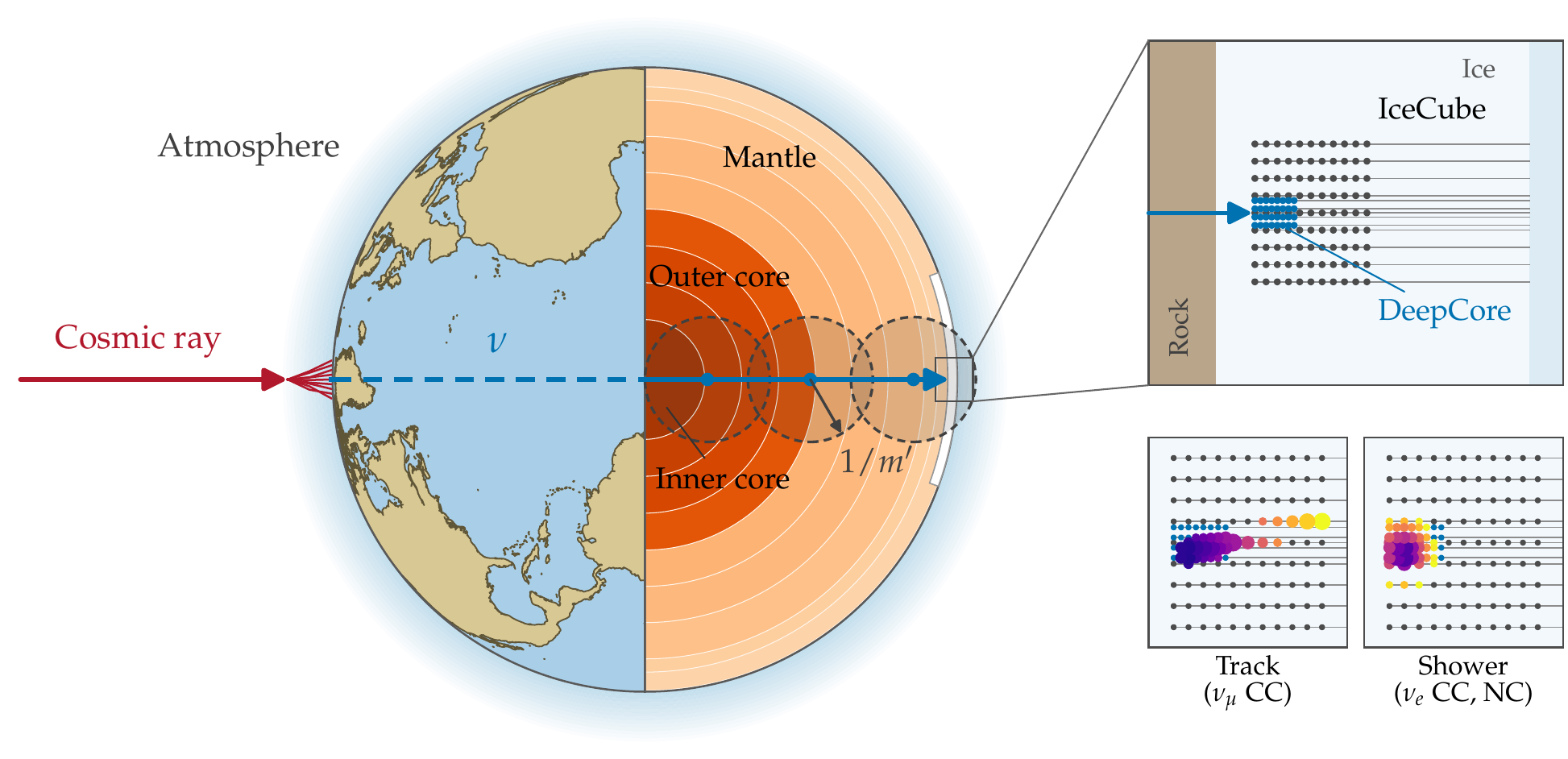
An atmospheric neutrino crosses the layers of the Earth on its way to IceCube DeepCore; dashed circles around three points of its path have a radius equal to the range of the force.
An atmospheric neutrino crosses the Earth on its way to IceCube DeepCore. Each dashed circle has a radius equal to the range of the force, 1/m′, where m′ is the mass of the Z′. The potential at each point of the path comes mostly from the matter within a few ranges of it, so the potential changes as the neutrino moves.
An atmospheric neutrino crosses the Earth on its way to IceCube DeepCore, with a map of where its potential comes from. The animation ends with the data and our limit.

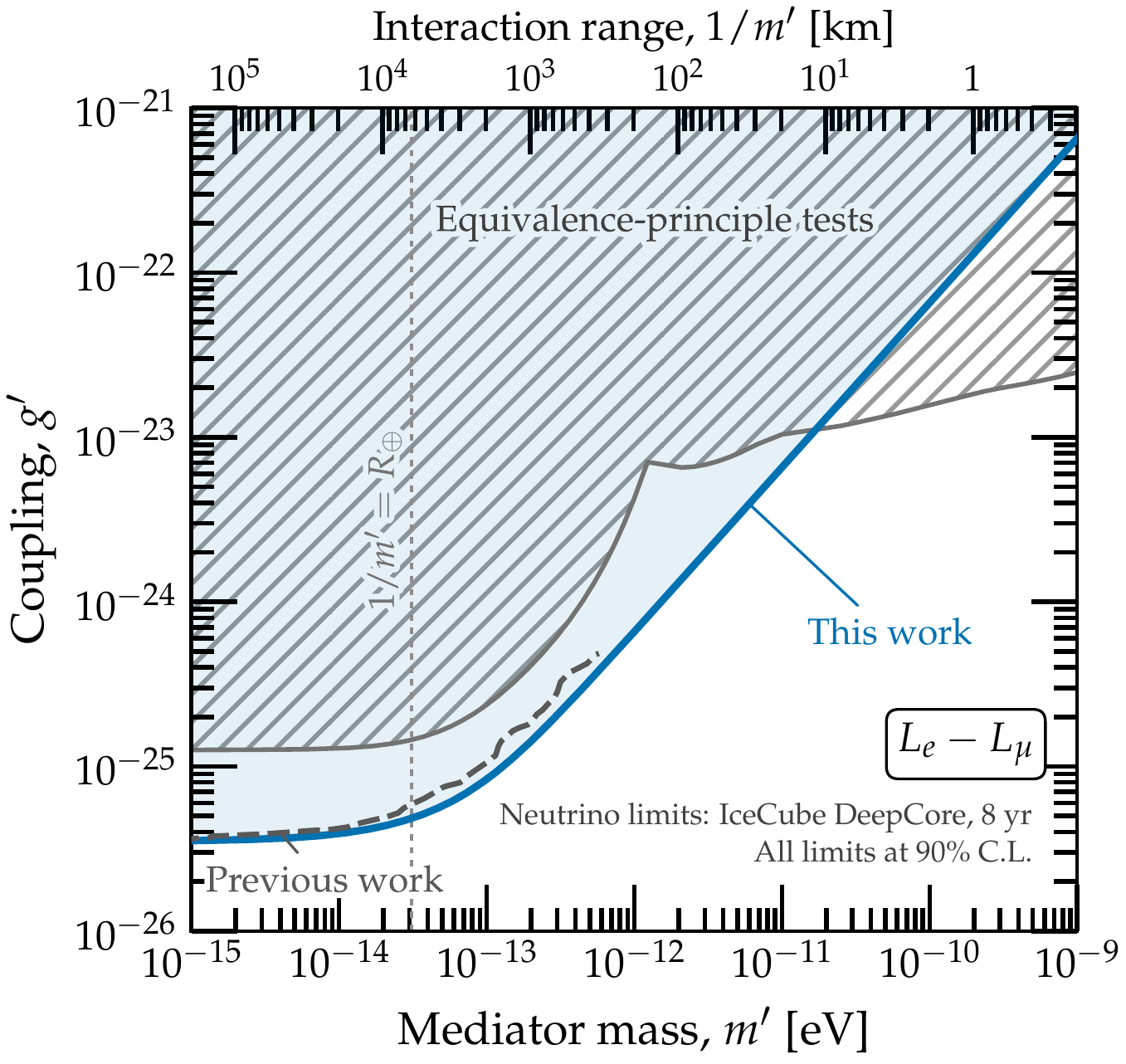
We set upper limits on the coupling of the Z′ for eight of the 14 symmetries that we study, those whose potential differs between muon and tau neutrinos. At ranges longer than about 1–12 km, depending on the symmetry, our limits are stronger than those from tests of the equivalence principle, by up to almost two orders of magnitude. These tests, with torsion balances and with the MICROSCOPE satellite, look for a force that pulls differently on bodies of different composition. They test how such a force acts on neutrinos only indirectly. Holding the potential at its value at the detector, as earlier analyses did, underestimates it along most of each path, since the mantle and the core are denser than the matter around the detector. Doing so would weaken our limits by about 20% at the longest ranges and by up to a factor of about 3 at the shortest.

Upper limit on the coupling of an L_e − L_μ interaction versus the mediator mass, from this work, compared with an earlier DeepCore limit and with tests of the equivalence principle.
Upper limits on the coupling of the Z′ for one of the symmetries that we study, Le − Lμ, whose charge is the electron-flavor number minus the muon-flavor number. The limits are shown versus the mass of the Z′ (bottom axis) and the range of the force (top axis). Our limit uses the potential along each path. The earlier limit, from the same DeepCore data, holds the potential constant along each path (it ends at the edge of the figure of that paper). It also differs from ours in other choices of the analysis. Tests of the equivalence principle exclude the hatched region.

Along the diameter of the Earth, standard oscillations turn nearly all muon neutrinos with energies near 24 GeV into other flavors. A potential that treats muon and tau neutrinos differently reduces their mixing, so more of them would reach the detector as muon neutrinos. Our limits come from these steeply up-going muon neutrinos. For the other six symmetries, whose potential acts on electron neutrinos alone, the data set no upper limit, since such a potential barely changes how muon neutrinos oscillate.

Detectors under construction or planned, such as the IceCube Upgrade, KM3NeT/ORCA, Hyper-Kamiokande, and DUNE, could tighten these limits. At every range that we study, the potential varies along the path of each neutrino, so analyses of their data should also compute it point by point. Our limits, the numbers behind every figure of the paper, and the code that draws them are public on GitHub.

Read more at:

Earth-sized tests of long-range neutrino interactions
Dyer F. Cardenas, Mauricio Bustamante
2611.14642 hep-ph

Constraining tau–sterile neutrino mixing with high-energy astrophysical neutrinos

Standard

Does a fourth neutrino, one that does not feel the weak interaction, mix with the three known ones?

Anomalies in short-baseline experiments have pointed to such a sterile neutrino, through its mixing with electron and muon neutrinos, although global fits find them in tension with other data. Its mixing with tau neutrinos, quantified by |Uτ4|², is the least tested. There are no intense beams of tau neutrinos, so terrestrial experiments probe this mixing only indirectly, through its effect on muon neutrinos, and each one only over a limited range of sterile-neutrino masses.

In a new paper with Qinrui Liu (Simon Fraser University), we show that high-energy astrophysical neutrinos test this mixing differently. These neutrinos, with TeV–PeV energies, are produced in cosmic accelerators, mainly in the decays of charged pions. Their sources make almost no tau neutrinos. Yet, over the cosmological distances that separate the sources from Earth, oscillations turn part of the electron and muon neutrinos into tau neutrinos. About one third of the neutrinos that reach Earth are expected to be tau neutrinos.

If tau neutrinos mix with a sterile neutrino, a fraction |Uτ4|² of these tau neutrinos goes missing, turned into sterile neutrinos that neutrino telescopes cannot see. The tau-neutrino fraction that the telescopes measure drops, while the ratio of electron to muon neutrinos stays as it is. This deficit is the same whatever the mass of the sterile neutrino. Of the three mixings of the sterile neutrino with the known ones, only this one leaves a mark that flavor measurements can detect even though we do not know what the sources emit.

Measuring the deficit is hard. In neutrino telescopes, tau and electron neutrinos leave similar signals, which makes present flavor measurements imprecise. Earlier work mapped the flavor composition that sterile mixing could produce at Earth. We do the reverse: we fit the mixing to flavor measurements, leaving the flavor composition at the sources free.

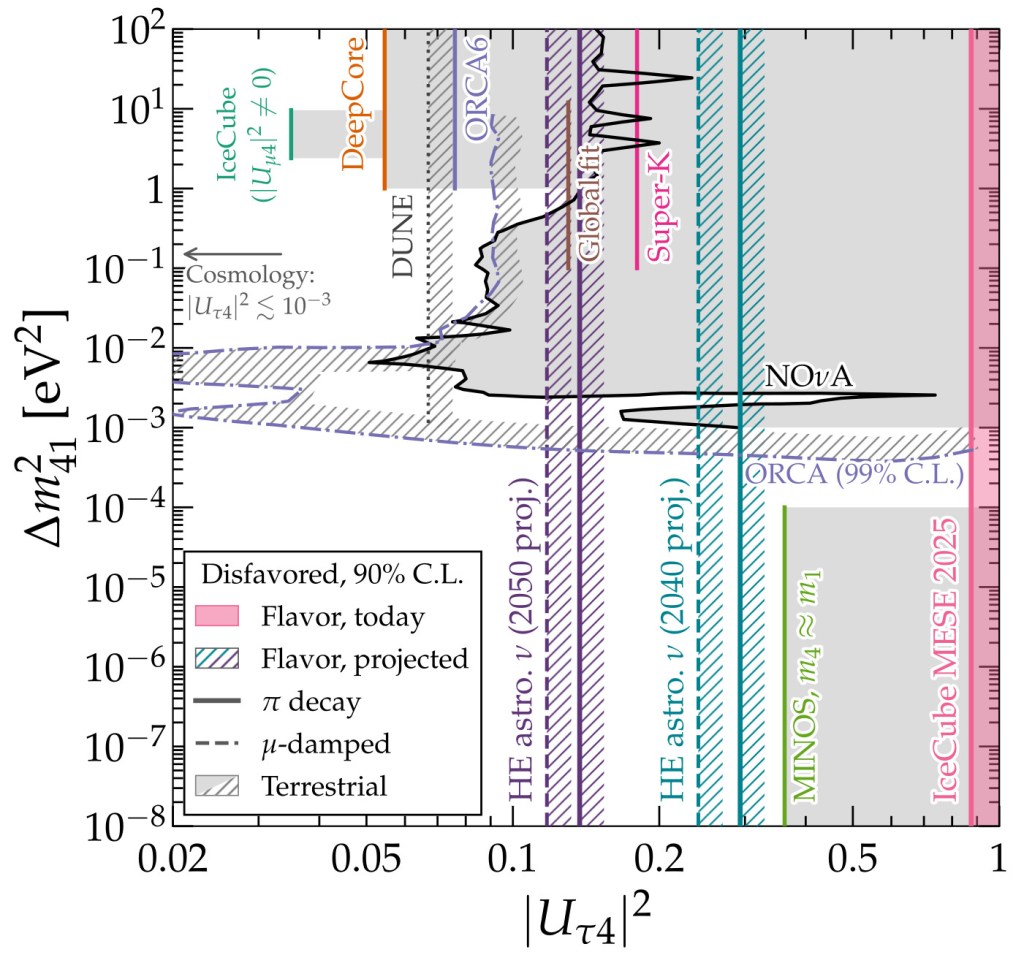
Using the flavor composition measured by IceCube with its latest sample of Medium-Energy Starting Events (MESE), we find |Uτ4|² < 0.88 at 90% C.L. This disfavors only mixing large enough to remove most of the tau neutrinos. Combining IceCube with present and planned neutrino telescopes, including IceCube-Gen2 and HUNT, could lower this limit to 0.24–0.29 by 2040 and to 0.12–0.14 by 2050, depending on how the neutrinos are made at the sources.

Limits on the mixing of tau neutrinos with a sterile neutrino, from high-energy astrophysical neutrinos today (pink) and projected for 2040 and 2050, compared with terrestrial limits (gray). The vertical axis, Δm²41, is the difference between the squared mass of the fourth neutrino and that of the first known one.

Our limits hold at every value of the sterile-neutrino mass, unlike most terrestrial ones, which each cover only a limited range. By 2050, they would be stronger than those of Super-K and MINOS and similar to that of a global fit of terrestrial data. They would remain weaker than the strongest terrestrial limits, from atmospheric neutrinos at the eV scale, from NOνA, and, in the future, from DUNE. Still, they would complement them: they hold at small mass splittings, where most terrestrial experiments set no limit, and they rest on different systematic uncertainties.

The main goal of next-generation neutrino telescopes is to find and understand the sources of high-energy astrophysical neutrinos. Their flavor measurements would also test, at no extra cost, whether a sterile neutrino mixes with tau neutrinos.

Read more at:

Constraining tau–sterile neutrino mixing with high-energy astrophysical neutrinos
Mauricio Bustamante, Qinrui Liu
2611.05170 hep-ph

New limits on neutrino decay from high-energy astrophysical neutrinos

Standard

In the Standard Model, neutrinos are effectively stable, their lifetimes orders of magnitude longer than the age of the Universe. In proposed extensions of the Standard Model, however, neutrinos might decay faster, and so observing them decay would constitute evidence of new neutrino physics.

Regardless, neutrino lifetimes, even augmented by new physics, are likely very long, and the effects of decay are likely manifest only in neutrinos that travel a long distance, during which the chances of them decaying becomes appreciable even if they are long-lived.

In a new paper, we have searched for signs of neutrino decay using the neutrinos from farthest away: the high-energy astrophysical neutrinos detected by IceCube, which travel cosmological-scale distances of Mpc-Gpc from their sources to Earth. Neutrino decay, in principle, alters the shape of the neutrino energy spectrum—introducing a step-like jump—and the flavor composition of the neutrinos upon reaching Earth—taking it outside the region expected from standard oscillations alone.

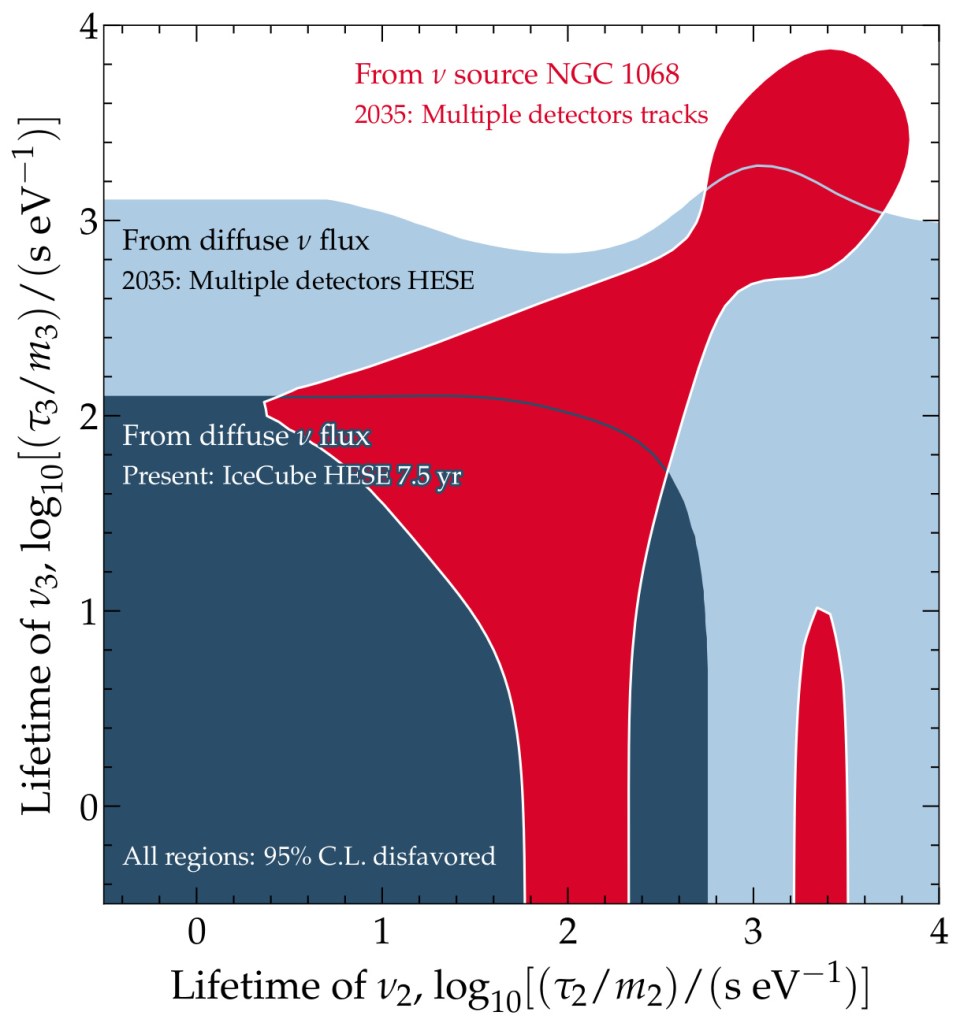
We find no signs of decay in present-day IceCube data, but place new, competitive lower limits on the lifetimes of the nu_2 and nu_3 neutrino mass eigenstates. We report, for the first time, limits inferred using the neutrinos from the first candidate steady-state astrophysical source of high-energy neutrinos, the active galaxy NGC 1068, and limits inferred from the diffuse flux of high-energy neutrinos.

These are arguably the most robust neutrino lifetime bounds garnered from high-energy astrophysical neutrinos so far! In addition, we make forecasts for the year 2035, combining multiple upcoming neutrino telescopes.

While similar studies have been performed before, ours brings two new perspectives, often overlooked or understudied, that make our results robust.

First, we consider broadly the large astrophysical uncertainties that plague the prediction of the flux of high-energy astrophysical neutrinos. This includes the size and shape of the neutrino energy spectrum, the flavor composition of the neutrino flux, the number or source populations and their distribution in redshift, and whether we have prior constraints on the size of the neutrino flux normalization. The impact of considering these uncertainties ranges from appreciable to critical. In some cases, they nearly make the sensitivity to neutrino decay vanish! Surprisingly, with present data, it is not possible to constrain neutrino decay using neutrinos from NGC 1068 due to the astrophysical unknowns!

Second, we model in detail the detection of neutrinos in IceCube and other neutrino telescopes. Their limited resolution to measure the energy, direction, and flavor of detected neutrinos blurs potential signs of neutrino decay in the flux of high-energy astrophysical neutrinos. We model experimental nuance using either tools provided publicly by the IceCube Collaboration (for the diffuse flux, using High Energy Starting Events), or using the PLEnuM (for the flux from NGC 1068, using tracks).

Read more at:

New limits on neutrino decay from high-energy astrophysical neutrinos
Victor B. Valera, Damiano F. G. Fiorillo, Ivan Esteban, Mauricio Bustamante
2405.14826 astro-ph

Download our digitized two-dimensional lifetime limits from this GitHub repository.