
Do neutrinos decay on their way through the Earth?
Neutrinos come in three states of definite mass, ν1, ν2, and ν3. The heavier states could decay into lighter ones if neutrinos interact with a new, very light particle. A neutrino that decays on its way to a detector turns into a lighter one, with less energy, that the detector may not see. Time dilation lengthens the lifetime of a moving neutrino by the ratio of its energy to its mass. Therefore, experiments test the ratio of lifetime to mass, τ/m. Low-energy neutrinos that travel far reach the largest values.
Geoneutrinos are such neutrinos. They are electron antineutrinos made in the radioactive decays of uranium and thorium inside the Earth. They have energies of a few MeV and reach a detector from anywhere in the Earth, from rock a few kilometers away to the far side of the planet, 12,742 km away. Therefore, they can test τ/m up to about 10−8 s eV−1, a range that reactor and accelerator neutrinos cannot reach.
In a new paper, I use geoneutrinos to test neutrino decay for the first time. I compute the geoneutrino signal at four detectors, Borexino, KamLAND, SNO+, and JUNO, for visible decay, in which the lighter antineutrinos that the decays produce can also be detected. The same detectors see antineutrinos from nuclear reactors, which would decay too, so I include them. I fit the published data of each experiment with a model built to match that experiment’s own analysis, then combine the four.
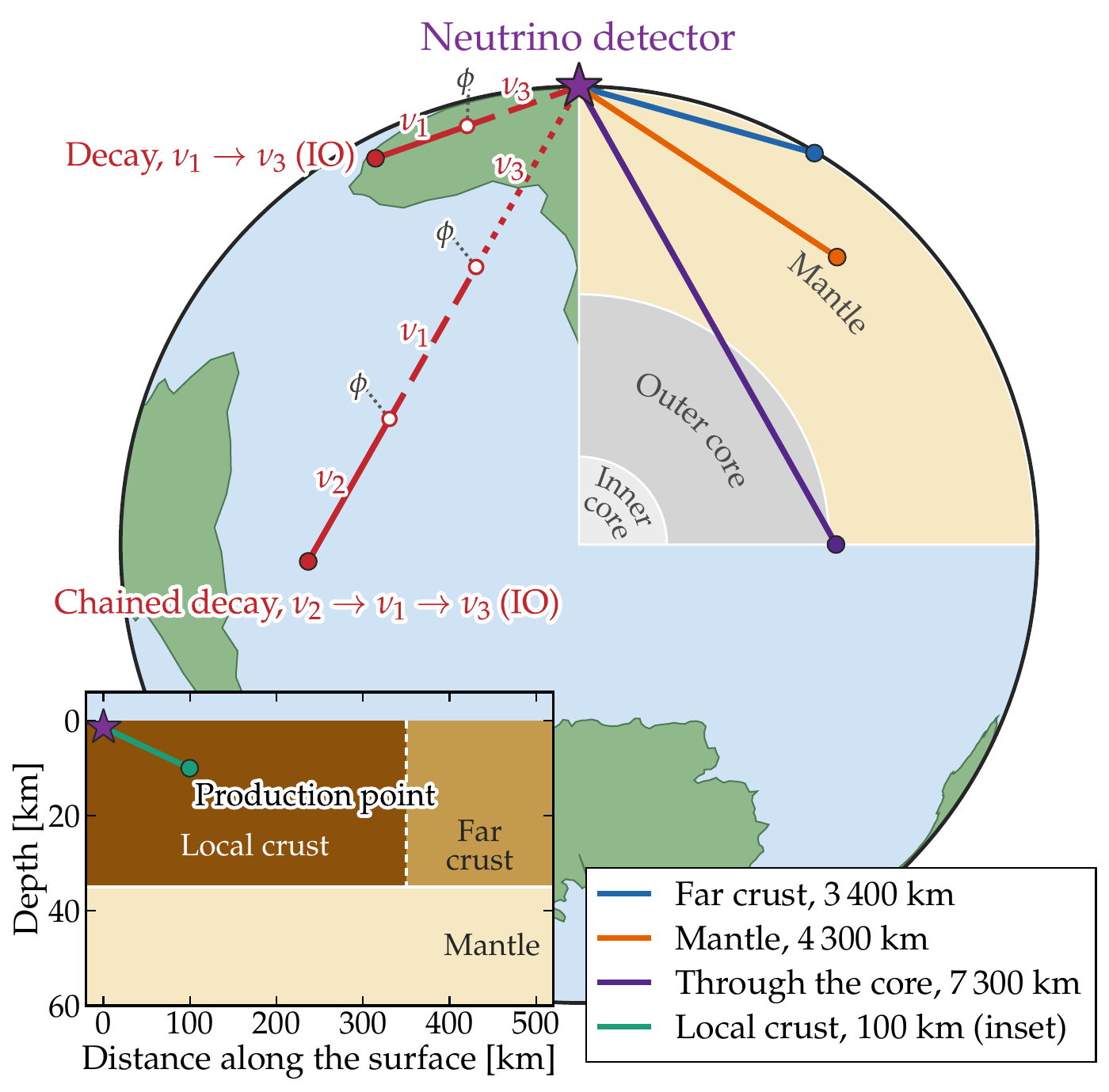
How many geoneutrinos the Earth emits depends on how much uranium and thorium it holds, on which models of the Earth disagree by a factor of three. I either take this amount from one of these models or leave it free. The data show no evidence of decay that holds across these choices. Geoneutrinos and reactor antineutrinos set the first terrestrial limits on the visible decay of ν1. Combining the four experiments, I find τ1/m1 > 3.7 × 10⁻⁹ s eV−1 at 90% C.L. with the amount of uranium and thorium free, and up to 1.6 × 10⁻⁸ s eV−1 with a model of the Earth.
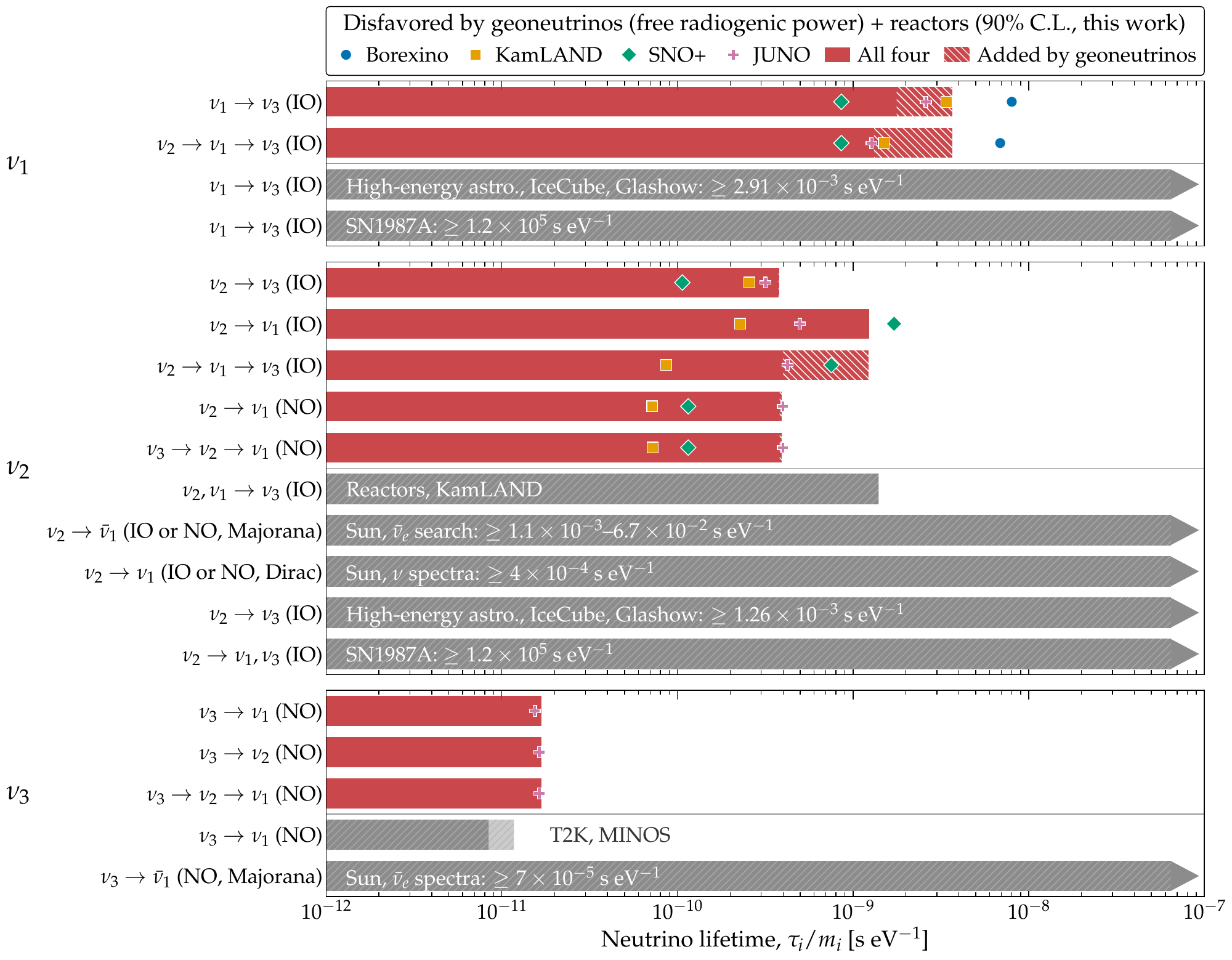
My strongest limits are on ν1, for two reasons. First, detectors see antineutrinos only through their electron flavor, of which ν1 carries the most, about two thirds. Second, ν1 can decay only into ν3, which is just 2% electron flavor, so a decaying ν1 is nearly lost to the detector. This decay is possible only if ν3 is the lightest state, an ordering of the masses called inverted.
Reactor antineutrinos matter too. When the amount of uranium and thorium is left free, the fit can raise it to replace the geoneutrinos lost to decay. It cannot do the same for reactor antineutrinos, whose number is fixed by the power of each reactor. Therefore, with the amount free, reactor antineutrinos count as much as geoneutrinos in the limit.
The most similar existing limit comes from an analysis of JUNO’s reactor antineutrinos, which treats the decay of ν1 as invisible, with daughters that escape detection. Compared at 95% C.L., it is 12 times weaker than mine. Neutrinos from the Sun, the supernova SN1987A, and distant cosmic sources travel much farther, so their limits are many orders of magnitude stronger.
More data will strengthen these limits. JUNO and SNO+ keep taking data. In its first 207 days, JUNO detected more geoneutrinos than the other three experiments combined. Every limit at 90% and 95% C.L., the numbers behind each figure, and the code that draws them are public on GitHub.
Read more at:
Geoneutrinos (and reactor neutrinos) do not visibly decay
Mauricio Bustamante
2611.23978 hep-ph

