
Does a fourth neutrino, one that does not feel the weak interaction, mix with the three known ones?
Anomalies in short-baseline experiments have pointed to such a sterile neutrino, through its mixing with electron and muon neutrinos, although global fits find them in tension with other data. Its mixing with tau neutrinos, quantified by |Uτ4|², is the least tested. There are no intense beams of tau neutrinos, so terrestrial experiments probe this mixing only indirectly, through its effect on muon neutrinos, and each one only over a limited range of sterile-neutrino masses.
In a new paper with Qinrui Liu (Simon Fraser University), we show that high-energy astrophysical neutrinos test this mixing differently. These neutrinos, with TeV–PeV energies, are produced in cosmic accelerators, mainly in the decays of charged pions. Their sources make almost no tau neutrinos. Yet, over the cosmological distances that separate the sources from Earth, oscillations turn part of the electron and muon neutrinos into tau neutrinos. About one third of the neutrinos that reach Earth are expected to be tau neutrinos.
If tau neutrinos mix with a sterile neutrino, a fraction |Uτ4|² of these tau neutrinos goes missing, turned into sterile neutrinos that neutrino telescopes cannot see. The tau-neutrino fraction that the telescopes measure drops, while the ratio of electron to muon neutrinos stays as it is. This deficit is the same whatever the mass of the sterile neutrino. Of the three mixings of the sterile neutrino with the known ones, only this one leaves a mark that flavor measurements can detect even though we do not know what the sources emit.
Measuring the deficit is hard. In neutrino telescopes, tau and electron neutrinos leave similar signals, which makes present flavor measurements imprecise. Earlier work mapped the flavor composition that sterile mixing could produce at Earth. We do the reverse: we fit the mixing to flavor measurements, leaving the flavor composition at the sources free.
Using the flavor composition measured by IceCube with its latest sample of Medium-Energy Starting Events (MESE), we find |Uτ4|² < 0.88 at 90% C.L. This disfavors only mixing large enough to remove most of the tau neutrinos. Combining IceCube with present and planned neutrino telescopes, including IceCube-Gen2 and HUNT, could lower this limit to 0.24–0.29 by 2040 and to 0.12–0.14 by 2050, depending on how the neutrinos are made at the sources.
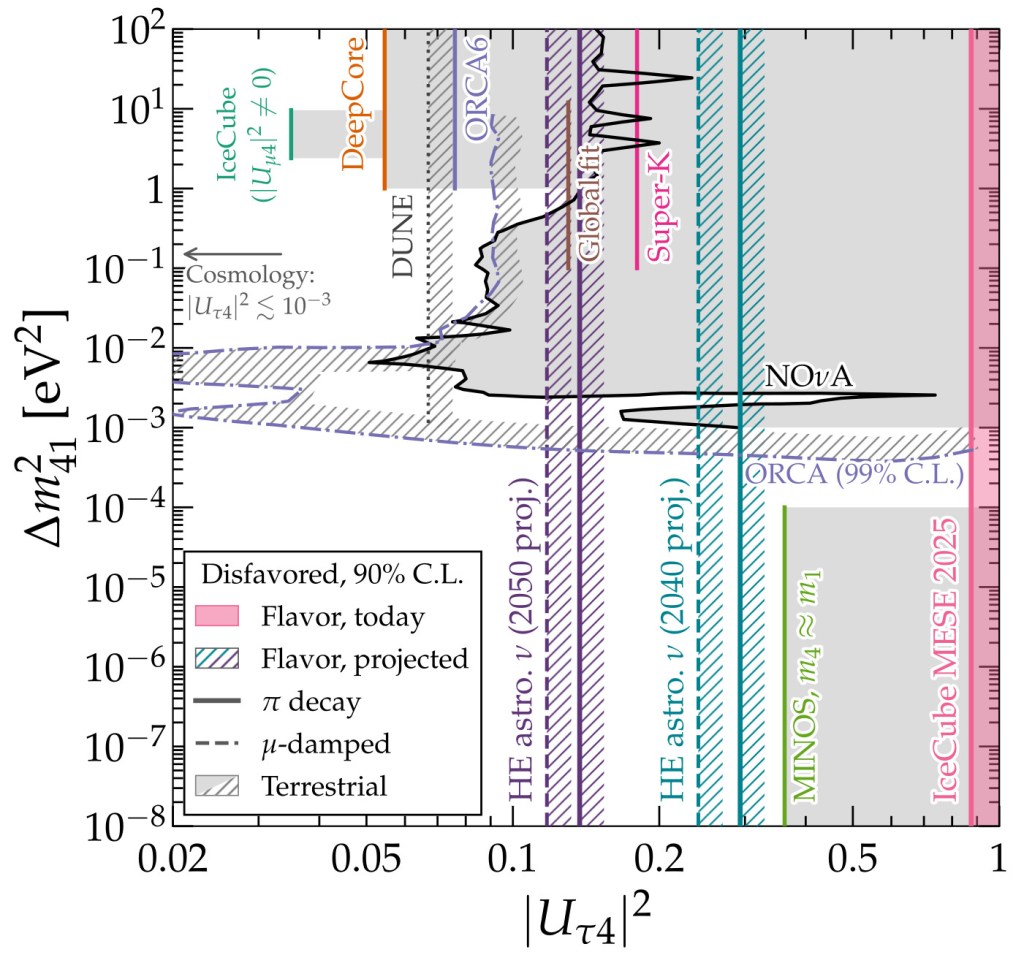
Our limits hold at every value of the sterile-neutrino mass, unlike most terrestrial ones, which each cover only a limited range. By 2050, they would be stronger than those of Super-K and MINOS and similar to that of a global fit of terrestrial data. They would remain weaker than the strongest terrestrial limits, from atmospheric neutrinos at the eV scale, from NOνA, and, in the future, from DUNE. Still, they would complement them: they hold at small mass splittings, where most terrestrial experiments set no limit, and they rest on different systematic uncertainties.
The main goal of next-generation neutrino telescopes is to find and understand the sources of high-energy astrophysical neutrinos. Their flavor measurements would also test, at no extra cost, whether a sterile neutrino mixes with tau neutrinos.
Read more at:
Constraining tau–sterile neutrino mixing with high-energy astrophysical neutrinos
Mauricio Bustamante, Qinrui Liu
2611.05170 hep-ph

