Astrophysical bounds on the high-energy evolution of neutrino mixing

Standard

Today, the values of the neutrino mixing angles and mass differences that govern flavor transitions are known to quite high precision. However, we know them exclusively from sub-TeV terrestrial experiments. Because these experiments operate at low transferred momenta (typically, Q ~ few GeV), a fundamental question remains: are the mixing parameters universal constants, or do they evolve at high energies?

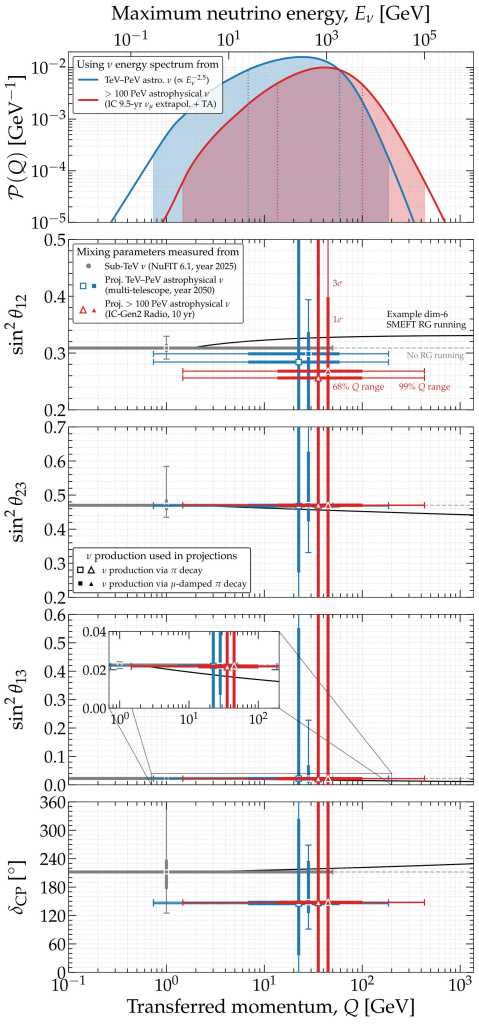
Quantum field theory dictates that these parameters should “run” with Q via renormalization group (RG) equations. While this running is negligible in the Standard Model, well-motivated new-physics frameworks, like the Standard Model Effective Field Theory (SMEFT), can accelerate this evolution. Detecting the high-energy running of neutrino mixing parameters would be a smoking-gun signature of new physics.

To access the high-Q regime, we turn to high-energy astrophysical neutrinos, with energies in the TeV–PeV and EeV ranges. They interact in neutrino telescopes via deep inelastic scattering and probe average momentum transfers of Q ~ 20-40 GeV, offering an unprecedented window into this high-Q evolution.

In a new paper with Qinrui Liu and Gabriela Barenboim, we evaluate the power of high-energy astrophysical neutrinos to test the evolution of neutrino mixing. We use the neutrino flavor composition at Earth, i.e., the relative proportions of electron, muon, and tau neutrinos in the diffuse flux. We execute a two-pronged analysis: first, extracting generic high-Q mixing parameters to remain model-agnostic, and second, constraining RG-inducing dimension-6 SMEFT coefficients.

We extract present bounds from the 11.4-year IceCube Medium Energy Starting Events (MESE) sample, published in 2025. Because the uncertainties in current flavor measurements are large, present data cannot yet meaningfully constrain the high-Q mixing parameters or SMEFT operators.

However, the future is promising. For our projections, we simulate the combined detection capabilities of existing (IceCube, Baikal-GVD, KM3NeT) and upcoming (P-ONE, IceCube-Gen2, NEON, TRIDENT, HUNT) optical-Cherenkov neutrino telescopes by the years 2040 and 2050, using both High-Energy Starting Events (HESE) and through-going muons. Crucially, we profile over the unknown astrophysical source flavor composition to ensure our bounds are robust and realistic.

Our results show that by 2040–2050, this global network will achieve the precision necessary to place unprecedented bounds on high-Q mixing (yielding particularly strong constraints in the 23 and 13 sectors). Furthermore, if the astrophysical neutrinos are produced via muon-damped pion decay, these telescopes will be capable of placing limits on individual SMEFT coefficients at a new-physics scale of 1 TeV, easily translatable to other energy scales.

We also forecasted the sensitivity of ultra-high-energy (UHE) radio arrays, such as the planned IceCube-Gen2 radio array. Counterintuitively, we found that despite UHE neutrinos possessing much higher energies, they yield drastically weaker constraints than their TeV–PeV counterparts. This is driven both by the logarithmic scaling of the RG evolution and by the vast experimental uncertainties inherent to radio-based flavor tagging.

Read more at:

Astrophysical bounds on the high-energy evolution of neutrino mixing
Mauricio Bustamante, Qinrui Liu, Gabriela Barenboim
2604.14409 hep-ph

Blurb on CERN Courier about KM3NeT ultra-high-energy neutrino

Standard

CERN Courier included a short quote of mine on their recent news bit about the observation by KM3NeT of the first ultra-high-energy neutrino: Cosmogenic candidate lights up KM3NeT.

To quote:

“Once KM3NeT and Baikal–GVD are fully constructed, we will have three large-scale neutrino telescopes of about the same size in operation around the world,” adds Mauricio Bustamante, theoretical astroparticle physicist at the Niels Bohr Institute of the University of Copenhagen. “This expanded network will monitor the full sky with nearly equal sensitivity in any direction, improving the chances of detecting new neutrino sources, including faint ones in new regions of the sky.”

KM3NeT discovery paper: Nature 638, 376 (2025) [open access]

Our PLEnuM paper about combining multiple neutrino telescopes:

Beyond first light: global monitoring for high-energy neutrino astronomy
Lisa Johanna Schumacher, Mauricio Bustamante, Matteo Agostini, Foteini Oikonomou, Elisa Resconi
2503.07549 astro-ph

Measuring the ultra-high-energy neutrino flavor composition in in-ice radio detectors

Standard

The flavor composition of high-energy cosmic neutrinos—i.e., the proportion of electron, muon, and tau neutrinos in the flux—is a versatile probe of neutrino physics and astrophysics (see, e.g., here, here, and here). So far, all measurements of it, by IceCube, have been in the TeV-PeV energy range. In the next decade, new neutrino telescopes might discover ultra-high-energy (UHE) neutrinos, with EeV-scale energies, opening up new possibilities. Yet, so far, the measurement of their flavor composition has remained largely unexplored (see, however, our recent paper here).

In a new paper led by postdoc Alan Coleman we propose new methods to measure the flavor composition of UHE neutrinos in upcoming large in-ice radio-detection neutrino telescopes, like RNO-G, under construction, and the planned radio array of IceCube-Gen2. 

The measurement is based on two flavor-sensitive channels: one sensitive to electron neutrinos, by looking for the elongation of radio Askaryan emission due to the Landau-Pomeranchuk-Migdal effect, and one sensitive mainly to muon and tau neutrinos, by looking for events that contain multiple showers, triggered by the stochastic losses of final-state muons and taus.

Our results, based on state-of-the-art simulations of IceCube-Gen2, show promising prospects. If the UHE neutrino flux is large (as in, informed by cosmic-ray measurements by the Telescope Array), we should achieve sensitivity enough to confirm standard predictions of the flavor composition and disfavor extreme deviations from them:

This would allow us, for instance, to infer the flavor composition at the point of production of the UHE neutrinos and thus indirectly probe their production mechanism and possibly the identity of the neutrino sources:

Read more at:

The flavor composition of ultra-high-energy cosmic neutrinos: measurement forecasts for in-ice radio-based EeV neutrino telescopes
Alan Coleman, Oscar Ericsson, Mauricio Bustamante, Christian Glaser
2402.02432 astro-ph