Are neutrinos Majorana? Fixed-target and high-energy astrophysical searches decide

Standard

Determining whether the neutrino is a Dirac or Majorana fermion remains a fundamental open question in particle physics. The standard experimental approach, neutrinoless double beta decay, carries structural limitations: it probes only the electron sector and can be obscured by Majorana CP-violation phase interference.

In a new paper co-authored with Gabriela Barenboim and Qinrui Liu, we propose an independent, complementary probe to overcome these blind spots.

We extend the Standard Model with a GeV-scale Heavy Neutral Lepton (HNL). If this HNL is a Majorana fermion, it induces a calculable mass threshold correction that modifies the active neutrino mixing parameters at high energies. This correction vanishes identically if the HNL is Dirac.

Our framework relies on multi-experiment synergy:

  1. Fixed-Target Discovery: Upcoming beam-dump experiments, such as SHiP, discover the HNL and measure its active-sterile couplings across the electron, muon, and tau sectors.
  2. Astrophysical Flavor Shift: The scattering of TeV-PeV astrophysical neutrinos resolves the HNL mass threshold. This induces a shift in the flavor composition of neutrinos arriving at Earth, detectable by next-generation neutrino telescopes.
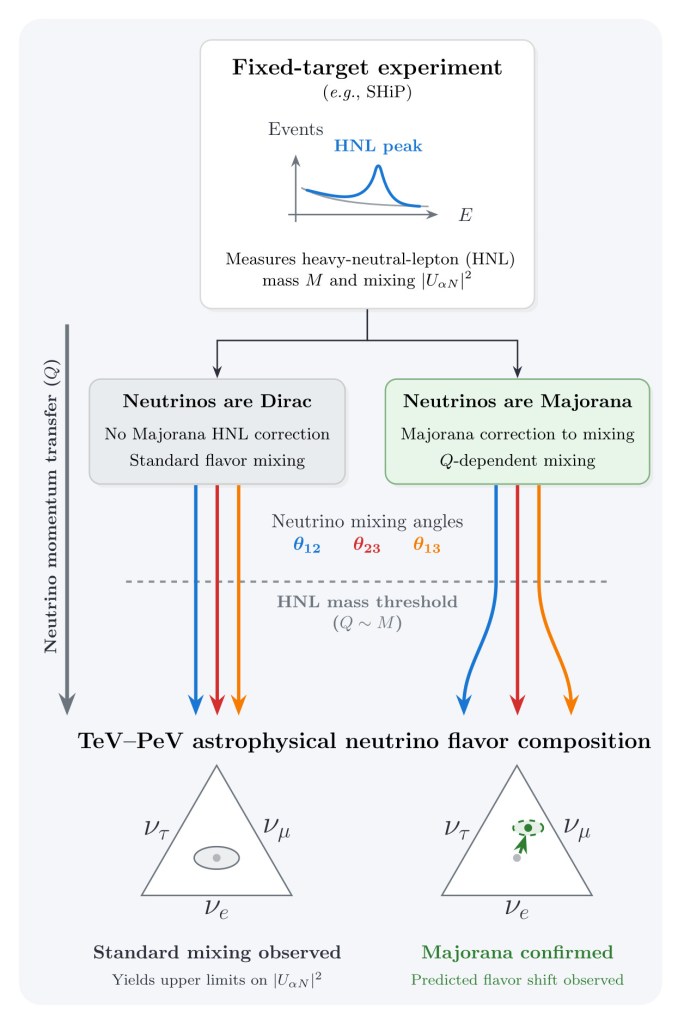
Because this astrophysical flavor shift is highly sensitive to the muon and tau sectors, it bypasses the electron-exclusivity of neutrinoless double beta decay. A correlated signal between a fixed-target experiment and a neutrino telescope network provides model-independent evidence for the Majorana nature of neutrinos.

In addition, we show that future measurements of the high-energy astrophysical neutrino flavor composition could set the world-best limits on the HNL couplings:
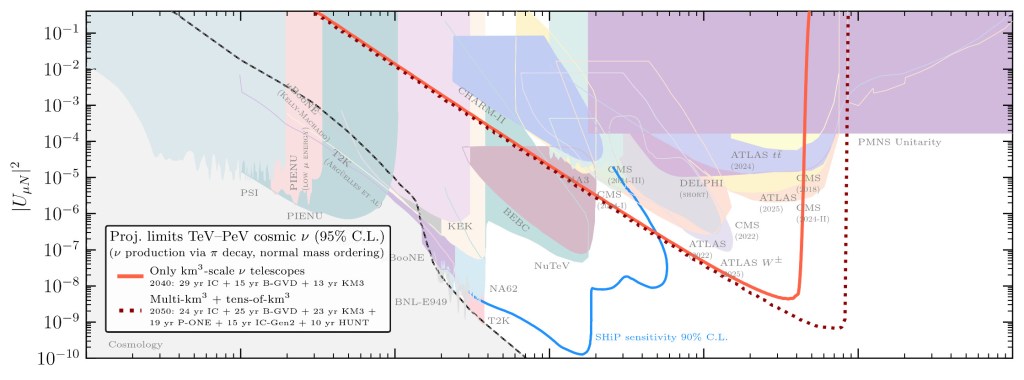
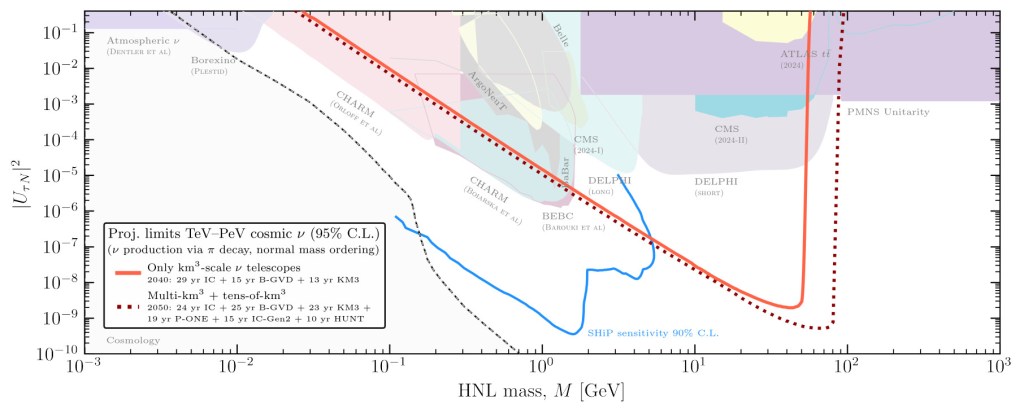
Read more at:

Are neutrinos Majorana? Fixed-target and high-energy astrophysical searches decide
Gabriela Barenboim, Mauricio Bustamante, Qinrui Liu
2606.17132 hep-ph
Measuring neutrino mixing above 1 TeV with astrophysical neutrinos

Standard

Today, the values of the neutrino mixing angles that govern flavor transitions are known to percent precision (the Dirac CP-violation phase is known much more poorly). However, these values are inferred exclusively from sub-TeV neutrino experiments. No measurement of the mixing parameters exists at the TeV scale and above. There, new-physics effects whose intensity grows with neutrino energy could modify the effective neutrino mixing. High-energy astrophysical neutrinos, with TeV-PeV energies, are primed for such measurements.

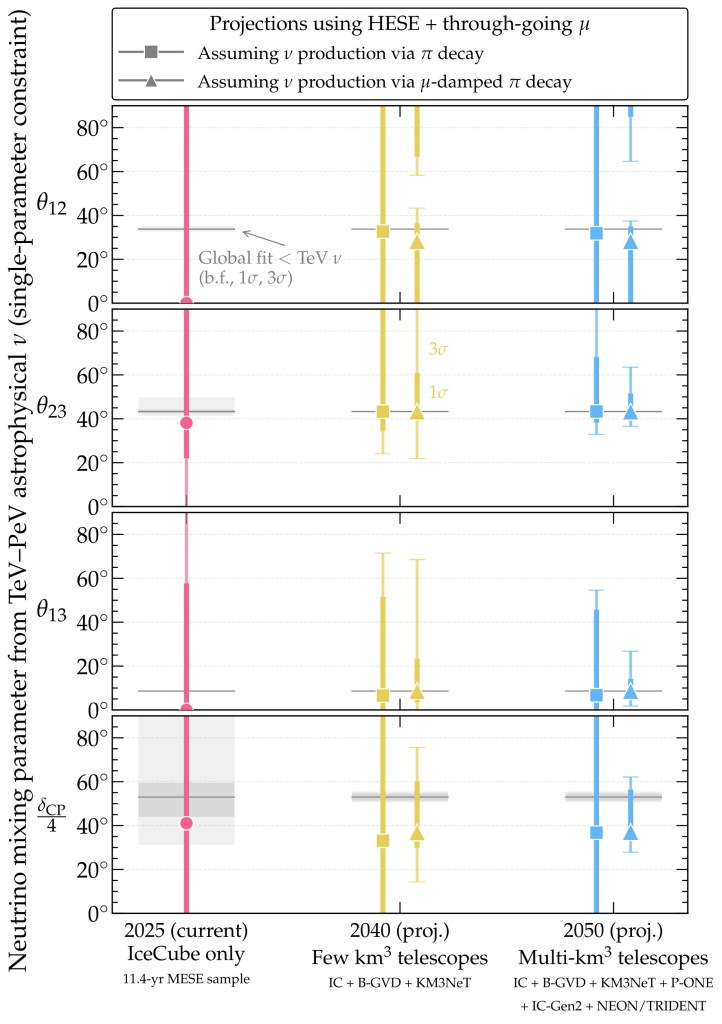
In a new paper with Qinrui Liu and Gabriela Barenboim, we have assessed in detail the power in these neutrinos to test mixing above 1 TeV, today and in the future. Concretely, we have extracted values of the four neutrino mixing angles (𝛉12, 𝛉23, 𝛉13) and the CP-violation phase (Ξ΄CP) from the flavor composition of high-energy astrophysical neutrinos, i.e., the proportion of electron, muon, and tau neutrinos in their diffuse flux.

We extract present bounds on the mixing parameters from the 11.4-year IceCube Medium Energy Starting Events (MESE) sample, published in 2025. We find that the uncertainty in the measurement is too large to claim meaningful sensitivity to the mixing parameter.

For our projections, we use multi-neutrino-telescope combinations using projected detection rates at existing (IceCube, Baikal-GVD, KM3NeT) and future (P-ONE, IceCube-Gen2, NEON, TRIDENT, HUNT) neutrino telescopes. For these, we combine High Energy Starting Events (HESE) and through-going muons. Our projections show clear sensitivity to 𝛉23 and 𝛉13 (and, if neutrino production occurs via muon-damped pion decay, to Ξ΄CP). This establishes benchmarks for the minimum size that new-physics modifications to the mixing parameters must have in order to be detectable.

Read more at:

Measuring neutrino mixing above 1 TeV with astrophysical neutrinos
Mauricio Bustamante, Qinrui Liu, Gabriela Barenboim
2602.14308 hep-ph

Measuring the ultra-high-energy neutrino flavor composition in in-ice radio detectors

Standard

The flavor composition of high-energy cosmic neutrinos—i.e., the proportion of electron, muon, and tau neutrinos in the flux—is a versatile probe of neutrino physics and astrophysics (see, e.g., here, here, and here). So far, all measurements of it, by IceCube, have been in the TeV-PeV energy range. In the next decade, new neutrino telescopes might discover ultra-high-energy (UHE) neutrinos, with EeV-scale energies, opening up new possibilities. Yet, so far, the measurement of their flavor composition has remained largely unexplored (see, however, our recent paper here).

In a new paper led by postdoc Alan Coleman we propose new methods to measure the flavor composition of UHE neutrinos in upcoming large in-ice radio-detection neutrino telescopes, like RNO-G, under construction, and the planned radio array of IceCube-Gen2. 

The measurement is based on two flavor-sensitive channels: one sensitive to electron neutrinos, by looking for the elongation of radio Askaryan emission due to the Landau-Pomeranchuk-Migdal effect, and one sensitive mainly to muon and tau neutrinos, by looking for events that contain multiple showers, triggered by the stochastic losses of final-state muons and taus.

Our results, based on state-of-the-art simulations of IceCube-Gen2, show promising prospects. If the UHE neutrino flux is large (as in, informed by cosmic-ray measurements by the Telescope Array), we should achieve sensitivity enough to confirm standard predictions of the flavor composition and disfavor extreme deviations from them:

This would allow us, for instance, to infer the flavor composition at the point of production of the UHE neutrinos and thus indirectly probe their production mechanism and possibly the identity of the neutrino sources:

Read more at:

The flavor composition of ultra-high-energy cosmic neutrinos: measurement forecasts for in-ice radio-based EeV neutrino telescopes
Alan Coleman, Oscar Ericsson, Mauricio Bustamante, Christian Glaser
2402.02432Β astro-ph