
Determining whether the neutrino is a Dirac or Majorana fermion remains a fundamental open question in particle physics. The standard experimental approach, neutrinoless double beta decay, carries structural limitations: it probes only the electron sector and can be obscured by Majorana CP-violation phase interference.
In a new paper co-authored with Gabriela Barenboim and Qinrui Liu, we propose an independent, complementary probe to overcome these blind spots.
We extend the Standard Model with a GeV-scale Heavy Neutral Lepton (HNL). If this HNL is a Majorana fermion, it induces a calculable mass threshold correction that modifies the active neutrino mixing parameters at high energies. This correction vanishes identically if the HNL is Dirac.
Our framework relies on multi-experiment synergy:
- Fixed-Target Discovery: Upcoming beam-dump experiments, such as SHiP, discover the HNL and measure its active-sterile couplings across the electron, muon, and tau sectors.
- Astrophysical Flavor Shift: The scattering of TeV-PeV astrophysical neutrinos resolves the HNL mass threshold. This induces a shift in the flavor composition of neutrinos arriving at Earth, detectable by next-generation neutrino telescopes.
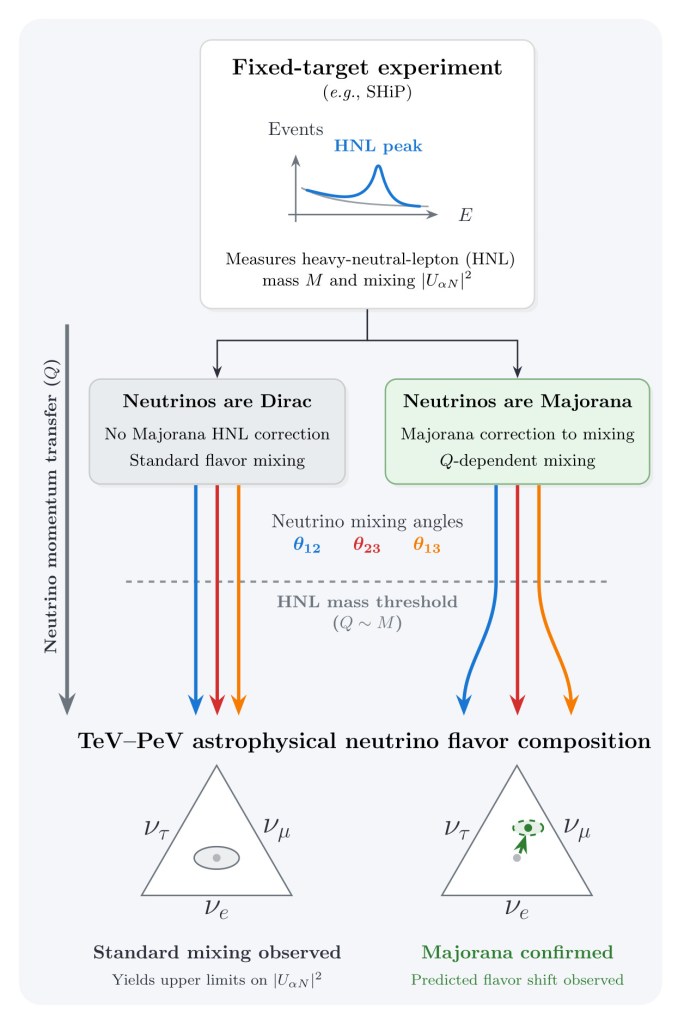
Because this astrophysical flavor shift is highly sensitive to the muon and tau sectors, it bypasses the electron-exclusivity of neutrinoless double beta decay. A correlated signal between a fixed-target experiment and a neutrino telescope network provides model-independent evidence for the Majorana nature of neutrinos.
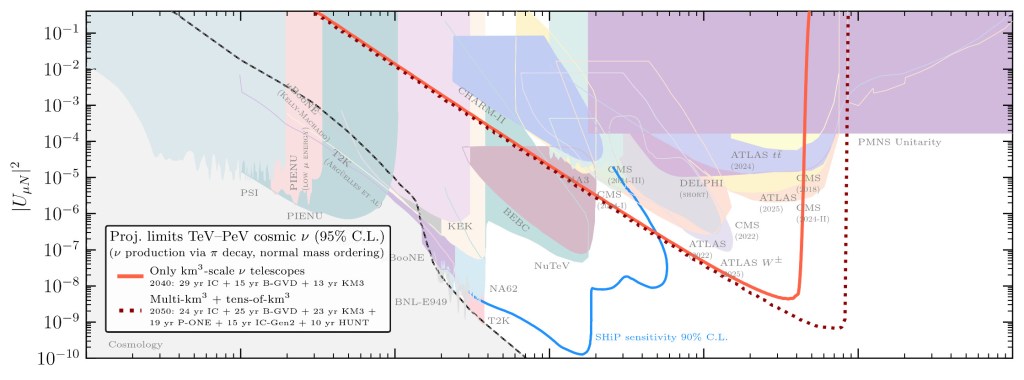
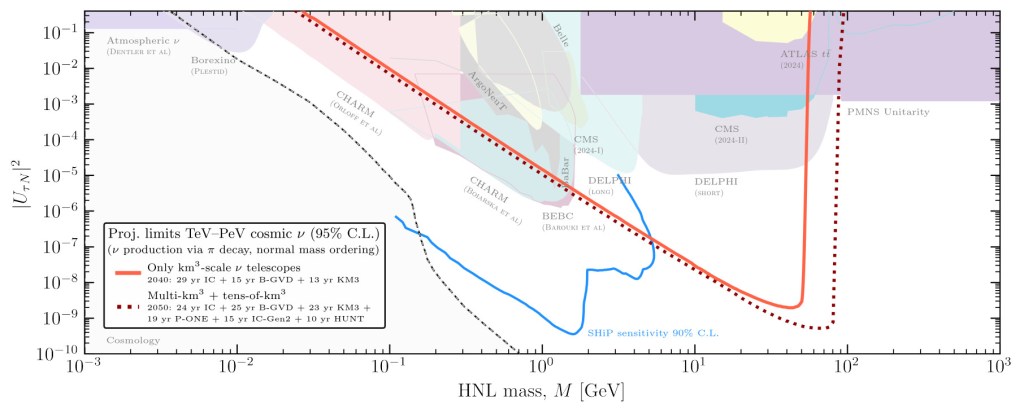
In addition, we show that future measurements of the high-energy astrophysical neutrino flavor composition could set the world-best limits on the HNL couplings:
Read more at:
Are neutrinos Majorana? Fixed-target and high-energy astrophysical searches decide
Gabriela Barenboim, Mauricio Bustamante, Qinrui Liu
2606.17132 hep-ph

