
Do neutrinos mix differently depending on how they are made or detected?
Today, solar, reactor, accelerator, and atmospheric neutrino experiments measure neutrino mixing at energies from MeV to TeV. Global fits combine all of them into a single set of mixing angles and a CP phase. That this works rests on an assumption so basic that it is rarely stated: every experiment sees the same mixing.
In quantum field theory, the parameters of a theory, like the strength of a force or the mixing angles, depend on the energy scale at which we choose to describe them. This “renormalization-group running” is a standard and powerful tool. It connects theories defined at very high energies, like grand unified theories, to the values we measure in the lab.
In recent years, a growing number of papers, including some of our own, went a step further. They assumed that the running is directly observable. In this view, a neutrino made or detected in a collision carries the mixing evaluated at the momentum transfer of that collision, roughly, at how hard the collision is. This would lead to striking signals:
- neutrinos changing flavor right at their source;
- different values of the CP phase in different experiments;
- unusual flavor ratios of the high-energy astrophysical neutrinos seen by IceCube.
In a new paper with Gabriela Barenboim (IFIC, University of Valencia) and Qinrui Liu (Simon Fraser University), we show that this premise is incorrect. The mixing is a property of the neutrino itself. It is fixed by quantum corrections to the neutrino as it travels freely from source to detector.
For the mixing to depend on the momentum transfer, the momentum transfer would have to enter those corrections. It does not: in the collisions that create and detect the neutrino, the momentum is exchanged through a W boson, not through the traveling neutrino. One can still choose to evaluate the mixing at the momentum transfer, as earlier works did. But then the corrections to the traveling neutrino, which those works left out, undo the running. Apart from tiny corrections at the collision points, every experiment, at any energy, measures the same mixing.
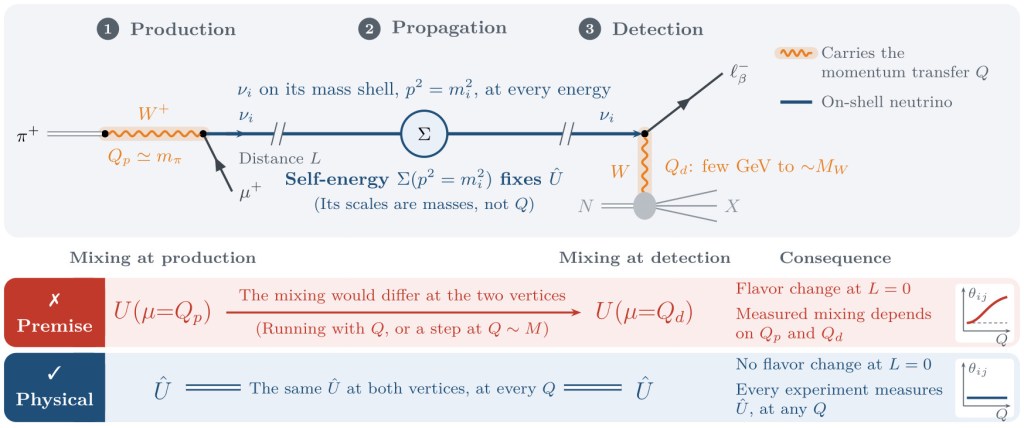
The running itself is real, and it remains useful for testing theories at high energies. What cannot be seen is a dependence of the mixing on the momentum transfer of the experiment. Even setting the theory aside, old data rule this out. The NuTeV and NOMAD experiments looked for neutrinos changing flavor close to their source. They limit any change in the mixing angles between production in pion decay and detection at a few GeV to below 0.7°–2.4°.
This tells us where not to look. If future measurements deviate from expectations, for example of the flavor composition of high-energy astrophysical neutrinos, the cause will be genuinely new physics, not the running of the mixing.
Read more at:
The renormalization-group running of neutrino mixing is undetectable
Gabriela Barenboim, Mauricio Bustamante, Qinrui Liu
2610.28744 hep-ph

