
How likely is a neutrino to interact? Below a few hundred GeV, accelerator experiments have measured the neutrino–nucleon cross section to within a few percent. Above that, measurements have been scarce. Collider neutrinos from FASER reached about 2 TeV in 2024, and astrophysical neutrinos detected by IceCube have been used to measure the cross section in energy bins above about 10 TeV (including in my own paper with Amy Connolly from a while back, 1711.11043).
In between, across the TeV scale, previous measurements each obtained a single value of the cross section over a wide energy range, so how it changes with energy remained largely unmeasured. That matters, because deviations from the Standard Model, whether from the structure of the nucleon or from new physics, would in general depend on energy and could be diluted in a single value.
In a new paper led by star postdoc Rasmi Hajjar, from CCAPP at Ohio State, and co-authored with Sergio Palomares-Ruiz, we resolve how the cross section changes across this range. Using eight years of public IceCube data, 305,735 events from upward-going muon neutrinos and antineutrinos that crossed the Earth before reaching the detector, we measure the muon-neutrino charged-current cross section in five energy bins, from 150 GeV to 40 TeV.
The measurement relies on two effects. The Earth absorbs part of the upward-going flux, more so for neutrinos that cross more of it, and more so at higher energies, where the cross section is larger. And the energy distribution of the events tracks how the cross section changes from one energy bin to the next. Together with independent knowledge of the atmospheric neutrino flux, these effects let us tell the cross section apart from the flux.
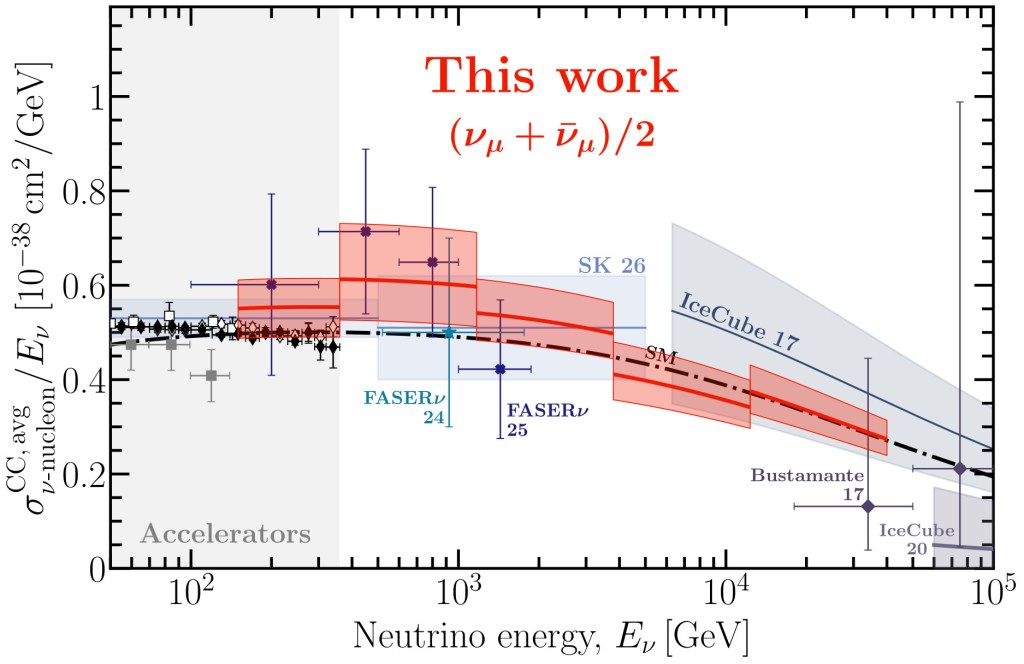
The average of the neutrino and antineutrino cross sections, shown in red, agrees with the Standard Model prediction across the whole energy range and is measured with an uncertainty below 20% in every bin. It overlaps with the collider measurements at low energies and with the astrophysical ones at high energies, bridging the gap between them. It is the most precise measurement of the neutrino–nucleon cross section across the TeV scale to date.
IceCube cannot tell a neutrino from an antineutrino event by event. Still, the two leave different imprints on the data:
- the atmospheric flux contains fewer antineutrinos;
- the antimuons they produce carry on average a larger share of their energy;
- the Earth absorbs them less.
Exploiting these differences, we find a first, albeit mild (1.6σ), indication that the neutrino and antineutrino cross sections can be measured separately above 1 TeV, where they had never been resolved. With ten times more data, within reach of next-generation neutrino telescopes, the uncertainty on the average cross section would fall below 10%. A non-zero antineutrino cross section above 360 GeV could then be established at more than 7σ.
Read more at:
Measurement of the neutrino cross section across the TeV scale using IceCube data
Rasmi Hajjar, Mauricio Bustamante, Sergio Palomares-Ruiz
2610.24068 hep-ph

