
I have posted the paper that accompanies Magνs, the code I released in August for computing neutrino oscillation probabilities.
In vacuum and in matter of constant density, the oscillation probability has an exact formula. Where the density changes along the path, as through the Earth, the Sun, or a supernova, it does not, and the equation of motion has to be integrated. The usual approaches both become slow at high accuracy. Cutting the matter profile into a staircase of constant-density steps gives an error that falls only as the square of the step width. Handing the equation to a general-purpose solver means resolving every oscillation, so the cost grows with the number of oscillations along the path, which can reach millions for a neutrino leaving the Sun. On top of that, each new experiment or model often means writing and validating a new solver.
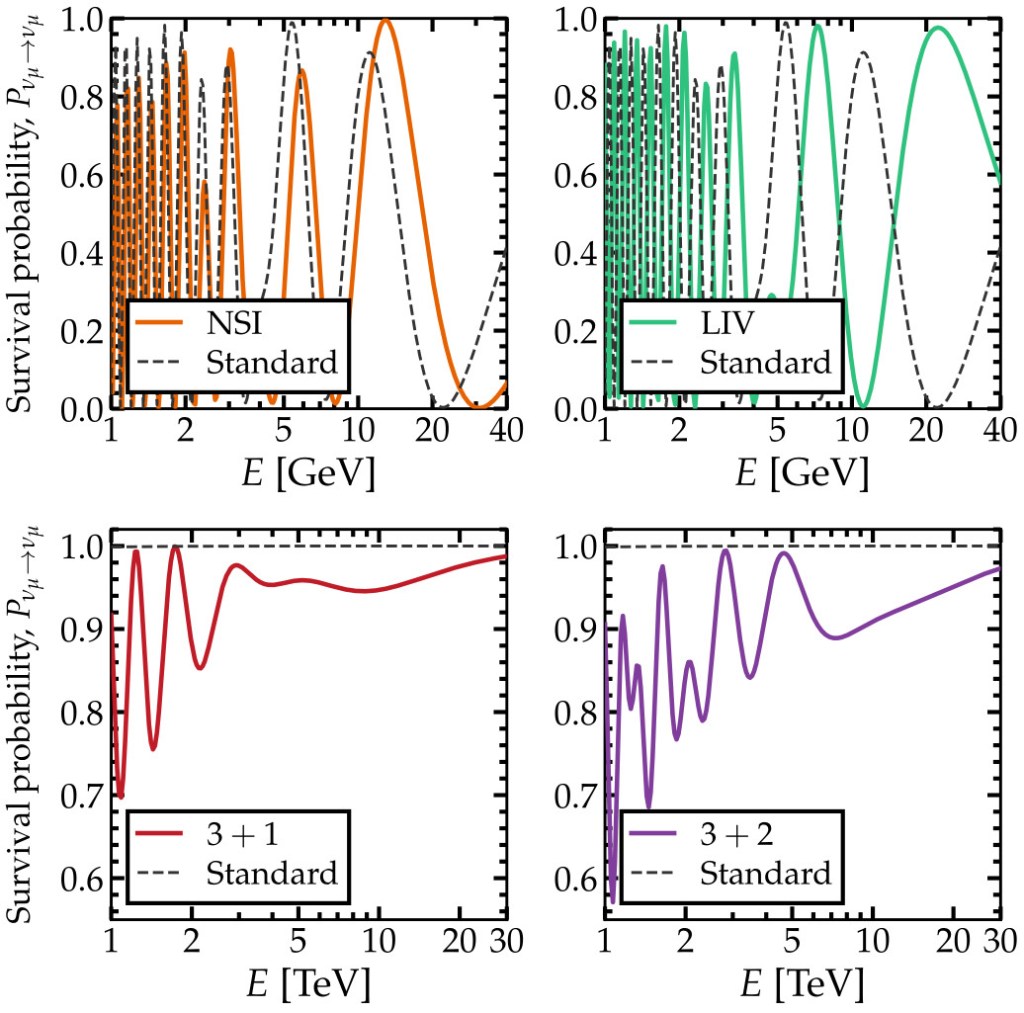
Magνs uses the Magnus expansion instead. Over a stretch of the path within which the density may vary, it writes the evolution of the neutrino as a single exponential built from integrals of the Hamiltonian. The error falls as up to the tenth power of the stretch’s length, and the cost is set by how fast the density changes, not by how many times the neutrino oscillates. Three advantages follow, whatever the Hamiltonian contains.
Robust. The evolution is exactly unitary at any order and any accuracy setting, so the probabilities always add up to one, to round-off.
Fast. A typical probability takes a few milliseconds, and a scan over energy or arrival direction is a single batched call, one to two orders of magnitude cheaper per point than computing the points one at a time.
Flexible. The Hamiltonian is any Hermitian matrix, at any number of flavors. Non-standard interactions, sterile neutrinos, Lorentz-invariance violation, pseudo-Dirac neutrinos, or an interaction nobody has written down yet all go through the same call.
Magνs also chooses its own method. You state a tolerance, and it decides how finely to divide the path. Where a cheaper route exists, it takes it, such as following the slowly changing eigenstates of the Hamiltonian across the Sun. Besides oscillating probabilities, it returns phase-averaged ones, the quantity solar and astrophysical neutrino experiments measure. The aim is to move the effort of studying a new experiment or model from writing a solver to specifying its physics.
The paper works through examples across the field: the Earth’s layers and core, the Sun, a supernova shock front, geoneutrinos, the flavor composition of astrophysical neutrinos, a jet inside a collapsing star, turbulent matter, and a Hamiltonian supplied by the user. Each is a variation on one call.
Install Magνs via PyPI:
pip install magnuspy
Documentation: https://mbustama.github.io/Magnus/
Notebooks: https://mbustama.github.io/Magnus/tutorials.html
Read more at:
Magνs: neutrino oscillation probabilities for any Hermitian Hamiltonian, any number of flavors, and any matter profile
Mauricio Bustamante
2610.07159 hep-ph

