
Do neutrinos feel a new long-range force, sourced by ordinary matter, that tells their flavors apart?
Neutrinos come in three flavors (electron, muon, and tau) and change from one flavor to another as they travel. Such a force would be carried by a new, very light particle, the Z′ boson of a new U(1)′ gauge symmetry. The electrons, protons, and neutrons of the Earth would create a potential that acts differently on each flavor and changes how neutrinos oscillate. For the Z′ masses that we study, from 10−15 to 10−9 eV, the force has a range of about 200 m to 30 Earth radii.
In a new paper led by Dyer F. Cardenas (PUCP, Lima, Peru), now an MSc student, who took part through the REPU program, we look for this force with atmospheric neutrinos that cross the Earth on their way to the IceCube DeepCore detector, at the South Pole. Inside the Earth, the potential changes along the path of each neutrino, more so the shorter the range of the force. Earlier analyses of the same data held the potential at its value at the detector. We compute it at every point of each path and use it to analyze eight years of public DeepCore data, with the systematic uncertainties of IceCube’s own analysis.
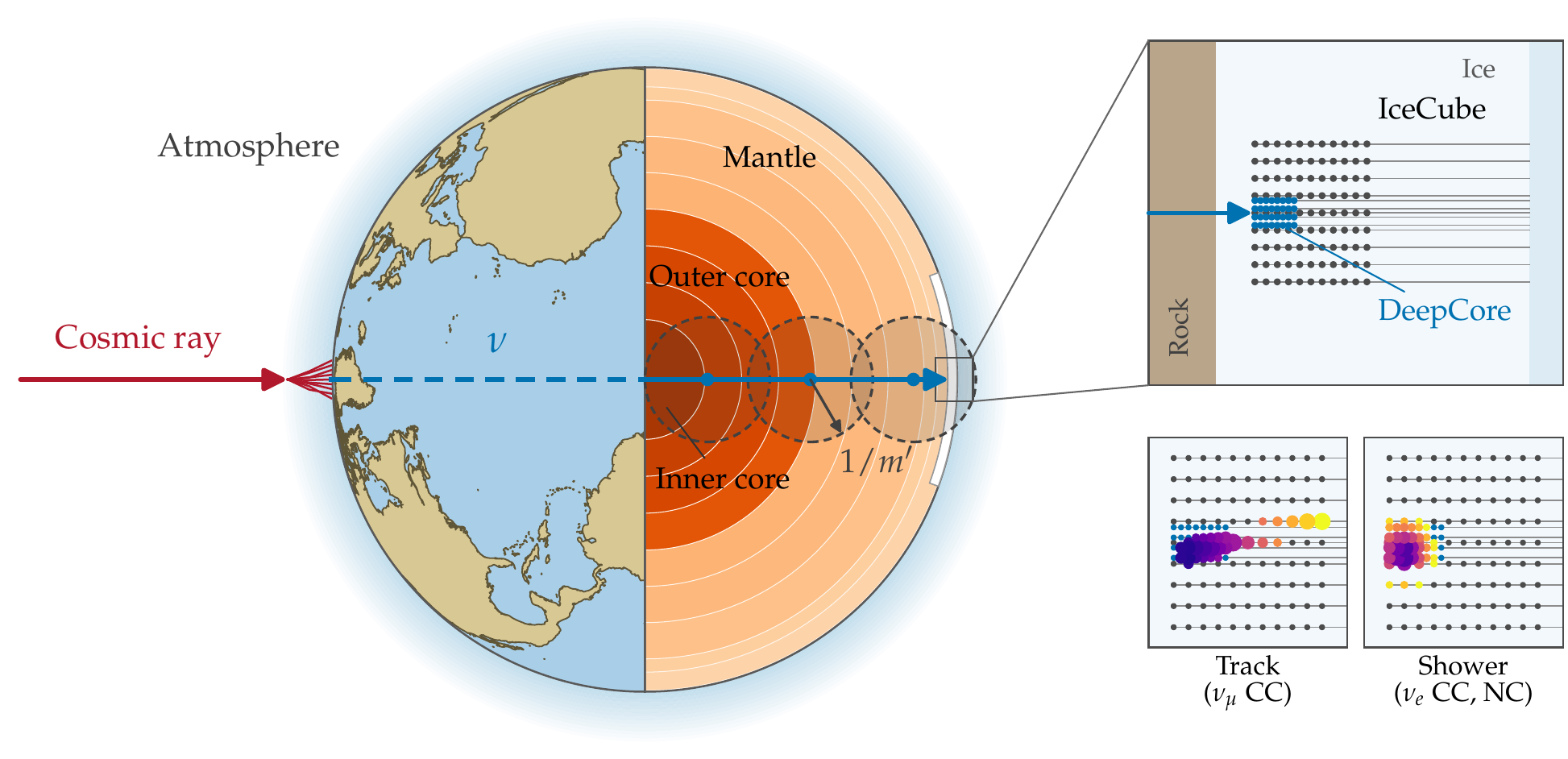
We set upper limits on the coupling of the Z′ for eight of the 14 symmetries that we study, those whose potential differs between muon and tau neutrinos. At ranges longer than about 1–12 km, depending on the symmetry, our limits are stronger than those from tests of the equivalence principle, by up to almost two orders of magnitude. These tests, with torsion balances and with the MICROSCOPE satellite, look for a force that pulls differently on bodies of different composition. They test how such a force acts on neutrinos only indirectly. Holding the potential at its value at the detector, as earlier analyses did, underestimates it along most of each path, since the mantle and the core are denser than the matter around the detector. Doing so would weaken our limits by about 20% at the longest ranges and by up to a factor of about 3 at the shortest.
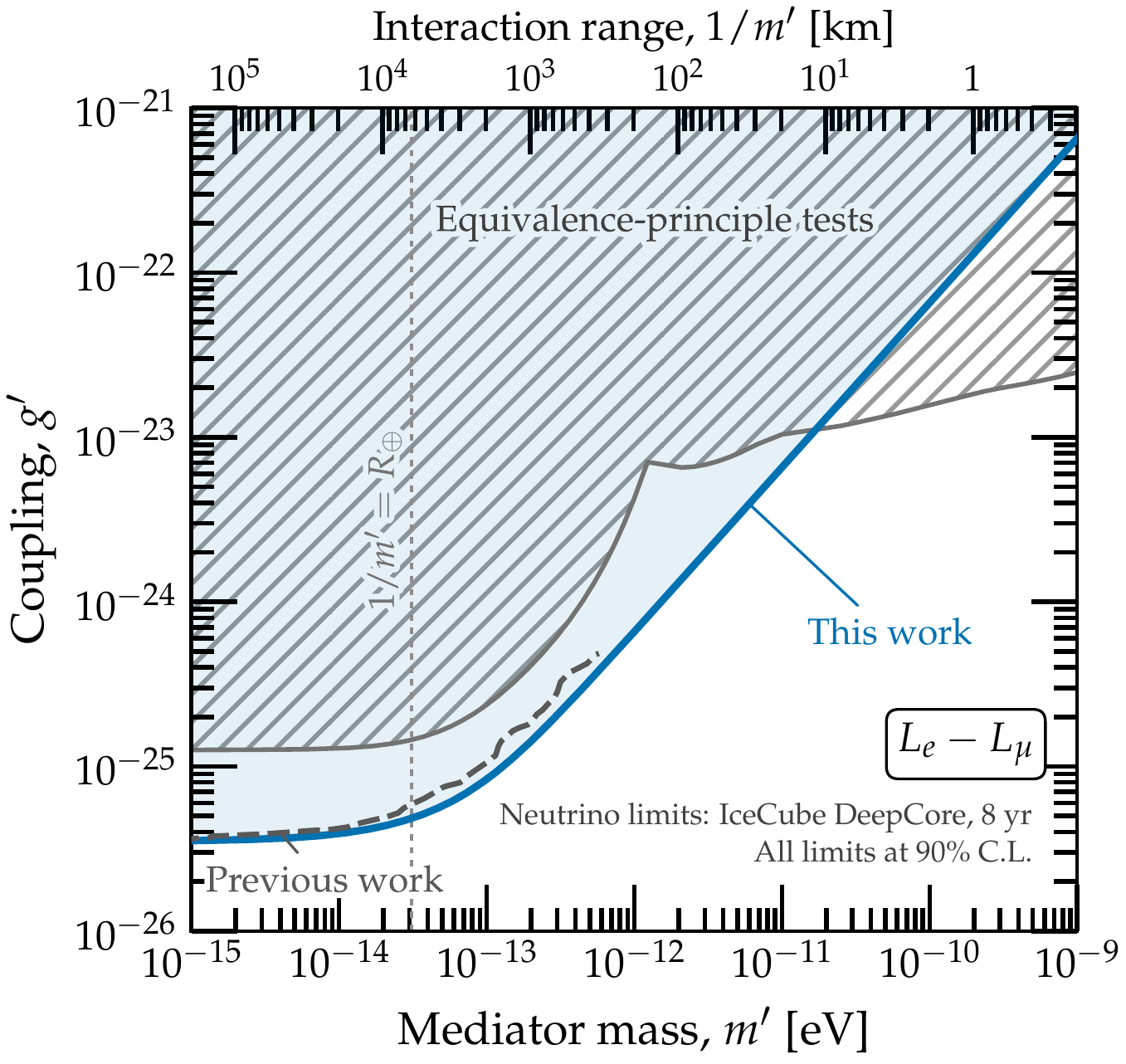
Along the diameter of the Earth, standard oscillations turn nearly all muon neutrinos with energies near 24 GeV into other flavors. A potential that treats muon and tau neutrinos differently reduces their mixing, so more of them would reach the detector as muon neutrinos. Our limits come from these steeply up-going muon neutrinos. For the other six symmetries, whose potential acts on electron neutrinos alone, the data set no upper limit, since such a potential barely changes how muon neutrinos oscillate.
Detectors under construction or planned, such as the IceCube Upgrade, KM3NeT/ORCA, Hyper-Kamiokande, and DUNE, could tighten these limits. At every range that we study, the potential varies along the path of each neutrino, so analyses of their data should also compute it point by point. Our limits, the numbers behind every figure of the paper, and the code that draws them are public on GitHub.
Read more at:
Earth-sized tests of long-range neutrino interactions
Dyer F. Cardenas, Mauricio Bustamante
2611.14642 hep-ph

