Electron stability constrains neutrino time delays

Standard

The search for Lorentz-invariance violation (LIV) is one of our best paths toward uncovering the quantum nature of spacetime. One of its most famous potential manifestations is the modification of neutrino propagation speeds.

For years, the community has known that superluminal (faster-than-light) neutrinos are heavily constrained. LIV would cause them to rapidly lose energy by radiating electron-positron pairs in a vacuum. Because of this, when anomalous time delays between cosmic neutrinos and gamma rays are observed, phenomenologists have naturally favored subluminal (slower-than-light) LIV propagation as the most viable explanation.

In a new paper co-authored with José Manuel Carmona, José Luis Cortés, Ardit Gkioni, and Maykoll A. Reyes, we demonstrate that this apparent subluminal loophole is actually an illusion.

We show that the same LIV modifications that slow down neutrinos inevitably render high-energy electrons unstable. Under subluminal LIV, electrons undergo a catastrophic decay process: e → e + ν + anti-ν. This triggers rapid and severe energy degradation.
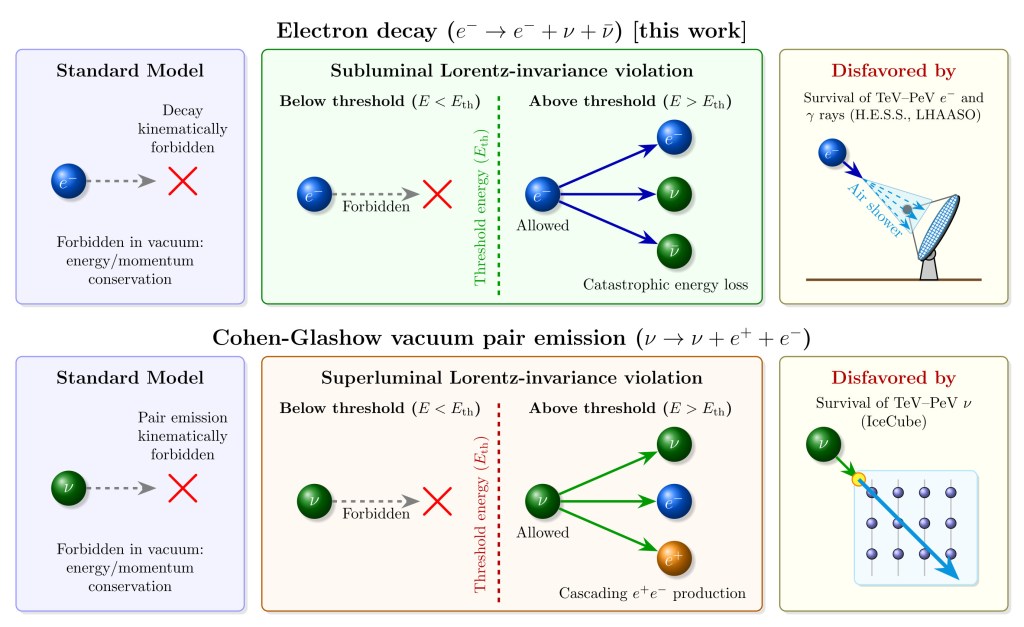
By demanding that electrons survive up to the extreme energies we observe in astrophysics—specifically, the 15.5-TeV candidates from H.E.S.S. and the 2.34-PeV electrons inferred by LHAASO in the Crab Nebula—we placed stringent new limits on subluminal LIV.

Our results firmly invalidate the subluminal parameter space previously invoked to explain years-long cosmic neutrino time delays. Consequently, any observable delays must either have purely astrophysical origins, rely on a universal LIV deformation across all particle species, or require physics well beyond the standard effective-field-theory framework.

Read more at:

Electron stability constrains neutrino time delays
Mauricio Bustamante, José Manuel Carmona, José Luis Cortés, Ardit Gkioni, Maykoll A. Reyes
2607.01339 hep-ph

No Flavor Anisotropy in the High-Energy Neutrino Sky Upholds Lorentz Invariance

Standard

Do neutrinos of different flavors have different preferred directions? If so, this would mean that Lorentz invariance is violated, something that is posited by some theories of quantum gravity. In them, Lorentz-invariance violation (LIV) would become more prominent the higher the energies involved.

Motivated by this, we look for signs of this flavor-dependent LIV using the high-energy astrophysical neutrinos seen by IceCube, with energies in the TeV-PeV range.

If LIV exists, the neutrinos would be affected by their interaction with a pervasive LIV field that couples differently to different neutrino flavors. As a result, the sky distributions of high-energy astrophysical electron, muon, and tau neutrinos arriving at Earth would be anisotropic.

In a new paper led by PhD student Bernanda Telalovic, we look for these high-energy neutrino flavor anisotropies in IceCube data, specifically, in the public 7.5-year sample of High-Energy Starting Events (HESE). We do this using the methods introduced in an earlier paper of ours (2310.15224).

We find no evidence for the patterns of flavor anisotropy expected from LIV, and so we place new upper limits on hundreds of parameters regulating Lorentz-invariance violation within the Standard Model Extension. We explore LIV operator dimensions from 2 to 8, each with a different dependence on neutrino energy and introducing different forms of flavor anisotropy.

For many of them, we improve upon existing limits—on account of using higher energies—or place limits for the first time ever:

Our new upper limits on the LIV parameters are available in digital form for download at 68%, 95%, and 99% C.L. GitHub, here.

Read more at:

No Flavor Anisotropy in the High-Energy Neutrino Sky Upholds Lorentz Invariance
Bernanda Telalovic, Mauricio Bustamante
2503.15468 astro-ph