Our paper on the GRAND prototype arrays is finally out!
GRAND, the Giant Radio Array for Neutrino Detection, is an envisioned next-generation observatory for the detection of ultra-high-energy cosmic rays, gamma rays, and, especially, neutrinos.
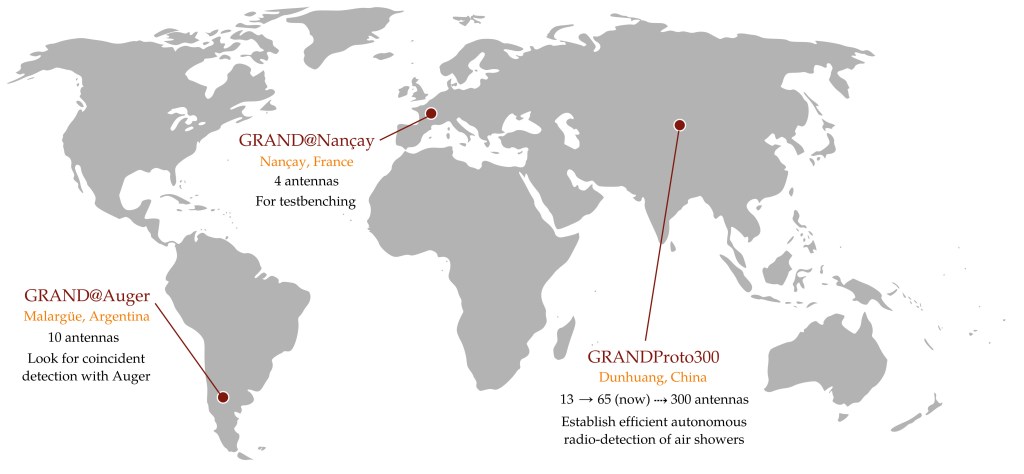
For the past two years, three small-scale GRAND prototype arrays have been running to test the technology and detection principle of the experiment: GRAND@Nançay in France, GRAND@Auger in Argentina, and GRANDProto300 in China.
This paper was led by Beatriz de Errico, from the Federal University of Rio de Janeiro, and Shen Wang, from Purple Mountain Observatory.
Lorentz invariance is one of the pillars of modern physics, underlying special relativity—and, with that, the Standard Model—and general relativity. It posits that the laws of physics are the same for all observers moving in their own inertial frame. Yet, at high energies and short distances, Lorentz invariance may no longer hold.
To date, Lorentz invariance remains unbroken in all experimental tests. If it were violated, however, it could have many and varied consequences. Accordingly, there have been multiple searches for Lorentz invariance violation, using atom interferometry, gamma rays, cosmic rays, and neutrinos, etc. See, for instance, the data tables in 0801.0287.
High-energy astrophysical neutrinos, with TeV-PeV, are powerful probes of Lorentz invariance, thanks to their high energies and long traveled distances from their sources to Earth, of Mpc-Gpc scales. If Lorentz invariance is violated, it could imply that, en route to Earth, higher-energy neutrinos would travel more slowly than lower-energy neutrinos.
In a new paper, we introduce methods to look for these temporal distortions. We use the high-energy joint time and energy distribution of the neutrino flare detected by IceCube in 2014/2015 from the blazar TXS 0506+056 to look for specific signatures from Lorentz-invariance violation. We do this by borrowing non-parametric statistical methods previously used to look for signs of Lorentz-invariance violation in the gamma rays from gamma-ray bursts (1807.00189).
And, in doing so, we account for the significant energy and directional uncertainty associated to the detection of high-energy astrophysical neutrinos. Doing this makes our analysis realistic and robust, even if it erodes some of its sensitivity.
As a result, we set new lower limits on the energy scale of Lorentz-invariance violation in neutrino propagation. If Lorentz invariance is broken, this must happen at energies beyond 10^{14} GeV, if the effects depend linearly on the neutrino energy, or beyond 10^9 GeV, if they depend quadratically on it.
In the hot, dense cores of core-collapse supernova, neutrinos could coalesce to make new, heavy particles, like Majoron-like bosons, with masses from tens of MeV to more than 100 MeV. After escaping the supernova, these Majorons would decay into energies comparable to the parent Majoron mass, far more energetic than the standard supernova neutrinos emitted from the neutrinosphere, and arriving at Earth later than them.
Thanks to large upcoming neutrino detectors, we might observe these high-energy neutrinos from the next galactic core-collapse supernova. Combining all available detection channels provides us with information on the energy, flavor, and arrival times of these neutrinos.
In a new paper, led by NBI PhD student Bernanda Telalovic, we have shown for the first time that we can combine this information use to clearly distinguish neutrinos from Majoron decay from the standard neutrinos of the next galactic supernova.
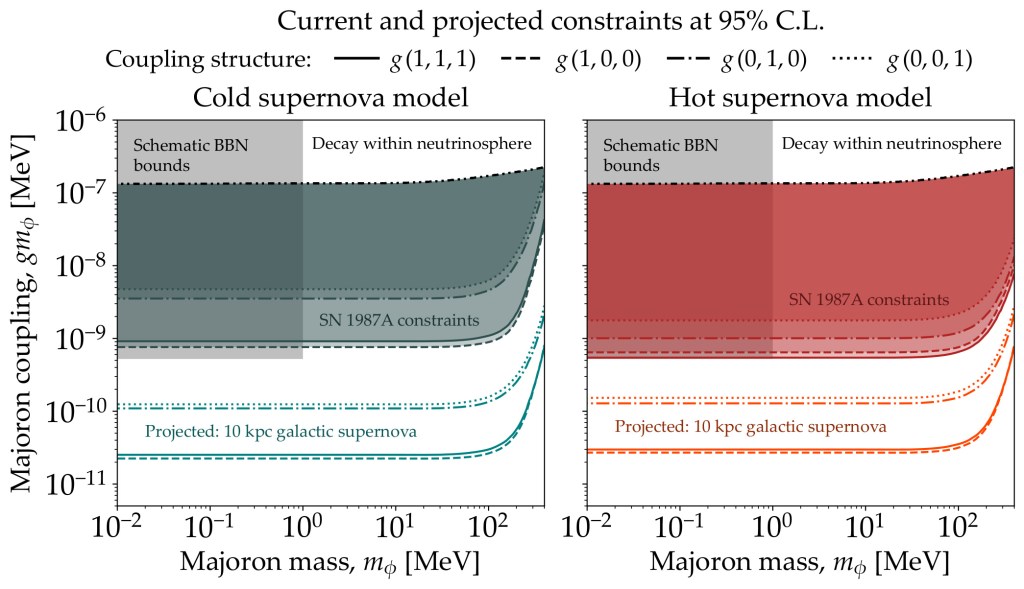
And, on top of that, we fold in the large uncertainty that exists in supernova physics by using two sophisticated supernova simulations (hot and cold) from the Garching group, obtained for two different assumptions for the mass of the proto-neutron star. However, our results do not hinge on us knowing what the real model, since we marginalize over it.
Should we detect no high-energy neutrinos, we will be able to place upper bounds on the Majoron coupling to neutrinos that are more than an order of magnitude stronger than the ones inferred from the observation of neutrinos from SN 1987A:
We show explicitly how the bounds are different depending on the flavor texture of the Majoron.
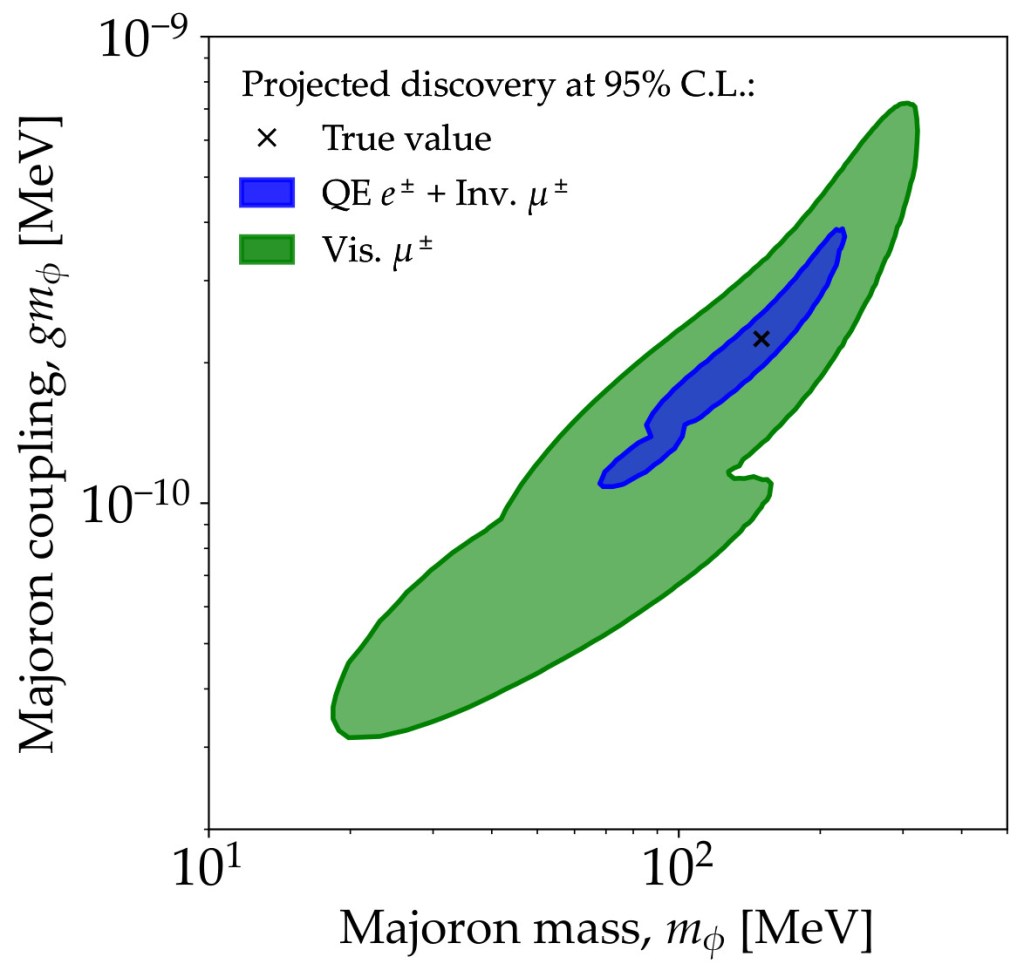
Conversely, should we detect high-energy neutrinos with late arrival times (tens of seconds post-bounce), we will be able to measure the mass and flavor-universal coupling of the Majoron:
If there are new neutrino interactions with matter, and if they affect neutrinos of different flavor differently, then they could impact neutrino oscillations. Long-baseline neutrino experiments are well-suited to look for them, thanks to their use of intense, well-characterized neutrino beams.
If the new interactions have a long range—i.e., if they are mediated by a new, ultra-light mediator—then neutrinos on Earth may experience a matter potential sourced by the vast amount of faraway matter elsewhere inside the Earth, Moon, Sun, Milky Way, and in the cosmological matter distribution, as pointed out in 1808.02042 [Universe’s Worth of Electrons to Probe Long-Range Interactions of High-Energy Astrophysical Neutrinos, by MB & Sanjib Agarwalla, PRL 2019]. This boosts the chances of discovering the new interaction even if it is supremely feeble.
In a recent paper (2305.05184 [Flavor-dependent long-range neutrino interactions in DUNE & T2HK: alone they constrain, together they discover, by Masoom Singh, MB, and Sanjib Agarwalla, JHEP 2023]), we explored the prospects of constraining or discovering these new, long-range neutrino interactions in the upcoming long-baseline experiments DUNE and T2HK. We found promising prospects. However, we explored only three different possible forms of the interaction, introduced by gauging three of the accidental global lepton-number U(1) symmetries of the Standard Model.
In a new paper (2404.02775), led by PhD students Masoom Singh and Pragyanprasu Swain, we now extend this to many other symmetries—a plethora of them!—that introduce new neutrino interactions with electrons, neutrons, and protons. Each symmetry affects oscillations differently.
Our new results cement and extend our original findings: DUNE and T2HK should be able to probe the existence of new interactions—and possibly discover and distinguish between alternatives—regardless of which symmetry is responsible for inducing them. The reach of DUNE and T2HK to probe new neutrino interactions is not only deep, but also broad!
The flavor composition of high-energy cosmic neutrinos—i.e., the proportion of electron, muon, and tau neutrinos in the flux—is a versatile probe of neutrino physics and astrophysics (see, e.g., here, here, and here). So far, all measurements of it, by IceCube, have been in the TeV-PeV energy range. In the next decade, new neutrino telescopes might discover ultra-high-energy (UHE) neutrinos, with EeV-scale energies, opening up new possibilities. Yet, so far, the measurement of their flavor composition has remained largely unexplored (see, however, our recent paper here).
In a new paper led by postdoc Alan Coleman we propose new methods to measure the flavor composition of UHE neutrinos in upcoming large in-ice radio-detection neutrino telescopes, like RNO-G, under construction, and the planned radio array of IceCube-Gen2.
The measurement is based on two flavor-sensitive channels: one sensitive to electron neutrinos, by looking for the elongation of radio Askaryan emission due to the Landau-Pomeranchuk-Migdal effect, and one sensitive mainly to muon and tau neutrinos, by looking for events that contain multiple showers, triggered by the stochastic losses of final-state muons and taus.
Our results, based on state-of-the-art simulations of IceCube-Gen2, show promising prospects. If the UHE neutrino flux is large (as in, informed by cosmic-ray measurements by the Telescope Array), we should achieve sensitivity enough to confirm standard predictions of the flavor composition and disfavor extreme deviations from them:
This would allow us, for instance, to infer the flavor composition at the point of production of the UHE neutrinos and thus indirectly probe their production mechanism and possibly the identity of the neutrino sources:




 Mauricio Bustamante