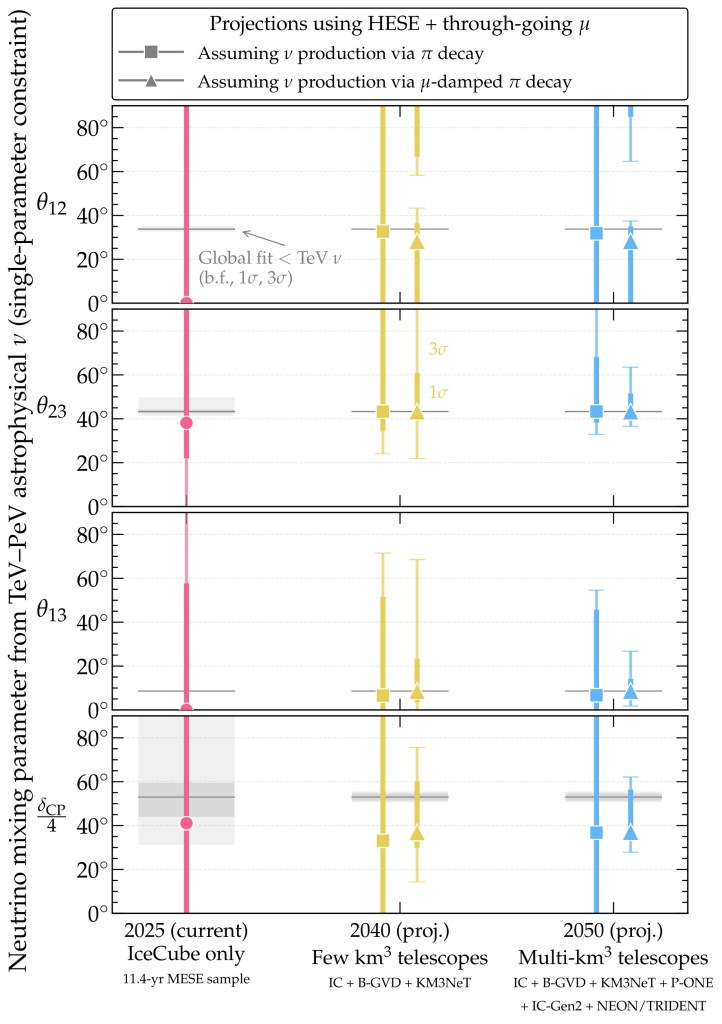
CERN Courier included a short quote of mine on their recent news bit about the observation by KM3NeT of the first ultra-high-energy neutrino: Cosmogenic candidate lights up KM3NeT.
To quote:
“Once KM3NeT and Baikal–GVD are fully constructed, we will have three large-scale neutrino telescopes of about the same size in operation around the world,” adds Mauricio Bustamante, theoretical astroparticle physicist at the Niels Bohr Institute of the University of Copenhagen. “This expanded network will monitor the full sky with nearly equal sensitivity in any direction, improving the chances of detecting new neutrino sources, including faint ones in new regions of the sky.”
Lorentz invariance is one of the pillars of modern physics, underlying special relativity—and, with that, the Standard Model—and general relativity. It posits that the laws of physics are the same for all observers moving in their own inertial frame. Yet, at high energies and short distances, Lorentz invariance may no longer hold.
To date, Lorentz invariance remains unbroken in all experimental tests. If it were violated, however, it could have many and varied consequences. Accordingly, there have been multiple searches for Lorentz invariance violation, using atom interferometry, gamma rays, cosmic rays, and neutrinos, etc. See, for instance, the data tables in 0801.0287.
High-energy astrophysical neutrinos, with TeV-PeV, are powerful probes of Lorentz invariance, thanks to their high energies and long traveled distances from their sources to Earth, of Mpc-Gpc scales. If Lorentz invariance is violated, it could imply that, en route to Earth, higher-energy neutrinos would travel more slowly than lower-energy neutrinos.
In a new paper, we introduce methods to look for these temporal distortions. We use the high-energy joint time and energy distribution of the neutrino flare detected by IceCube in 2014/2015 from the blazar TXS 0506+056 to look for specific signatures from Lorentz-invariance violation. We do this by borrowing non-parametric statistical methods previously used to look for signs of Lorentz-invariance violation in the gamma rays from gamma-ray bursts (1807.00189).
And, in doing so, we account for the significant energy and directional uncertainty associated to the detection of high-energy astrophysical neutrinos. Doing this makes our analysis realistic and robust, even if it erodes some of its sensitivity.
As a result, we set new lower limits on the energy scale of Lorentz-invariance violation in neutrino propagation. If Lorentz invariance is broken, this must happen at energies beyond 10^{14} GeV, if the effects depend linearly on the neutrino energy, or beyond 10^9 GeV, if they depend quadratically on it.
In the hot, dense cores of core-collapse supernova, neutrinos could coalesce to make new, heavy particles, like Majoron-like bosons, with masses from tens of MeV to more than 100 MeV. After escaping the supernova, these Majorons would decay into energies comparable to the parent Majoron mass, far more energetic than the standard supernova neutrinos emitted from the neutrinosphere, and arriving at Earth later than them.
Thanks to large upcoming neutrino detectors, we might observe these high-energy neutrinos from the next galactic core-collapse supernova. Combining all available detection channels provides us with information on the energy, flavor, and arrival times of these neutrinos.
In a new paper, led by NBI PhD student Bernanda Telalovic, we have shown for the first time that we can combine this information use to clearly distinguish neutrinos from Majoron decay from the standard neutrinos of the next galactic supernova.
And, on top of that, we fold in the large uncertainty that exists in supernova physics by using two sophisticated supernova simulations (hot and cold) from the Garching group, obtained for two different assumptions for the mass of the proto-neutron star. However, our results do not hinge on us knowing what the real model, since we marginalize over it.
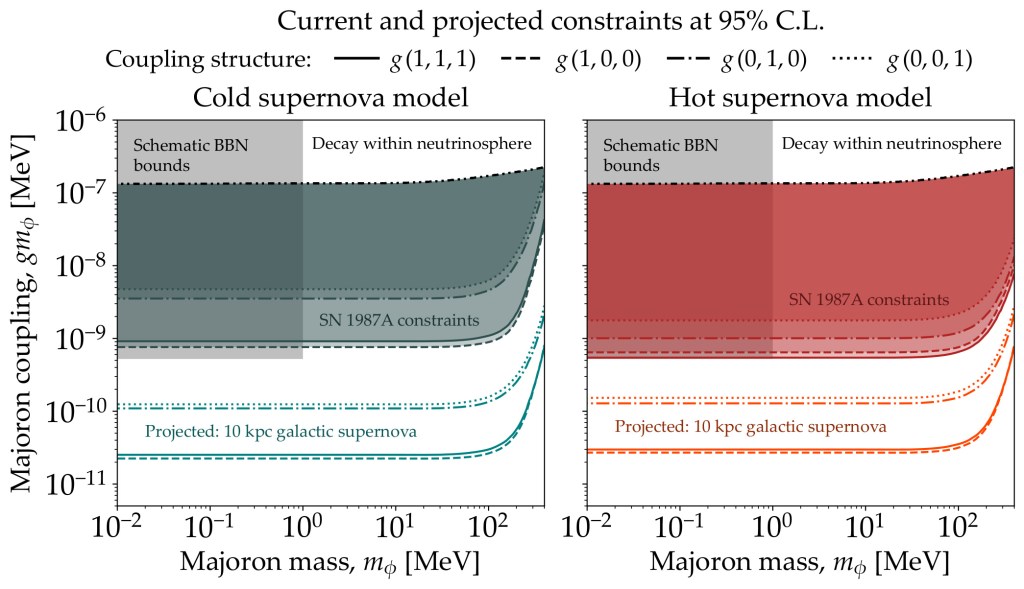
Should we detect no high-energy neutrinos, we will be able to place upper bounds on the Majoron coupling to neutrinos that are more than an order of magnitude stronger than the ones inferred from the observation of neutrinos from SN 1987A:
We show explicitly how the bounds are different depending on the flavor texture of the Majoron.
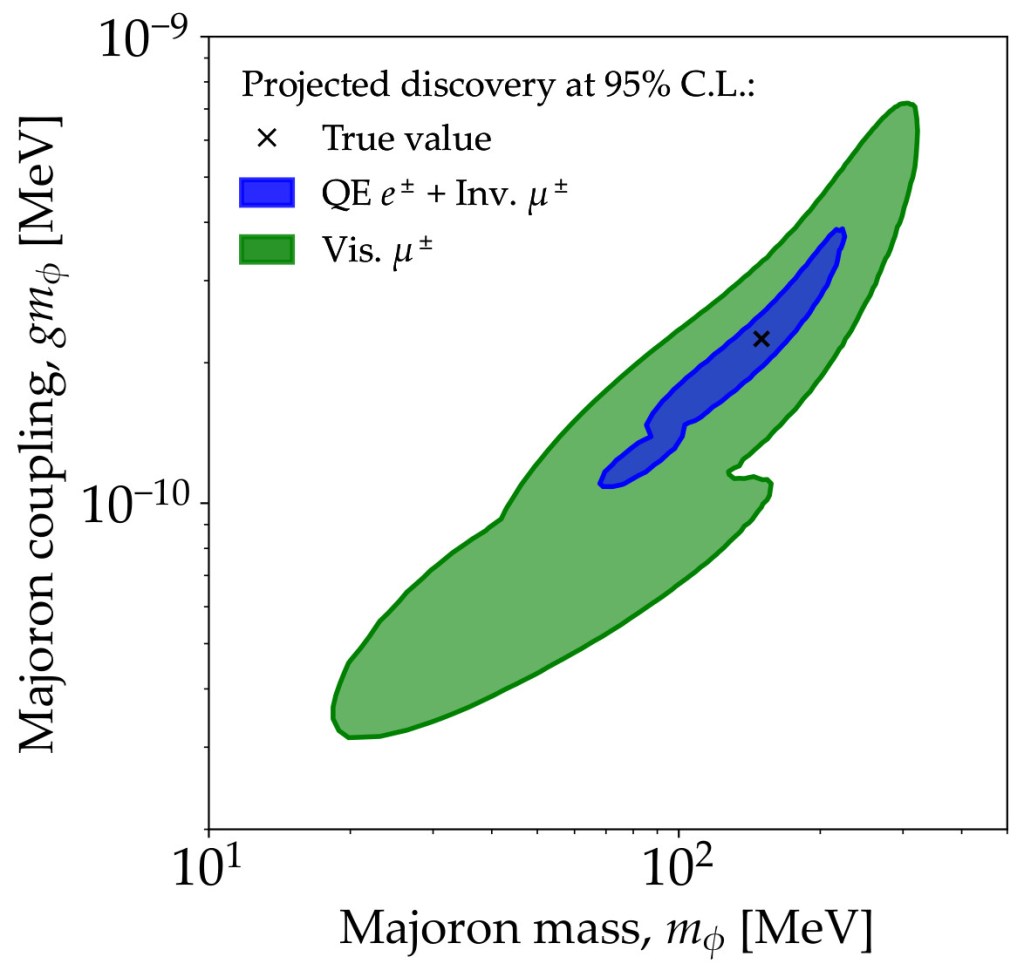
Conversely, should we detect high-energy neutrinos with late arrival times (tens of seconds post-bounce), we will be able to measure the mass and flavor-universal coupling of the Majoron:
In the Standard Model, neutrinos are effectively stable, their lifetimes orders of magnitude longer than the age of the Universe. In proposed extensions of the Standard Model, however, neutrinos might decay faster, and so observing them decay would constitute evidence of new neutrino physics.
Regardless, neutrino lifetimes, even augmented by new physics, are likely very long, and the effects of decay are likely manifest only in neutrinos that travel a long distance, during which the chances of them decaying becomes appreciable even if they are long-lived.
In a new paper, we have searched for signs of neutrino decay using the neutrinos from farthest away: the high-energy astrophysical neutrinos detected by IceCube, which travel cosmological-scale distances of Mpc-Gpc from their sources to Earth. Neutrino decay, in principle, alters the shape of the neutrino energy spectrum—introducing a step-like jump—and the flavor composition of the neutrinos upon reaching Earth—taking it outside the region expected from standard oscillations alone.
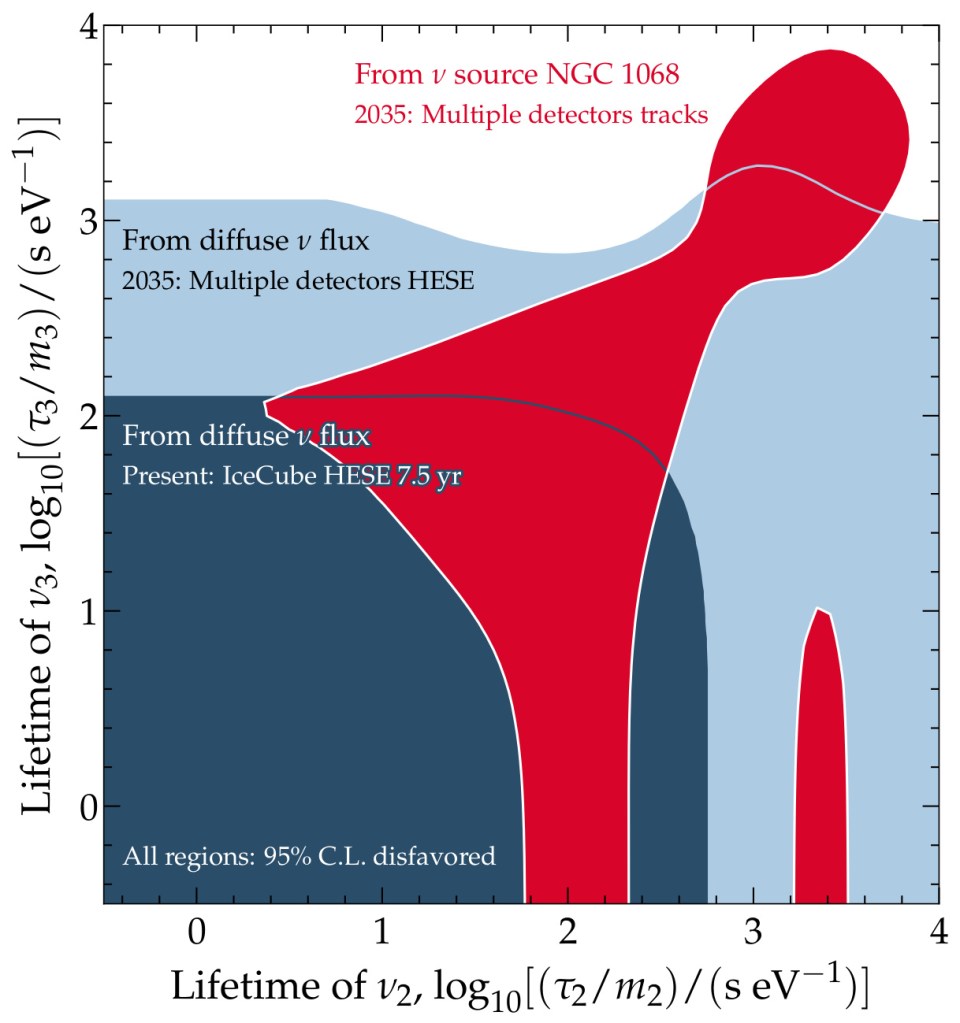
We find no signs of decay in present-day IceCube data, but place new, competitive lower limits on the lifetimes of the nu_2 and nu_3 neutrino mass eigenstates. We report, for the first time, limits inferred using the neutrinos from the first candidate steady-state astrophysical source of high-energy neutrinos, the active galaxy NGC 1068, and limits inferred from the diffuse flux of high-energy neutrinos.
These are arguably the most robust neutrino lifetime bounds garnered from high-energy astrophysical neutrinos so far! In addition, we make forecasts for the year 2035, combining multiple upcoming neutrino telescopes.
While similar studies have been performed before, ours brings two new perspectives, often overlooked or understudied, that make our results robust.
First, we consider broadly the large astrophysical uncertainties that plague the prediction of the flux of high-energy astrophysical neutrinos. This includes the size and shape of the neutrino energy spectrum, the flavor composition of the neutrino flux, the number or source populations and their distribution in redshift, and whether we have prior constraints on the size of the neutrino flux normalization. The impact of considering these uncertainties ranges from appreciable to critical. In some cases, they nearly make the sensitivity to neutrino decay vanish! Surprisingly, with present data, it is not possible to constrain neutrino decay using neutrinos from NGC 1068 due to the astrophysical unknowns!
Second, we model in detail the detection of neutrinos in IceCube and other neutrino telescopes. Their limited resolution to measure the energy, direction, and flavor of detected neutrinos blurs potential signs of neutrino decay in the flux of high-energy astrophysical neutrinos. We model experimental nuance using either tools provided publicly by the IceCube Collaboration (for the diffuse flux, using High Energy Starting Events), or using the PLEnuM (for the flux from NGC 1068, using tracks).