CERN Courier included a short quote of mine on their recent news bit about the observation by KM3NeT of the first ultra-high-energy neutrino: Cosmogenic candidate lights up KM3NeT.
To quote:
“Once KM3NeT and Baikal–GVD are fully constructed, we will have three large-scale neutrino telescopes of about the same size in operation around the world,” adds Mauricio Bustamante, theoretical astroparticle physicist at the Niels Bohr Institute of the University of Copenhagen. “This expanded network will monitor the full sky with nearly equal sensitivity in any direction, improving the chances of detecting new neutrino sources, including faint ones in new regions of the sky.”
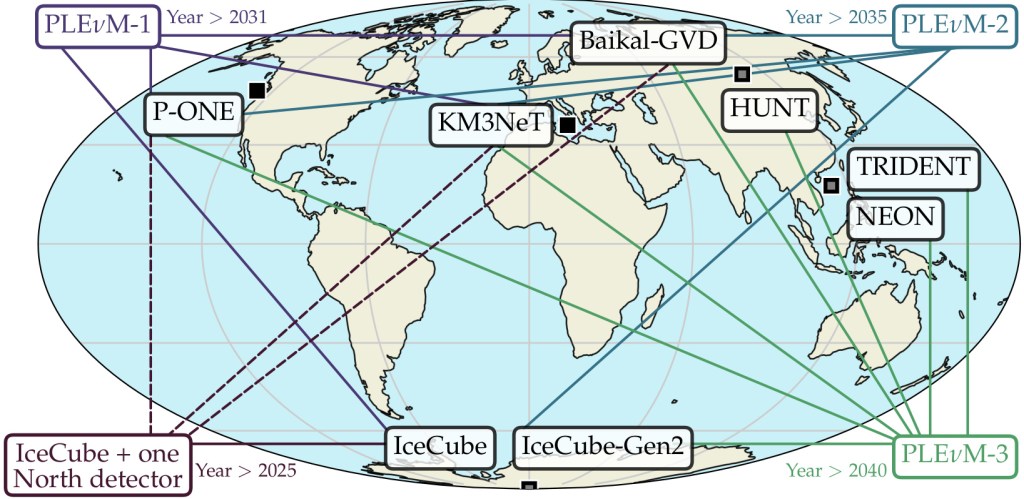
Genuine high-energy neutrino astronomy needs many and varied astrophysical sources. But finding sources is hard, especially having only one km-scale neutrino telescope in operation. This is changing fast, though, thanks to the ongoing construction of KM3NeT and Baikal-GVD, but transformative progress will require us to think globally.
In a new paper, led by Lisa Schumacher, we show that, in the next 10-20 years, IceCube + Baikal-GVD, KM3NeT, IceCube-Gen2, P-ONE, TRIDENT, NEON, & HUNT, taken together in PLEnuM, could allow us to make global high-energy neutrino monitoring a reality. Together, they will increase the global rate of neutrino detection by up to 30 times and continuously monitor the entire sky.
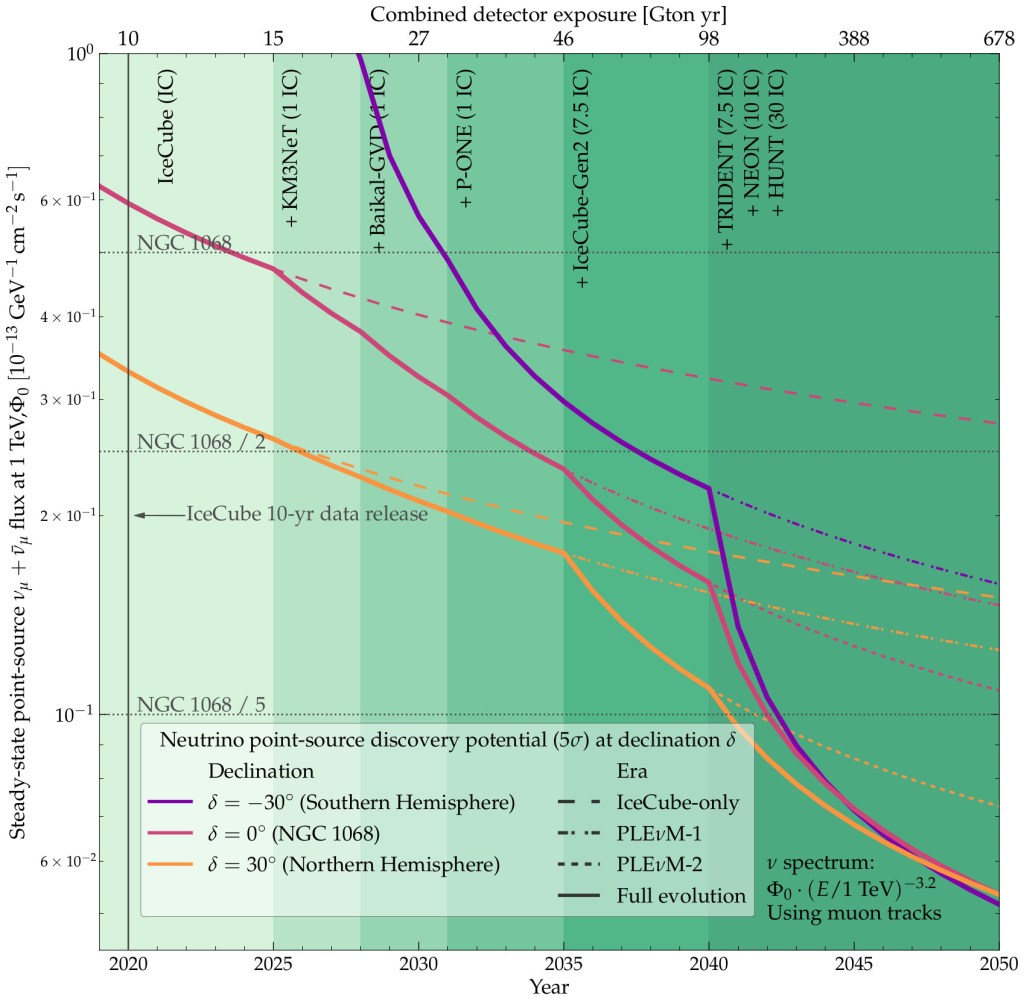
To showcase this, we focus on one of the most prominent science cases in high-energy neutrino astronomy: finding steady-state sources. A combined analysis of global data will expedite source discovery—in some cases, by decades—and enable the detection of fainter sources anywhere in the sky, discovering up to tens of new neutrino sources.
This is seen, for example, in our forecasts for the evolution of the discovery potential of neutrino sources that have a soft spectrum (like NGC 1068), placed in different locations in the sky:
The PLEnuM tools used to obtain the results in our paper (plus more) are open-source and available on GitHub, here.
In the hot, dense cores of core-collapse supernova, neutrinos could coalesce to make new, heavy particles, like Majoron-like bosons, with masses from tens of MeV to more than 100 MeV. After escaping the supernova, these Majorons would decay into energies comparable to the parent Majoron mass, far more energetic than the standard supernova neutrinos emitted from the neutrinosphere, and arriving at Earth later than them.
Thanks to large upcoming neutrino detectors, we might observe these high-energy neutrinos from the next galactic core-collapse supernova. Combining all available detection channels provides us with information on the energy, flavor, and arrival times of these neutrinos.
In a new paper, led by NBI PhD student Bernanda Telalovic, we have shown for the first time that we can combine this information use to clearly distinguish neutrinos from Majoron decay from the standard neutrinos of the next galactic supernova.
And, on top of that, we fold in the large uncertainty that exists in supernova physics by using two sophisticated supernova simulations (hot and cold) from the Garching group, obtained for two different assumptions for the mass of the proto-neutron star. However, our results do not hinge on us knowing what the real model, since we marginalize over it.
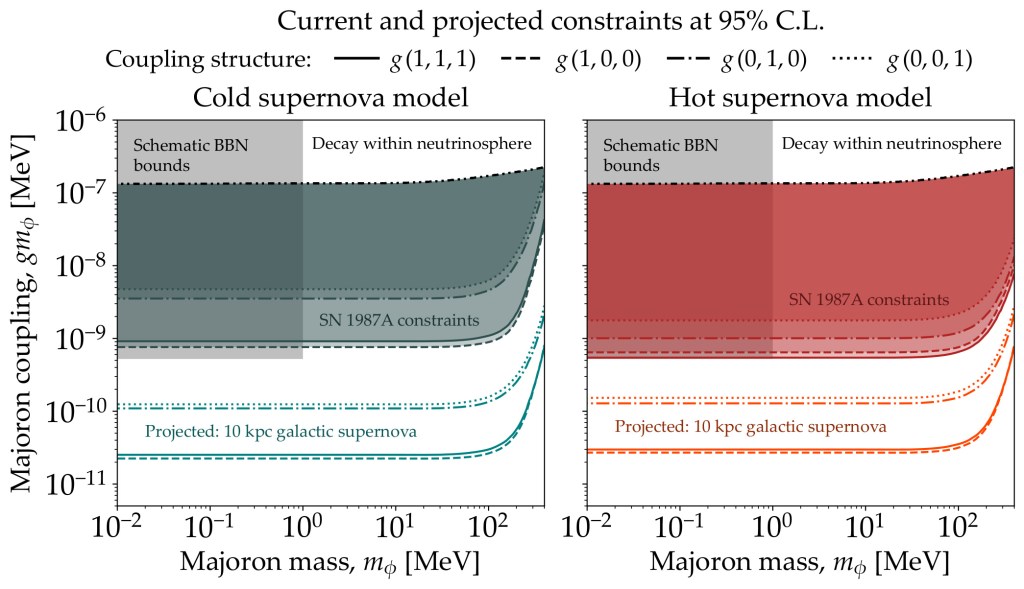
Should we detect no high-energy neutrinos, we will be able to place upper bounds on the Majoron coupling to neutrinos that are more than an order of magnitude stronger than the ones inferred from the observation of neutrinos from SN 1987A:
We show explicitly how the bounds are different depending on the flavor texture of the Majoron.
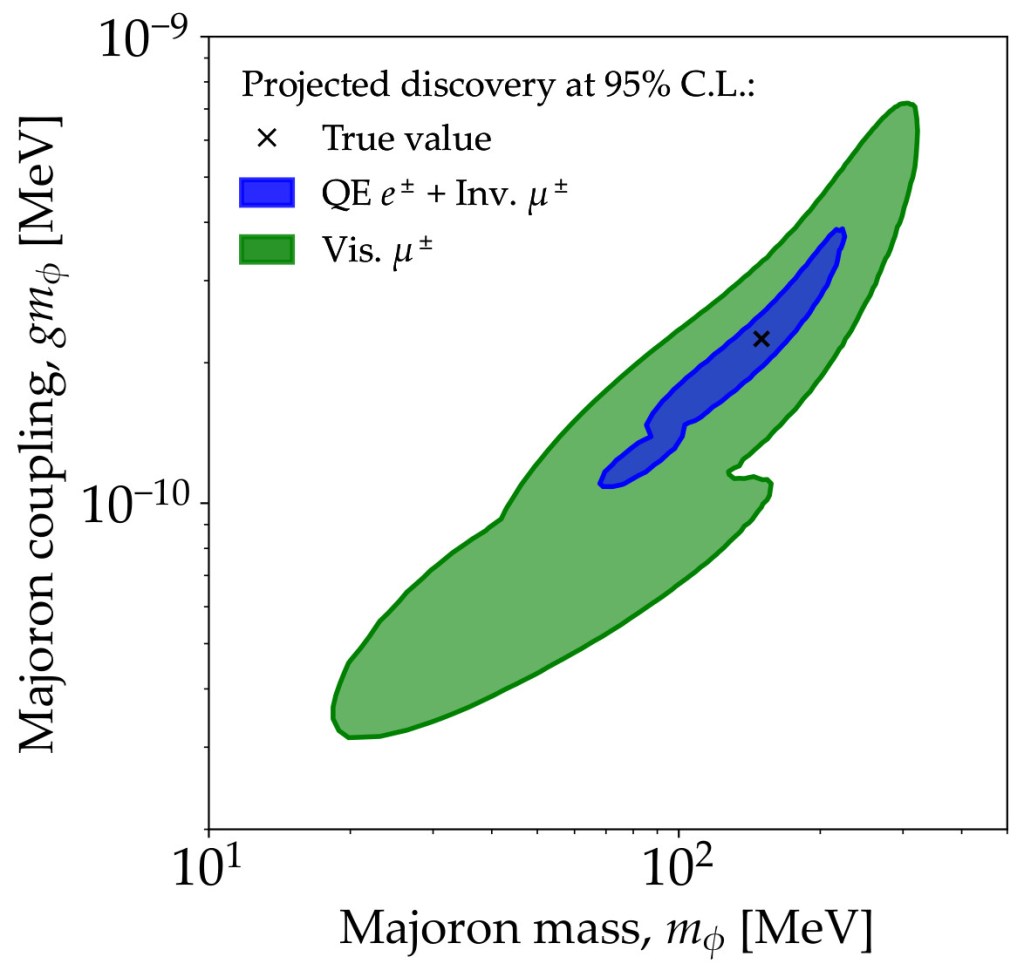
Conversely, should we detect high-energy neutrinos with late arrival times (tens of seconds post-bounce), we will be able to measure the mass and flavor-universal coupling of the Majoron:
If there are new neutrino interactions with matter, and if they affect neutrinos of different flavor differently, then they could impact neutrino oscillations. Long-baseline neutrino experiments are well-suited to look for them, thanks to their use of intense, well-characterized neutrino beams.
If the new interactions have a long range—i.e., if they are mediated by a new, ultra-light mediator—then neutrinos on Earth may experience a matter potential sourced by the vast amount of faraway matter elsewhere inside the Earth, Moon, Sun, Milky Way, and in the cosmological matter distribution, as pointed out in 1808.02042 [Universe’s Worth of Electrons to Probe Long-Range Interactions of High-Energy Astrophysical Neutrinos, by MB & Sanjib Agarwalla, PRL 2019]. This boosts the chances of discovering the new interaction even if it is supremely feeble.
In a recent paper (2305.05184 [Flavor-dependent long-range neutrino interactions in DUNE & T2HK: alone they constrain, together they discover, by Masoom Singh, MB, and Sanjib Agarwalla, JHEP 2023]), we explored the prospects of constraining or discovering these new, long-range neutrino interactions in the upcoming long-baseline experiments DUNE and T2HK. We found promising prospects. However, we explored only three different possible forms of the interaction, introduced by gauging three of the accidental global lepton-number U(1) symmetries of the Standard Model.
In a new paper (2404.02775), led by PhD students Masoom Singh and Pragyanprasu Swain, we now extend this to many other symmetries—a plethora of them!—that introduce new neutrino interactions with electrons, neutrons, and protons. Each symmetry affects oscillations differently.
Our new results cement and extend our original findings: DUNE and T2HK should be able to probe the existence of new interactions—and possibly discover and distinguish between alternatives—regardless of which symmetry is responsible for inducing them. The reach of DUNE and T2HK to probe new neutrino interactions is not only deep, but also broad!



 Mauricio Bustamante