Measuring neutrino mixing above 1 TeV with astrophysical neutrinos

Standard

Today, the values of the neutrino mixing angles that govern flavor transitions are known to percent precision (the Dirac CP-violation phase is known much more poorly). However, these values are inferred exclusively from sub-TeV neutrino experiments. No measurement of the mixing parameters exists at the TeV scale and above. There, new-physics effects whose intensity grows with neutrino energy could modify the effective neutrino mixing. High-energy astrophysical neutrinos, with TeV-PeV energies, are primed for such measurements.

In a new paper with Qinrui Liu and Gabriela Barenboim, we have assessed in detail the power in these neutrinos to test mixing above 1 TeV, today and in the future. Concretely, we have extracted values of the four neutrino mixing angles (𝛉12, 𝛉23, 𝛉13) and the CP-violation phase (δCP) from the flavor composition of high-energy astrophysical neutrinos, i.e., the proportion of electron, muon, and tau neutrinos in their diffuse flux.
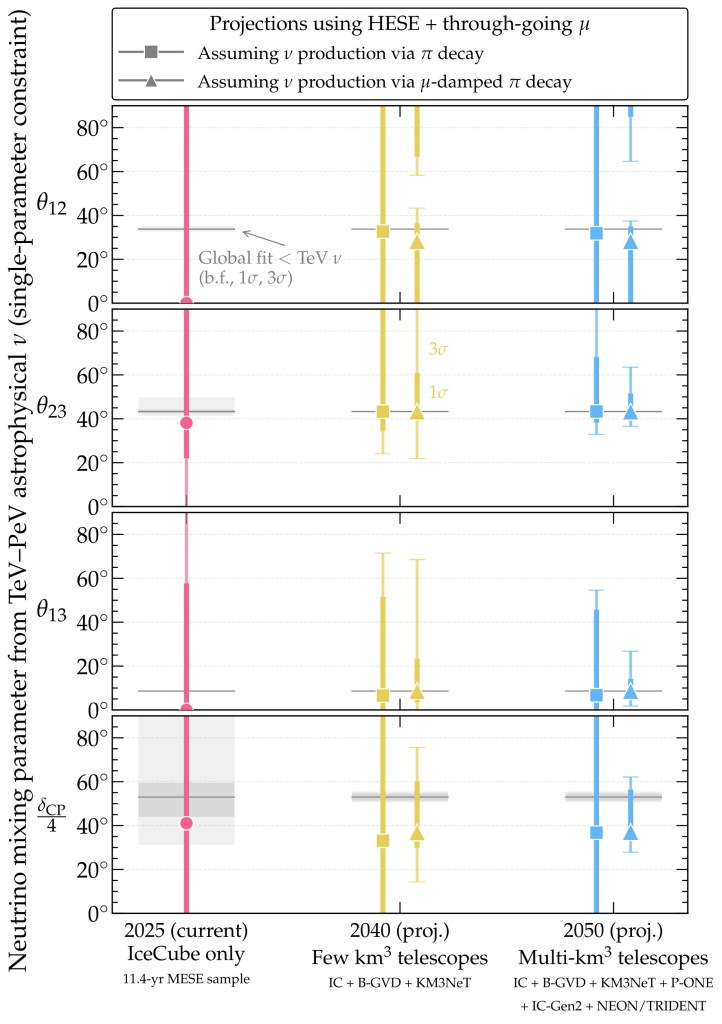
We extract present bounds on the mixing parameters from the 11.4-year IceCube Medium Energy Starting Events (MESE) sample, published in 2025. We find that the uncertainty in the measurement is too large to claim meaningful sensitivity to the mixing parameter.

For our projections, we use multi-neutrino-telescope combinations using projected detection rates at existing (IceCube, Baikal-GVD, KM3NeT) and future (P-ONE, IceCube-Gen2, NEON, TRIDENT, HUNT) neutrino telescopes. For these, we combine High Energy Starting Events (HESE) and through-going muons. Our projections show clear sensitivity to 𝛉23 and 𝛉13 (and, if neutrino production occurs via muon-damped pion decay, to δCP). This establishes benchmarks for the minimum size that new-physics modifications to the mixing parameters must have in order to be detectable.

Read more at:

Measuring neutrino mixing above 1 TeV with astrophysical neutrinos
Mauricio Bustamante, Qinrui Liu, Gabriela Barenboim
2602.14308 hep-ph

Testing Lorentz invariance with a flare of high-energy astrophysical neutrinos

Standard

Lorentz invariance is one of the pillars of modern physics, underlying special relativity—and, with that, the Standard Model—and general relativity. It posits that the laws of physics are the same for all observers moving in their own inertial frame. Yet, at high energies and short distances, Lorentz invariance may no longer hold.

To date, Lorentz invariance remains unbroken in all experimental tests. If it were violated, however, it could have many and varied consequences. Accordingly, there have been multiple searches for Lorentz invariance violation, using atom interferometry, gamma rays, cosmic rays, and neutrinos, etc. See, for instance, the data tables in 0801.0287.

High-energy astrophysical neutrinos, with TeV-PeV, are powerful probes of Lorentz invariance, thanks to their high energies and long traveled distances from their sources to Earth, of Mpc-Gpc scales. If Lorentz invariance is violated, it could imply that, en route to Earth, higher-energy neutrinos would travel more slowly than lower-energy neutrinos.

In a new paper, we introduce methods to look for these temporal distortions. We use the high-energy joint time and energy distribution of the neutrino flare detected by IceCube in 2014/2015 from the blazar TXS 0506+056 to look for specific signatures from Lorentz-invariance violation. We do this by borrowing non-parametric statistical methods previously used to look for signs of Lorentz-invariance violation in the gamma rays from gamma-ray bursts (1807.00189).

And, in doing so, we account for the significant energy and directional uncertainty associated to the detection of high-energy astrophysical neutrinos. Doing this makes our analysis realistic and robust, even if it erodes some of its sensitivity.

As a result, we set new lower limits on the energy scale of Lorentz-invariance violation in neutrino propagation. If Lorentz invariance is broken, this must happen at energies beyond 10^{14} GeV, if the effects depend linearly on the neutrino energy, or beyond 10^9 GeV, if they depend quadratically on it.

Read more at:

Probing Lorentz invariance with a high-energy neutrino flare
Mauricio Bustamante, John Ellis, Rostislav Konoplich, and Alexander S. Sakharov
2408.15949 astro-ph