Measuring neutrino mixing above 1 TeV with astrophysical neutrinos

Standard

Today, the values of the neutrino mixing angles that govern flavor transitions are known to percent precision (the Dirac CP-violation phase is known much more poorly). However, these values are inferred exclusively from sub-TeV neutrino experiments. No measurement of the mixing parameters exists at the TeV scale and above. There, new-physics effects whose intensity grows with neutrino energy could modify the effective neutrino mixing. High-energy astrophysical neutrinos, with TeV-PeV energies, are primed for such measurements.

In a new paper with Qinrui Liu and Gabriela Barenboim, we have assessed in detail the power in these neutrinos to test mixing above 1 TeV, today and in the future. Concretely, we have extracted values of the four neutrino mixing angles (𝛉12, 𝛉23, 𝛉13) and the CP-violation phase (δCP) from the flavor composition of high-energy astrophysical neutrinos, i.e., the proportion of electron, muon, and tau neutrinos in their diffuse flux.
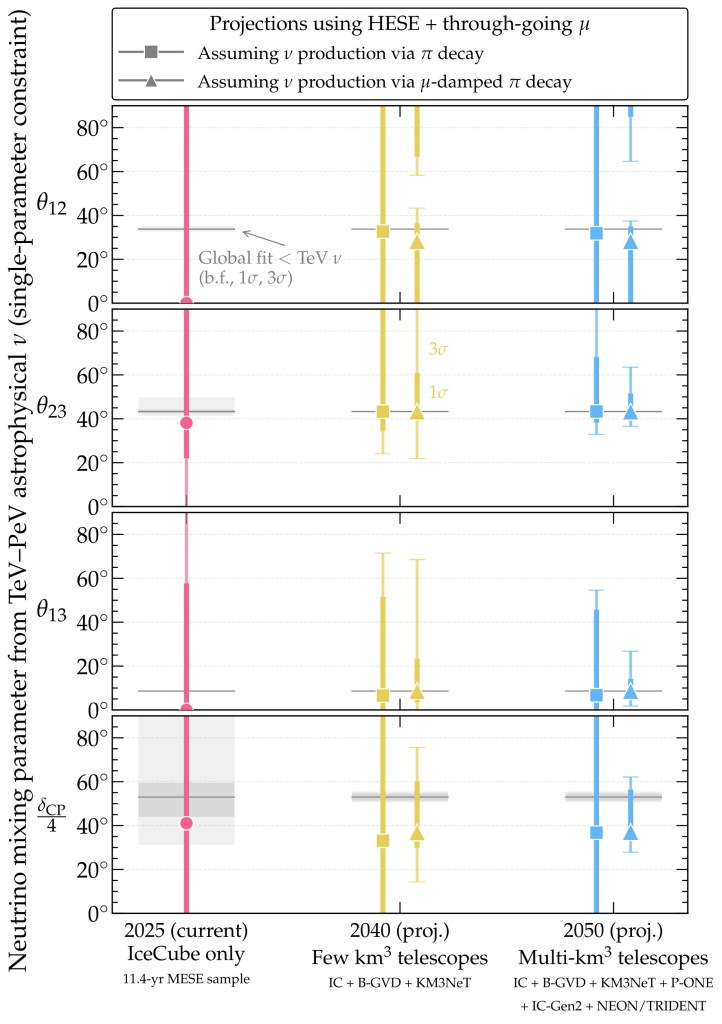
We extract present bounds on the mixing parameters from the 11.4-year IceCube Medium Energy Starting Events (MESE) sample, published in 2025. We find that the uncertainty in the measurement is too large to claim meaningful sensitivity to the mixing parameter.

For our projections, we use multi-neutrino-telescope combinations using projected detection rates at existing (IceCube, Baikal-GVD, KM3NeT) and future (P-ONE, IceCube-Gen2, NEON, TRIDENT, HUNT) neutrino telescopes. For these, we combine High Energy Starting Events (HESE) and through-going muons. Our projections show clear sensitivity to 𝛉23 and 𝛉13 (and, if neutrino production occurs via muon-damped pion decay, to δCP). This establishes benchmarks for the minimum size that new-physics modifications to the mixing parameters must have in order to be detectable.

Read more at:

Measuring neutrino mixing above 1 TeV with astrophysical neutrinos
Mauricio Bustamante, Qinrui Liu, Gabriela Barenboim
2602.14308 hep-ph

A plethora of long-range neutrino interactions probed by DUNE and T2HK

Standard

If there are new neutrino interactions with matter, and if they affect neutrinos of different flavor differently, then they could impact neutrino oscillations. Long-baseline neutrino experiments are well-suited to look for them, thanks to their use of intense, well-characterized neutrino beams.

If the new interactions have a long range—i.e., if they are mediated by a new, ultra-light mediator—then neutrinos on Earth may experience a matter potential sourced by the vast amount of faraway matter elsewhere inside the Earth, Moon, Sun, Milky Way, and in the cosmological matter distribution, as pointed out in 1808.02042 [Universe’s Worth of Electrons to Probe Long-Range Interactions of High-Energy Astrophysical Neutrinos, by MB & Sanjib Agarwalla, PRL 2019]. This boosts the chances of discovering the new interaction even if it is supremely feeble.

In a recent paper (2305.05184 [Flavor-dependent long-range neutrino interactions in DUNE & T2HK: alone they constrain, together they discover, by Masoom Singh, MB, and Sanjib Agarwalla, JHEP 2023]), we explored the prospects of constraining or discovering these new, long-range neutrino interactions in the upcoming long-baseline experiments DUNE and T2HK. We found promising prospects. However, we explored only three different possible forms of the interaction, introduced by gauging three of the accidental global lepton-number U(1) symmetries of the Standard Model.

In a new paper (2404.02775), led by PhD students Masoom Singh and Pragyanprasu Swain, we now extend this to many other symmetries—a plethora of them!—that introduce new neutrino interactions with electrons, neutrons, and protons. Each symmetry affects oscillations differently.

Our new results cement and extend our original findings: DUNE and T2HK should be able to probe the existence of new interactions—and possibly discover and distinguish between alternatives—regardless of which symmetry is responsible for inducing them. The reach of DUNE and T2HK to probe new neutrino interactions is not only deep, but also broad!

Read more at

A plethora of long-range neutrino interactions probed by DUNE and T2HK
Sanjib Kumar Agarwalla, Mauricio Bustamante, Masoom Singh, Pragyanprasu Swain
2404.02775 hep-ph

Download the digitized data from out plots from this GitHub repository.