
In the Standard Model, neutrinos are effectively stable, their lifetimes orders of magnitude longer than the age of the Universe. In proposed extensions of the Standard Model, however, neutrinos might decay faster, and so observing them decay would constitute evidence of new neutrino physics.
Regardless, neutrino lifetimes, even augmented by new physics, are likely very long, and the effects of decay are likely manifest only in neutrinos that travel a long distance, during which the chances of them decaying becomes appreciable even if they are long-lived.
In a new paper, we have searched for signs of neutrino decay using the neutrinos from farthest away: the high-energy astrophysical neutrinos detected by IceCube, which travel cosmological-scale distances of Mpc-Gpc from their sources to Earth. Neutrino decay, in principle, alters the shape of the neutrino energy spectrum—introducing a step-like jump—and the flavor composition of the neutrinos upon reaching Earth—taking it outside the region expected from standard oscillations alone.
We find no signs of decay in present-day IceCube data, but place new, competitive lower limits on the lifetimes of the nu_2 and nu_3 neutrino mass eigenstates. We report, for the first time, limits inferred using the neutrinos from the first candidate steady-state astrophysical source of high-energy neutrinos, the active galaxy NGC 1068, and limits inferred from the diffuse flux of high-energy neutrinos.
These are arguably the most robust neutrino lifetime bounds garnered from high-energy astrophysical neutrinos so far! In addition, we make forecasts for the year 2035, combining multiple upcoming neutrino telescopes.
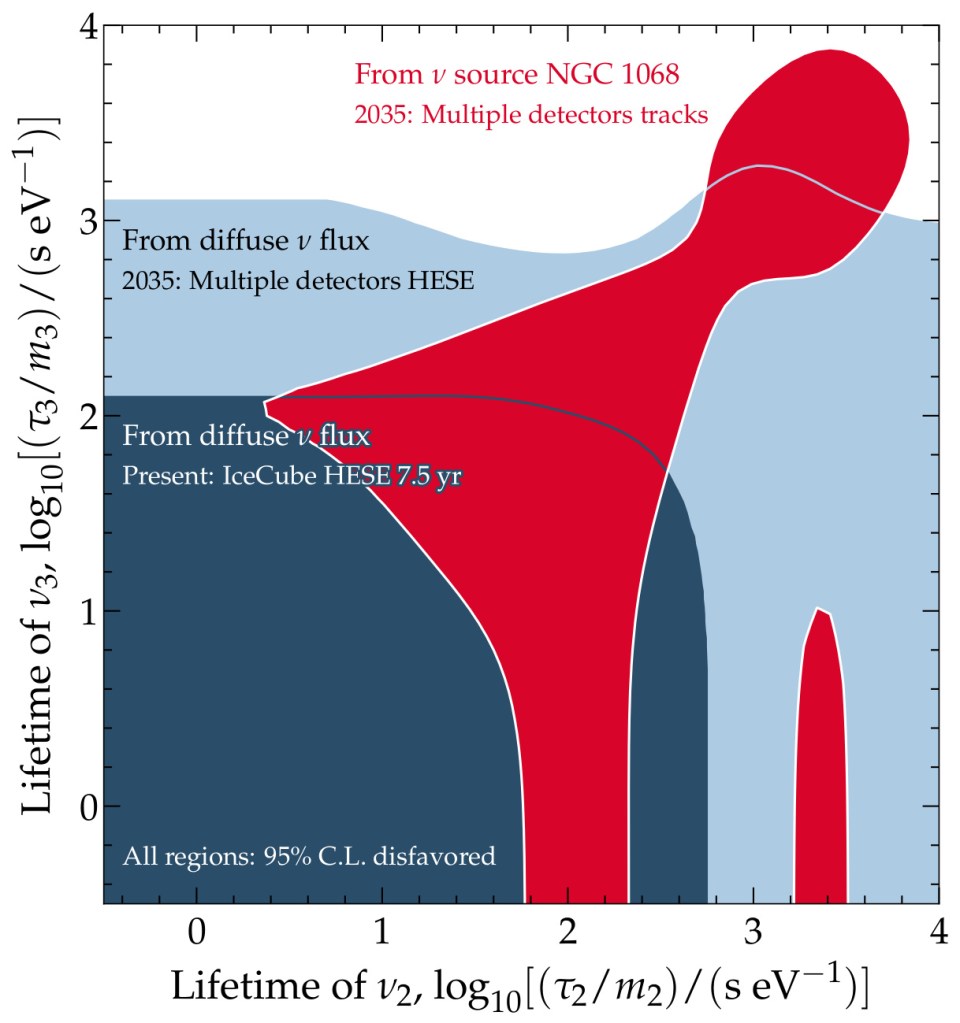
While similar studies have been performed before, ours brings two new perspectives, often overlooked or understudied, that make our results robust.
First, we consider broadly the large astrophysical uncertainties that plague the prediction of the flux of high-energy astrophysical neutrinos. This includes the size and shape of the neutrino energy spectrum, the flavor composition of the neutrino flux, the number or source populations and their distribution in redshift, and whether we have prior constraints on the size of the neutrino flux normalization. The impact of considering these uncertainties ranges from appreciable to critical. In some cases, they nearly make the sensitivity to neutrino decay vanish! Surprisingly, with present data, it is not possible to constrain neutrino decay using neutrinos from NGC 1068 due to the astrophysical unknowns!
Second, we model in detail the detection of neutrinos in IceCube and other neutrino telescopes. Their limited resolution to measure the energy, direction, and flavor of detected neutrinos blurs potential signs of neutrino decay in the flux of high-energy astrophysical neutrinos. We model experimental nuance using either tools provided publicly by the IceCube Collaboration (for the diffuse flux, using High Energy Starting Events), or using the PLEnuM (for the flux from NGC 1068, using tracks).
Read more at:
New limits on neutrino decay from high-energy astrophysical neutrinos
Victor B. Valera, Damiano F. G. Fiorillo, Ivan Esteban, Mauricio Bustamante
2405.14826 astro-ph

Download our digitized two-dimensional lifetime limits from this GitHub repository.

 Mauricio Bustamante