What twelve years of daily arXiv picks say about my reading

Standard

How has what I read changed over twelve years?

Since February 2014, I have kept a daily list of the arXiv preprints that I find interesting. Since October 2017, the list has been public on this site as My daily arXiv picks. I recently gathered all of it, 18,169 papers, into one table and looked at what it says. Here are the highlights.

I pick three times as many papers. In 2014 I picked 704 papers. In 2025 I picked 2,166, and 2026 is at 1,910 so far. I have also become much stingier with two stars, which I use for papers that are very relevant to my own work: they made up a quarter of my picks in 2014–2017, and about 2% since 2019.
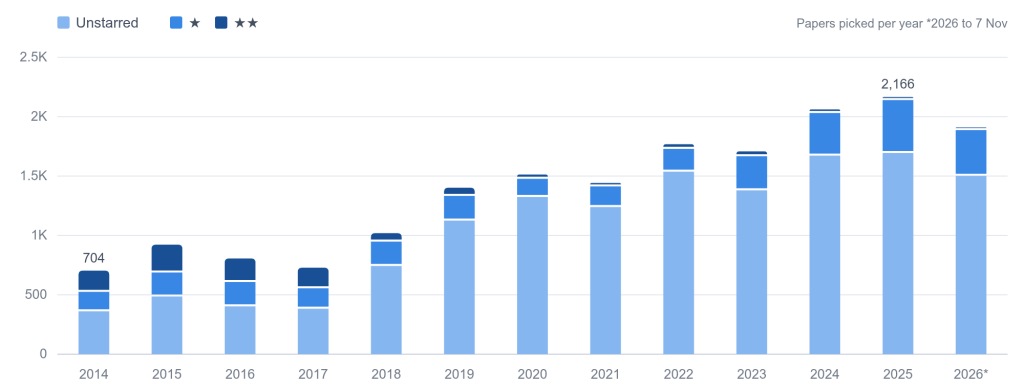
Stacked bar chart of the number of arXiv papers picked per year from 2014 to 2026, split into unstarred, one-star and two-star picks.
Papers I picked each year, split by star level. One star marks a paper I found especially interesting; two stars, one that is very relevant to my own work. 2026 runs to November 7.

From astro-ph towards hep-ph. In 2014, 62% of my picks were listed in astro-ph and 16% in hep-ph. In 2026, the split is 44% and 39%. Most of the shift happened between 2017 and 2021.
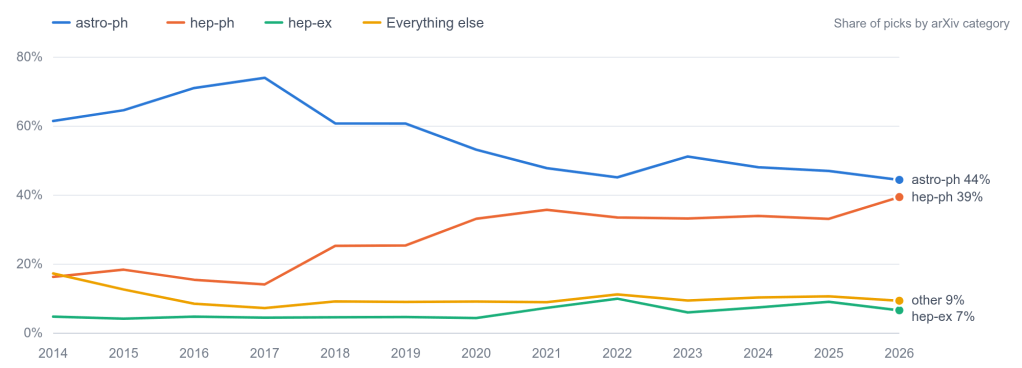
Line chart of the share of picks in astro-ph, hep-ph, hep-ex and other arXiv categories from 2014 to 2026.
Share of my picks in each arXiv category, by year.

What I read and what I star have drifted apart. To compare topics fairly across years, I compared how often I star papers on a topic with how often I star papers overall in the same years. The topics I star most often are all about high-energy neutrinos: the 220-PeV KM3NeT event KM3-230213A (3.3 times my average star rate), the Glashow resonance (3.0), NGC 1068 and Seyfert galaxies (2.8), and high-energy astrophysical neutrinos in general (2.3).

Dark matter, on the other hand, is the single largest topic I pick: 3,094 papers, about a fifth of my picks in recent years. Yet I star it at only 0.8 times my average rate. Axions grew from under 1% of my picks to about 5%, and machine learning from almost nothing to 4% in 2026, but I rarely star either. Gamma-ray bursts went the other way, from about 11% of my picks in 2014–2017 to 2% in 2025–2026.
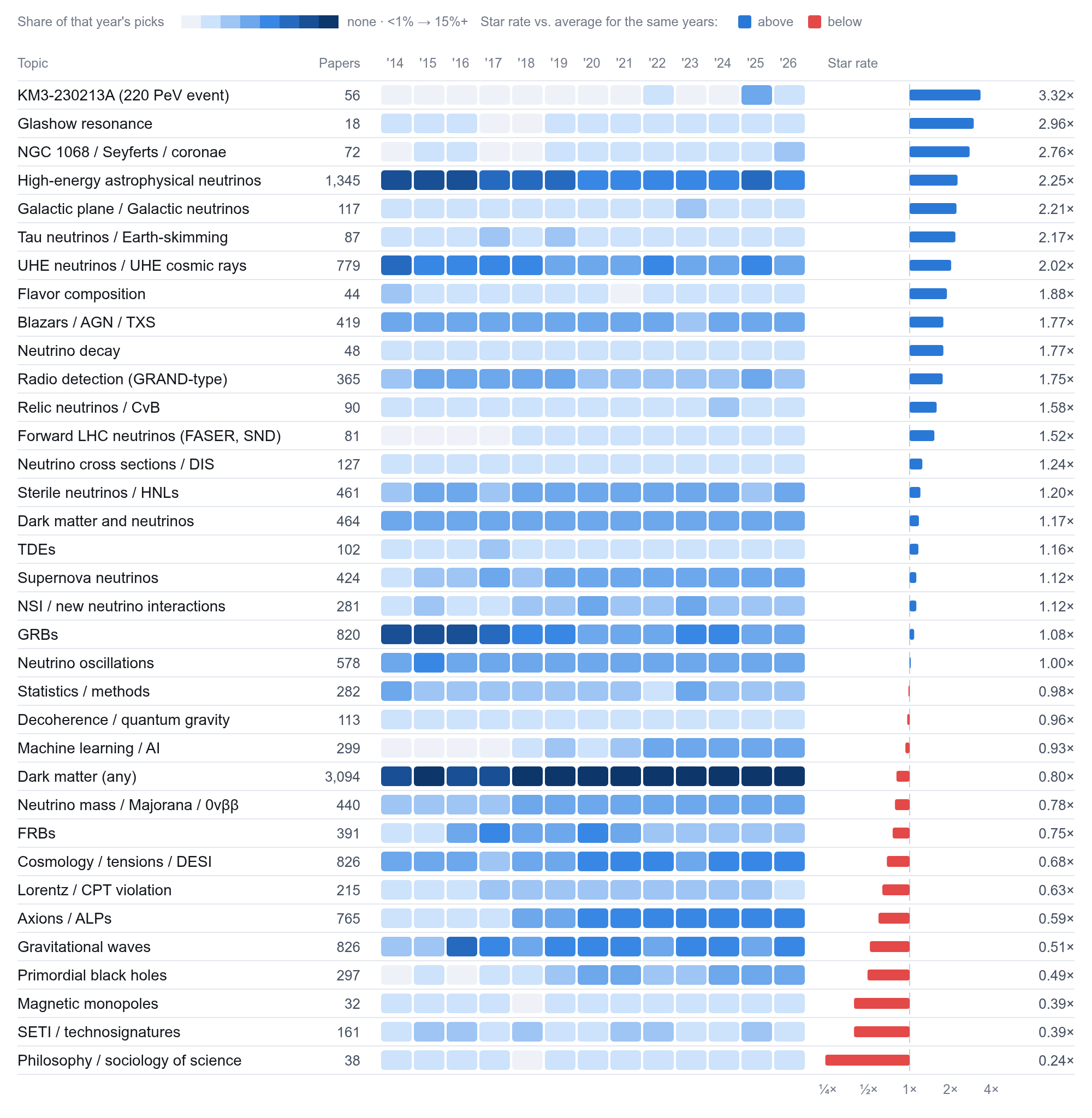
Table of 34 topics showing each topic’s share of picks per year as colored cells, and how often papers on each topic are starred relative to the average.
Each row is a topic, assigned by keywords in paper titles. The colored cells show the share of each year’s picks on that topic. The bars show how often I star papers on that topic compared with my average for the same years. Click to enlarge.

Explore the list. I put all 18,169 picks in a searchable page. You can search by title, author, or arXiv identifier, and filter by stars, year, arXiv category, or topic.

A few caveats: topics are assigned by keyword matches on paper titles, so they are approximate, and years come from arXiv identifiers.

I put together the analysis and the searchable page with the help of Claude.

2026 April Fools’ Day papers

Standard

This year’s April Fools’ Day arXiv paper haul was possibly the biggest one I have seen so far (as always, they are marked with a special symbol around April 1st on my daily arXiv picks). Thanks to John Beacom for pointing 2603.29912, which I missed on my first pass.

379710-200 Predictions of the LSST Solar System (non-)Yield
Joseph Murtagh, Ian Chow
2604.00206 astro-ph

379710-200 Pegasi Ascendant: Ranking Constellation Genitives on their Aesthetic Merit
Pranav Nagarajan
2604.00144 astro-ph

379710-200 Your Outie Is a Wonderful Astronomer: Macrodata Refinement of the Astro-ph ArXiv Feed at Phermon Industries
Yuan-Sen Ting
2603.29771 astro-ph

379710-200 On The Detection of Digiorno-like Objects in the Flavor Zone
Logan A. Pearce, Sue D’Oh Nym
2603.28977 astro-ph

379710-200 New Paradigms in Pasta: Introducing 𝙶𝙵 𝚙𝚊𝚜𝚝𝚊𝚖𝚊𝚛𝚔𝚎𝚛𝚜 for Enhanced Inclusivity and Productivity
Julian Falcone, Nabanita Das
2603.28957 astro-ph

379710-200 What does the Universe sound like?
Francesco Iacovelli
2603.29996 gr-qc

379710-200 Mexican Burrowing Toads as gravitational wave detectors
Frederic V. Hessman, Christian Jooss
2603.29334 gr-qc

379710-200 Galactic Constellations in DESI DR1 and the Scales of Cosmological Homogeneity
Claire Lamman
2603.29912 astro-ph

379710-200 AI Cosplaying as Astrophysicists: A Controlled Synthetic-Agent Study of AI-Assisted Astrophysical Research Workflows
Chun Huang
2603.29039 astro-ph

379710-200 An innovative alternative to traditional funding streams for extragalactic astronomy
Stephen M. Wilkins, Jack Turner, Connor Sant Fournier, Behnood Bandi, Aswin Vijayan
2603.29340 astro-ph

379710-200 Declarative bespoke modelling: A new approach
DBM Collaboration: David Komanek, Vaclav Pavlík, Santiago Jimenez, Rhys Taylor
2603.28847 astro-ph

379710-200 Schrödinger’s Seed: Purr-fect Initialization for an Impurr-fect Universe
Mi chen, Renhao Ye
2603.29115 astro-ph

379710-200 A Lower Bound on the Number of Fundamental Constants
William Luke Matthewson
2603.29300 astro-ph

379710-200 CROCS Data Release I: Constraints on the Hubble Constant
Luke Weisenbach et al.
2603.29879 astro-ph

379710-200 First Detection of Exoplanetary Cannabinoids: Evidence for THC and CBD in the Atmosphere of K2-18b
Amie J. Chism et al.
2603.29700 astro-ph

379710-200 The Universe Favors Primes: A Study in the Primality of Cosmic Structures
Nan Li, Shiyin Shen
2603.29321 astro-ph

379710-200 Do Papers with Titles Ending in a Question Mark Usually Have the Answer “No”?
Daniel Stern, Brian Grefenstette
2603.29936 astro-ph

379710-200 No hair but plenty of feathers: are birds black holes?
Andrew Laeuger, Taylor Knapp
2603.29064 gr-qc

379710-200 New Constraints on the M Dwarf Cosmic Shoreline from a Galaxy Far, Far Away
Michael Radica
2603.29743 astro-ph

379710-200 Cloudy With a Chance of Meatballs
Wolf Cukier, Dominic Samra, Vighnesh Nagpal, Diana Powell, Maria Steinrueck, Christopher Wirth
2603.29883 astro-ph

379710-200 Milky Way evolution on a human timescale
Eugene, Neige
2603.29503 astro-ph

379710-200 The Hollyfeld Gambit in Astrophysics
Benne Holwerda
2603.29964 astro-ph

379710-200 StarHash: unique, memorable, and deterministic names for astronomical objects
T. L. Killestein
2603.29584 astro-ph

379710-200 A Therapy Session with Sgr A*
Mayura Balakrishnan, Robert Frazier, Joseph Michail
2603.29963 astro-ph

379710-200 Enabling fundamental understanding of Nature with novel binning methods for 2D histograms
Igor Vaiman
2603.30006 astro-ph

379710-200 Antimatter Propulsion for Interstellar Travel via Positron Production from Potassium-40 Rich Biological Matter
C. Hall, L. N. H. P. Hall
2603.29635 astro-ph

379710-200 Cow-culation: Reentry Impact Risk to Livestock in the Satellite Megaconstellation Era
Samantha M. Lawler, Michele T. Bannister, Laura E. Revell
2603.29324 astro-ph

379710-200 Lots of Shade on Satellite Constellations
Michael B. Lund
2603.29212 physics

379710-200 Where to Search For Life: Evidence from narrative sources with established predictive efficacy
Elizabeth R Stanway
2603.28883 astro-ph

379710-200 Plan 9: Detecting Atmospheric Deterrence Against Interstellar Monsters
David R. Rice, Michael J. Radke
2603.28895 astro-ph

379710-200 Sugar Rush: Improving Observing Productivity via Night Dessert
J.J. Charfman Jr, S. Hyman, N.T.S
2603.28915 astro-ph