
Genuine high-energy neutrino astronomy needs many and varied astrophysical sources. But finding sources is hard, especially having only one km-scale neutrino telescope in operation. This is changing fast, though, thanks to the ongoing construction of KM3NeT and Baikal-GVD, but transformative progress will require us to think globally.
In a new paper, led by Lisa Schumacher, we show that, in the next 10-20 years, IceCube + Baikal-GVD, KM3NeT, IceCube-Gen2, P-ONE, TRIDENT, NEON, & HUNT, taken together in PLEnuM, could allow us to make global high-energy neutrino monitoring a reality. Together, they will increase the global rate of neutrino detection by up to 30 times and continuously monitor the entire sky.
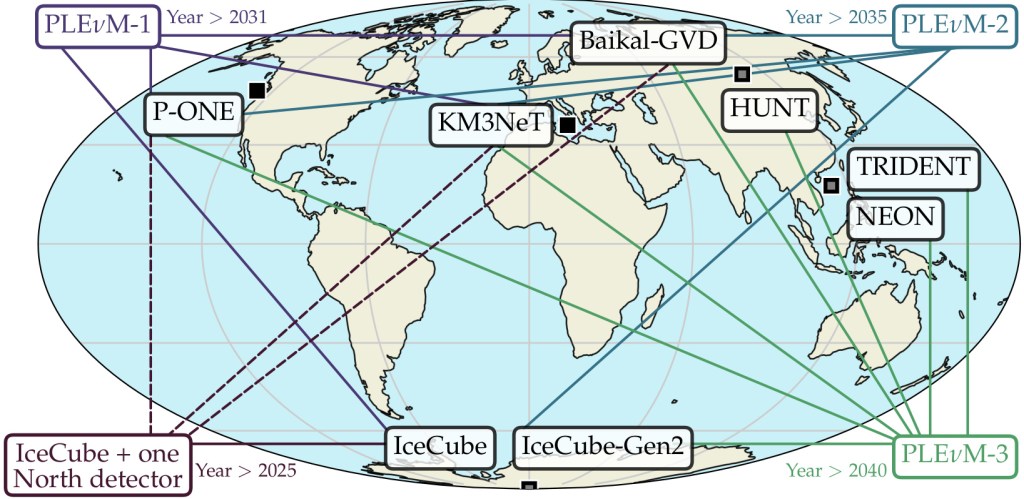
To showcase this, we focus on one of the most prominent science cases in high-energy neutrino astronomy: finding steady-state sources. A combined analysis of global data will expedite source discovery—in some cases, by decades—and enable the detection of fainter sources anywhere in the sky, discovering up to tens of new neutrino sources.
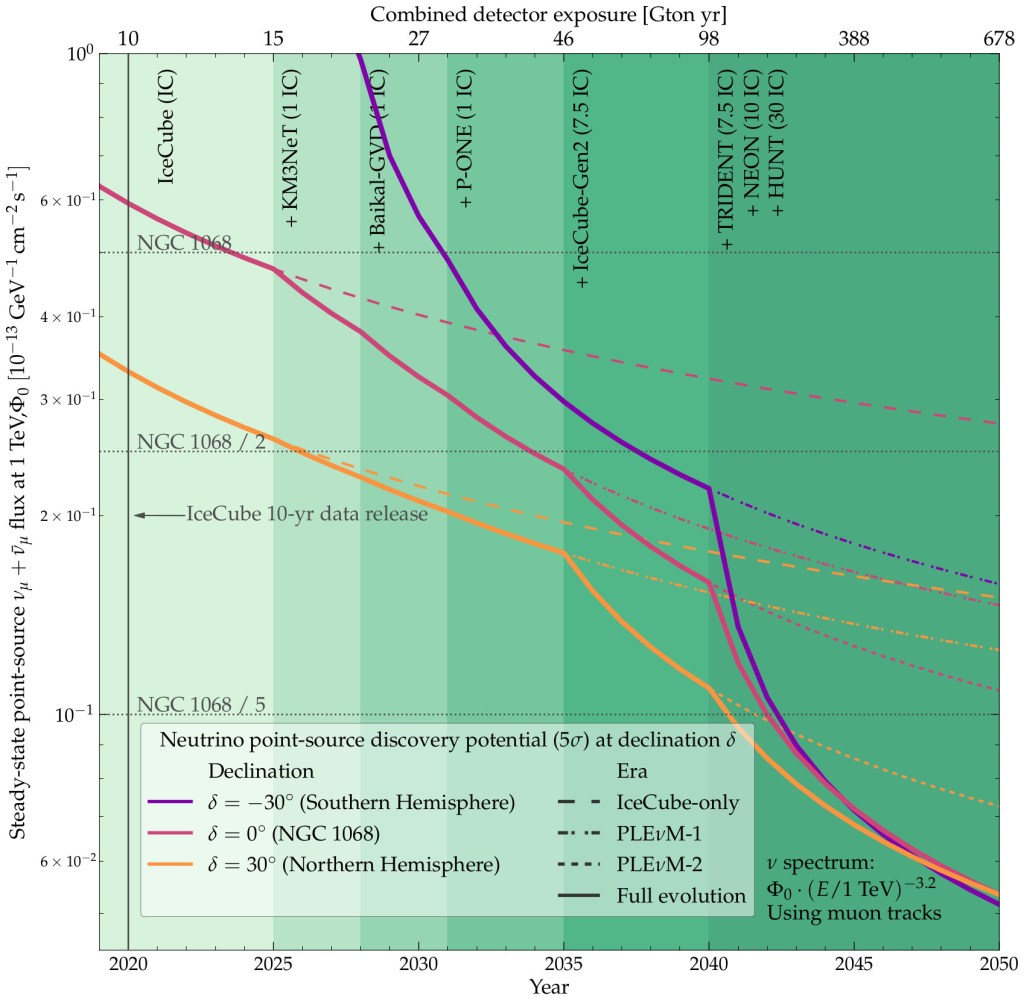
This is seen, for example, in our forecasts for the evolution of the discovery potential of neutrino sources that have a soft spectrum (like NGC 1068), placed in different locations in the sky:
The PLEnuM tools used to obtain the results in our paper (plus more) are open-source and available on GitHub, here.
Read more at:
Beyond first light: global monitoring for high-energy neutrino astronomy
Lisa Johanna Schumacher, Mauricio Bustamante, Matteo Agostini, Foteini Oikonomou, Elisa Resconi
2503.07549 astro-ph
 Mauricio Bustamante