
Can the flavors of the Milky Way’s high-energy neutrinos tell us how they are made?
In 2023, IceCube found evidence of high-energy neutrinos coming from the plane of the Milky Way (I wrote about this finding in Nature Reviews Physics). It has since confirmed their detection and measured how bright different stretches of the plane are in neutrinos. Their origin is still debated. They may be made when cosmic rays, protons and nuclei with very high energies, hit the gas between the stars, or they may come from sources too faint to be seen one by one.
Neutrinos come in three flavors: electron, muon, and tau. How the neutrinos are made determines the share of each flavor, their flavor composition. Cosmic rays that hit gas make pions, short-lived particles whose decays, through muons, yield one electron neutrino for every two muon neutrinos and no tau neutrinos. Other processes give other mixes. Decaying neutrons make only electron antineutrinos. In magnetic fields strong enough that the muons lose their energy before they decay, only muon neutrinos keep high energies. The flavor composition of the Milky Way’s neutrinos has never been measured.
In a new paper, I forecast how well neutrino telescopes can measure this composition. Deep in ice or water, these telescopes see muon neutrinos mostly as long tracks of light, and electron and tau neutrinos as compact showers. The inner Galaxy lies mostly in the southern sky. IceCube, at the South Pole, sees it almost only in showers, while KM3NeT, under the Mediterranean Sea, sees it in tracks. Together, they see all three flavors. I combine them (à la PLEnuM) with six more telescopes, running, being built, or planned: Baikal-GVD, P-ONE, TRIDENT, NEON, HUNT, and IceCube-Gen2.
With IceCube’s 15 years of data and 10 years of KM3NeT at full size, the two could start to tell the inner Galaxy’s flavor composition apart from the one that decaying neutrons would give. With 10 years of each of the other six telescopes, all eight would measure the share of electron neutrinos made in the inner Galaxy to within 27%. That is enough to tell pion decays apart from both decaying neutrons and production in strong magnetic fields.
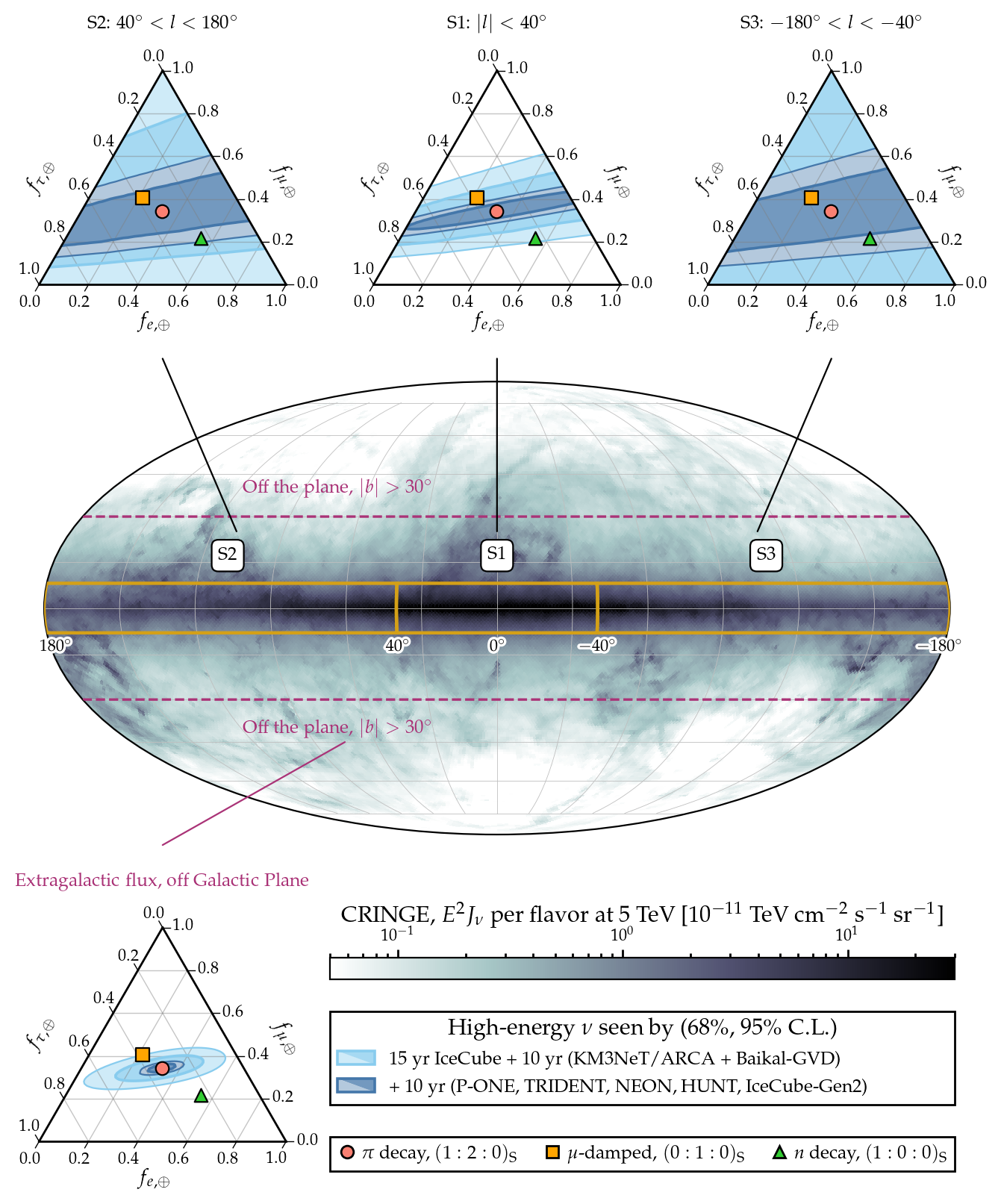
Once measured, the Milky Way’s composition would also become a reference for the high-energy neutrinos from beyond it, whose flavor composition IceCube has measured only imprecisely. The two compositions differ only if the neutrinos are made, or travel, differently. A difference could reveal strong magnetic fields in distant sources, or neutrinos that decay over the billions of light-years that those neutrinos travel, but not over the far shorter distances inside the Milky Way.
Read more at:
Measuring the flavor composition of high-energy neutrinos from the Milky Way
Mauricio Bustamante
2611.34797 astro-ph.HE

