Invisibles School 2023: Lectures on multi-messenger astrophysics

Standard

During August 21-26, I delivered four lectures on multi-messenger astrophysics at the 2023 Invisibles School in Bad Honnef, Germany.

The three sets of lecture slides are here:

Slides I (pdf): Introduction and ultra-high-energy cosmic rays

Slides II (pdf): High-energy cosmic neutrinos: introduction and astrophysical aspects

Slides III (pdf): High-energy cosmic neutrinos: particle-physics aspects

Joint measurement of the ultra-high-energy neutrino spectrum and cross section

Standard

Soon (fingers crossed), new neutrino telescopes might be able to discover ultra-high-energy (UHE) neutrinos, with energies above 100 PeV. Two unknown quantities that will be targeted are the UHE neutrino flux and the UHE neutrino-nucleon cross section. Their measurement is co-dependent: the number of neutrino-initiated events detected will depend on their product.

Yet, typically, when forecasting one, important assumptions are made about the other, either on their size, their dependence on neutrino energy, or both (for recent work, see, e.g., 2007.10334, 2204.04237, 2205.09763, 2210.03756). This may have cast existing forecasts in too optimistic a light and downplayed the real capabilities of UHE neutrino telescopes to deliver measurements unhampered by the above assumptions.

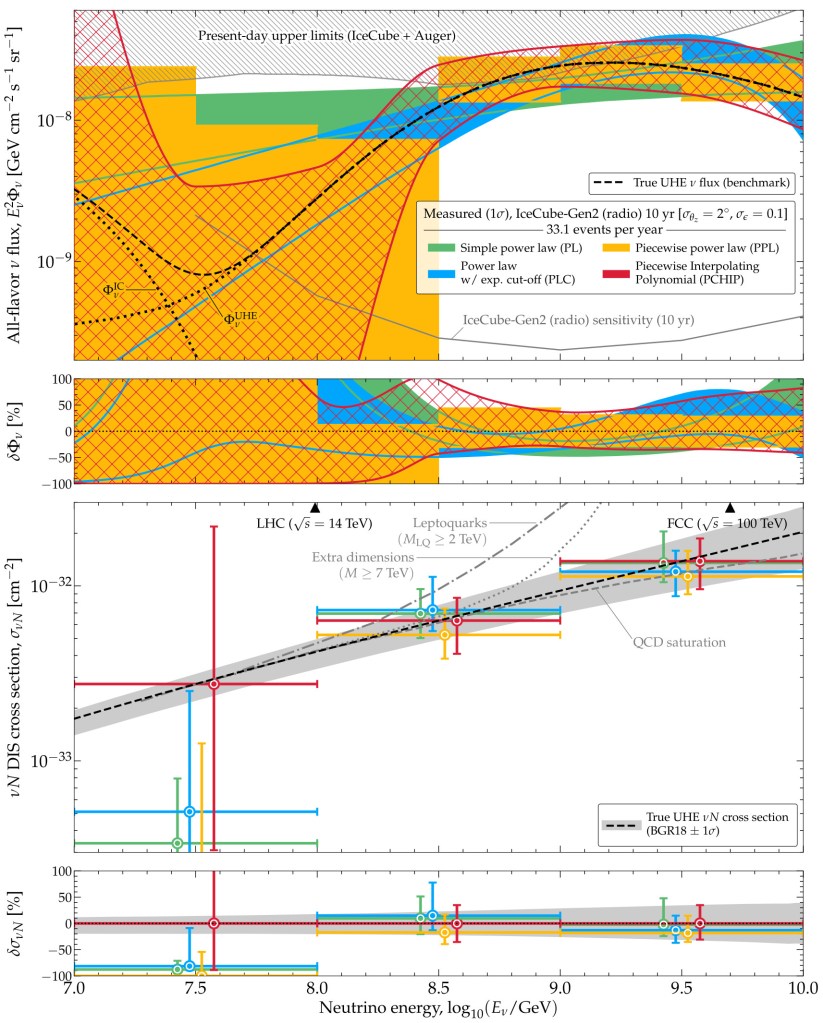
In a new paper led by Víctor Valera and co-authored by Olga Mena and I, we have shown that upcoming UHE neutrinos telescopes should be able to jointly measure the UHE neutrino spectrum and cross section, including its energy dependence, without assuming prior knowledge of either:

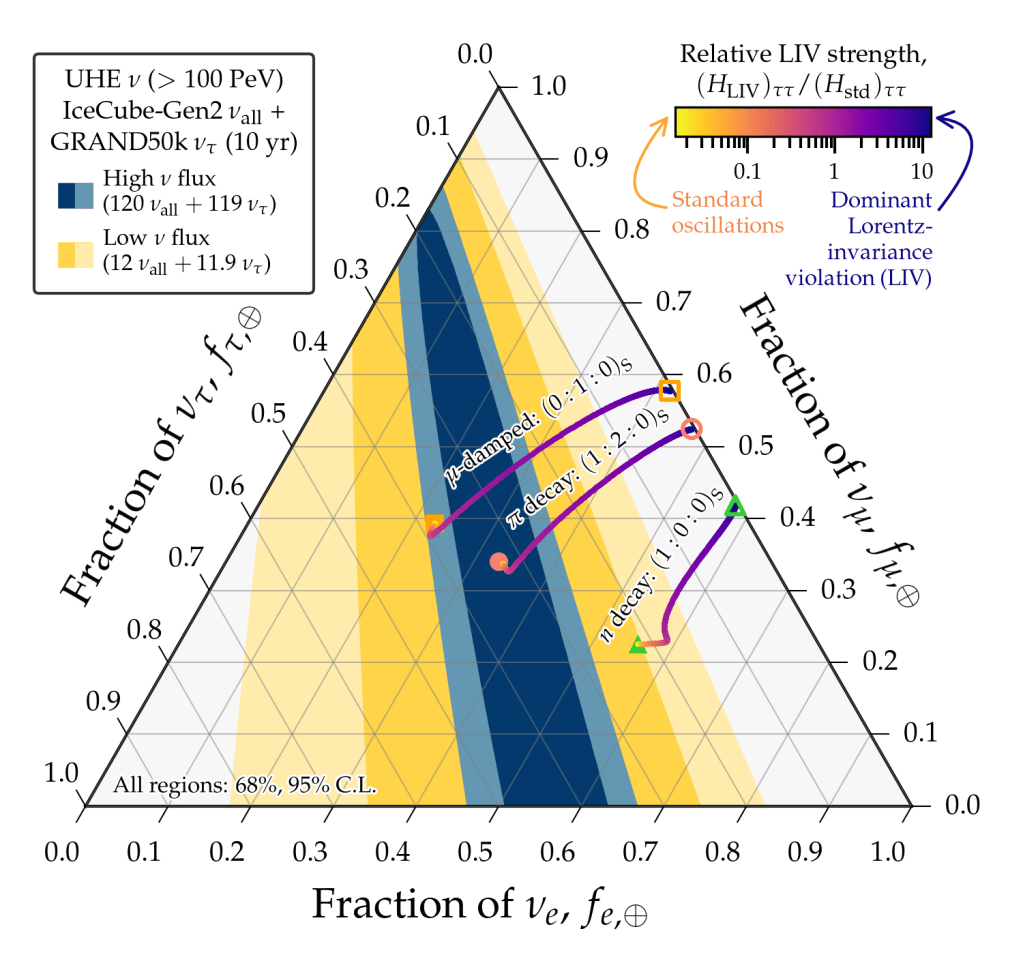
We gear our forecasts to the radio-detection of UHE neutrinos in the radio array of IceCube-Gen2. We test different prescriptions, and recommend using flexible parametrizations of the neutrino spectrum—not a power law—that are able to capture its features. We find loose targets for the detector energy and angular resolution that are compatible with present-day design considerations, about 10% per decade in shower energy and about 2° in zenith angle.

Read more at

Joint measurement of the ultra-high-energy neutrino spectrum and cross section
Victor B. Valera, Mauricio Bustamante, Olga Mena
2308.07709 astro-ph

Dark matter decay into ultra-high-energy neutrinos

Standard

One way to probe dark matter is to find whether it decays into neutrinos. Heavy dark matter, with a mass larger than 10^7 GeV, might decay into ultra-high-energy neutrinos, with energies larger than 10^7 GeV. In the next 10-20 years, a new generation of ultra-high-energy neutrino telescopes, like IceCube-Gen2, should be able to look for these neutrinos.

However, ultra-high-energy neutrinos not made in dark matter decay represent an unknown background to these dark-matter searches. These are the cosmogenic and astrophysical ultra-high-energy neutrinos, first predicted by Berezinsky in 1969, that we have been looking for for the the last 50+ years.

Essentially, while neutrinos from dark matter are concentrated in directions near the Galactic Center—where dark matter is more abundant—the flux of non-dark-matter neutrinos is isotropic. If that flux is high, it could obscure the signal of neutrinos from dark-matter decay.

In a recent paper led by Damiano Fiorillo, and co-authored by Víctor Valera and Walter Winter, we show that future searches for ultra-high-energy neutrinos should be able to survive the existence of even a medium-sized background of cosmogenic or astrophysical neutrinos, even if that background is not known a priori.

Discovery of heavy dark matter decay into ultra-high-energy neutrinos, or constraints on it, are relatively safe from backgrounds:

Read more at

Searches for dark matter decay with ultra-high-energy neutrinos endure backgrounds
Damiano F. G. Fiorillo, Victor Valera, Mauricio Bustamante, Walter Winter
2307.02538 astro-ph

Flavor-dependent long-range neutrino interactions

Standard

A few years ago, Sanjib Agarwalla and I published a paper on looking for new, flavor dependent, long-range neutrino-electron interactions that could affect neutrino oscillations. The new interactions are introduced by gauging lepton-number symmetries Le-Lmu and Le-Ltau. They are mediated by new neutral vector bosons, Z’. Because we considered them to be ultra-light, with masses below 10^{-10} eV, the interaction range is ultra-long. This allowed us to use the large collections of electrons in the local and distant Universe — the Earth, Moon, Sun, Milky Way, and cosmological electrons — as sources of the new matter potential, and the measurement of the flavor composition of high-energy astrophysical neutrinos as IceCube as the observable:

Universe’s Worth of Electrons to Probe Long-Range Interactions of High-Energy Astrophysical Neutrinos
Mauricio Bustamante, Sanjib Kumar Agarwalla
Phys. Rev. Lett. 6, 061103 (2019) [1808.02042]

This week we uploaded to the arXiv two follow-up works, in collaboration with Sanjib’s students Masoom and Sudipta and postdoc Ashish:

Present and future constraints on flavor-dependent long-range interactions of high-energy astrophysical neutrinos
Sanjib Kumar Agarwalla, Mauricio Bustamante, Sudipta Das, Ashish Narang
arXiv:2305.03675

Flavor-dependent long-range neutrino interactions in DUNE & T2HK: alone they constrain, together they discover
Masoom Singh, Mauricio Bustamante, Sanjib Kumar Agarwalla
arXiv:2305.05184

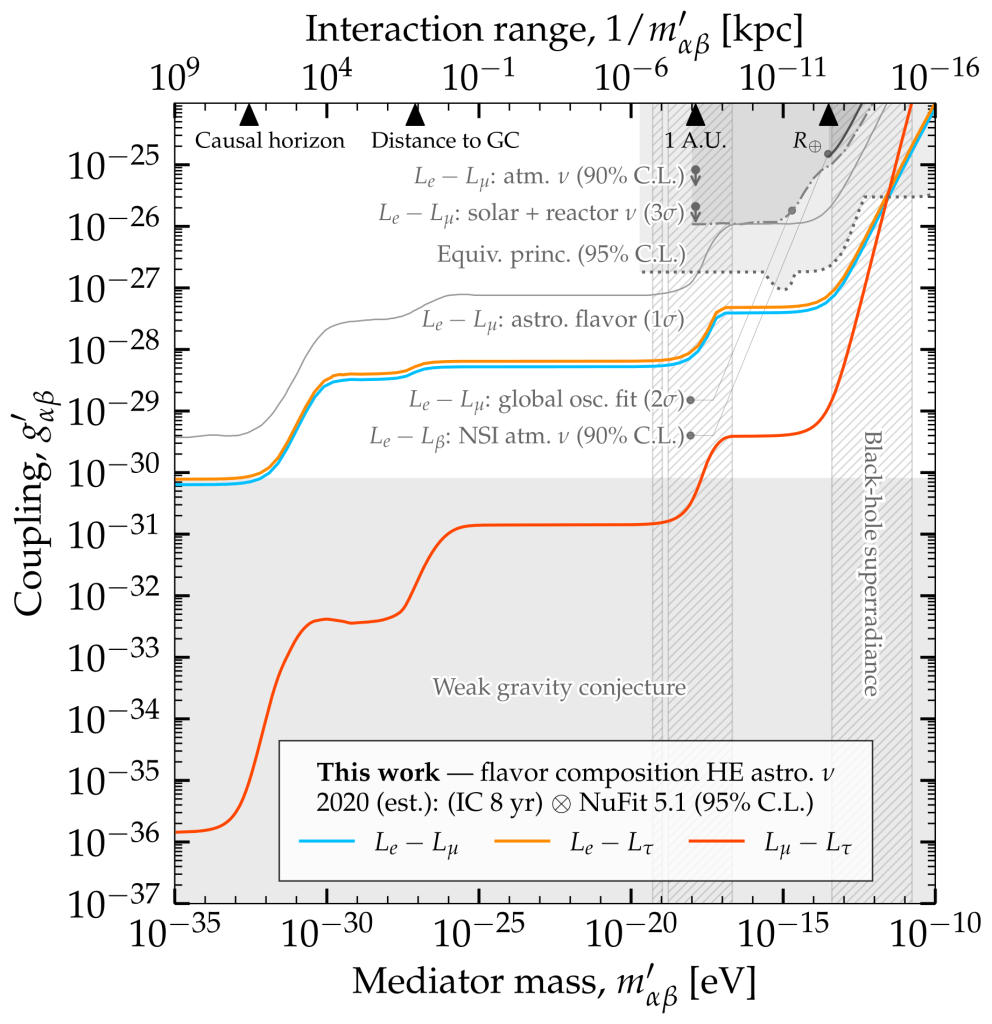
In the first paper, we revisit, revamp, and extend the analysis that we did in 2018, using the flavor composition of high-energy astrophysical neutrinos. There two main improvements. First, we now use a Bayesian statistical analysis, which allows us to claim constraints at higher significance than in the original paper. It also allows us to consistently treat the uncertainties in neutrino mixing parameters and in the measurement of the flavor composition. Second, we now consider also new neutrino-neutron interactions, introduced by gauging Lmu-Ltau. The constraints that we get on the coupling strength are these:

From the abstract: We find that, already today, the IceCube neutrino telescope demonstrates potential to constrain flavor-dependent long-range interactions significantly better than existing constraints, motivating further analysis. 

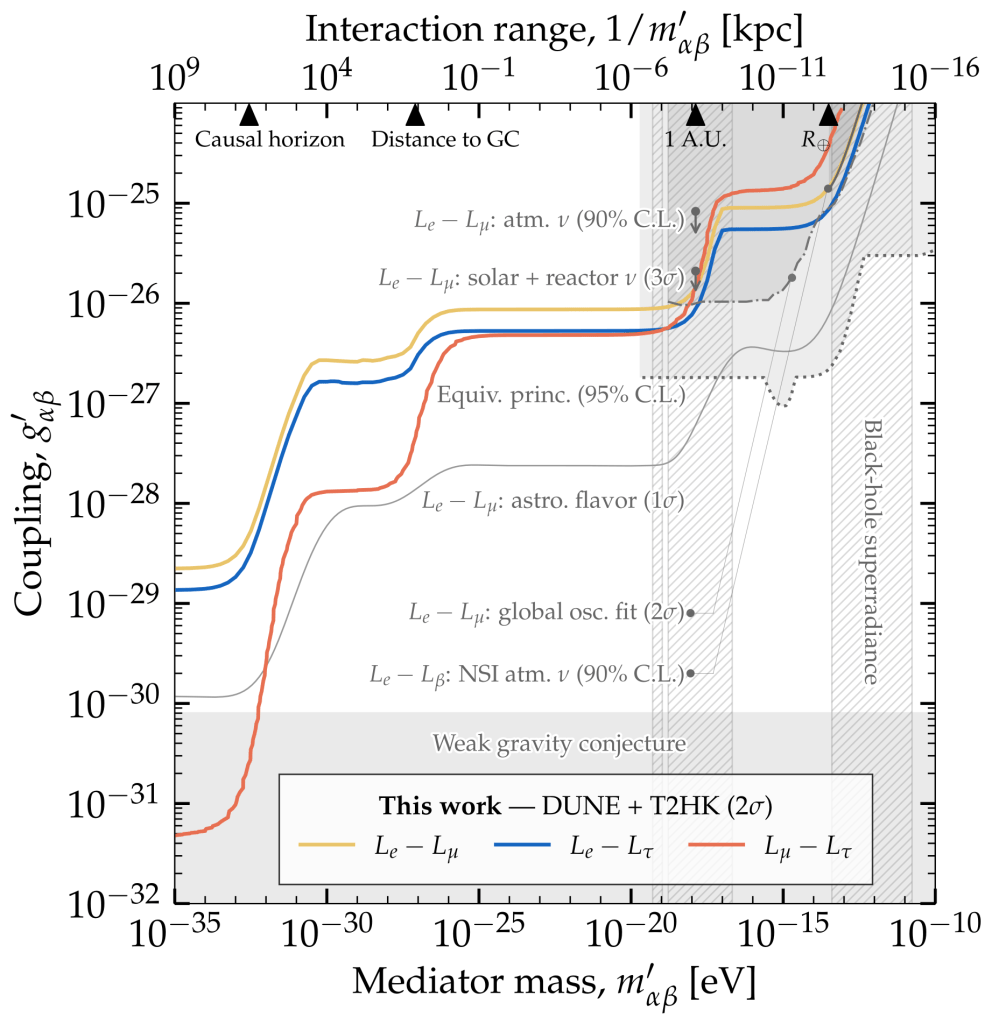
In the second paper, we study the same problem, but now using next-generation long-baseline neutrino experiments DUNE and T2HK. The neutrino energies are much lower, MeV-GeV compared to the TeV-PeV of astrophysical neutrinos. However, the event rates are enormous, and that makes DUNE and T2HK sensitive to even subtle modifications of the oscillation probabilities. In this case, the constraints are these:

From the abstract: Alone, DUNE and T2HK may strongly constrain long-range interactions, setting new limits on their coupling strength for mediators lighter than 10^{−18} eV. However, if the new interactions are subdominant, then both DUNE and T2HK, together, will be needed to discover them, since their combination lifts parameter degeneracies that weaken their individual sensitivity.

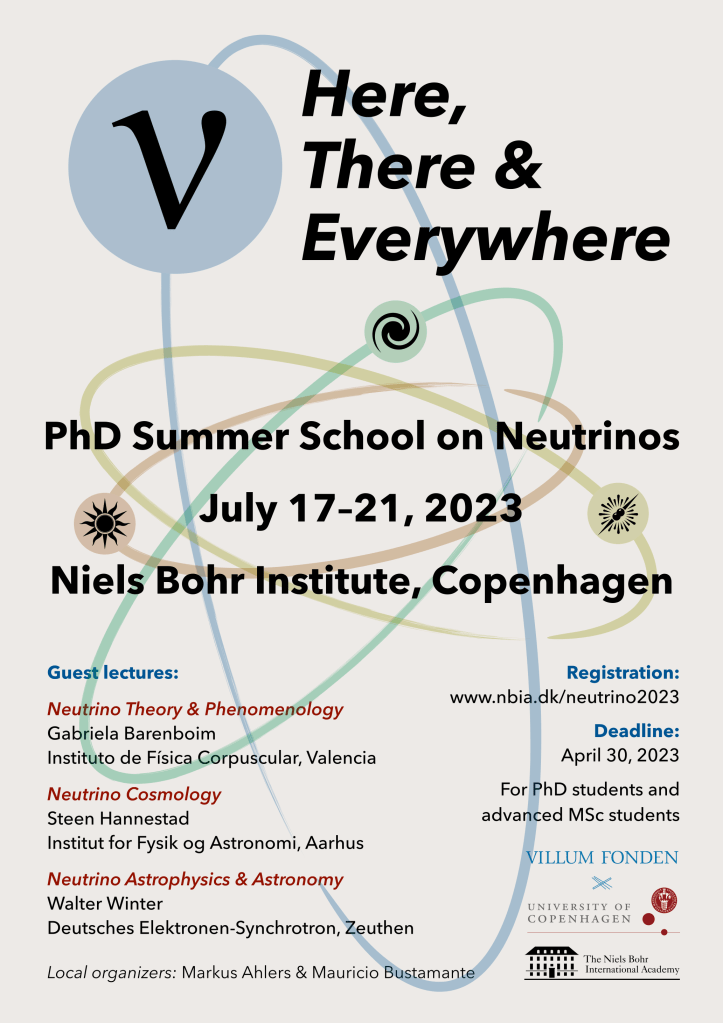
NBIA Neutrino Summer School 2023

Standard

Join us in the 2023 edition of the NBIA PhD Summer School on Neutrinos: Here, There & Everywhere!

💻 nbia.nbi.ku.dk/neutrino2023

📌 Where? Niels Bohr Institute, Copenhagen, Denmark

📅 When? July 17-21, 2023

🙋 For whom? PhD students and advanced MSc students

👥 Participation mode? In person (remote participation possible if you can’t come)

💵 Participation fee: None

❓ Questions? E-mail the local organizers (addresses on the school page)

⏳ Registration deadline: April 30 (register early; limited capacity)
Bump-hunting in the diffuse flux of high-energy cosmic neutrinos

Standard

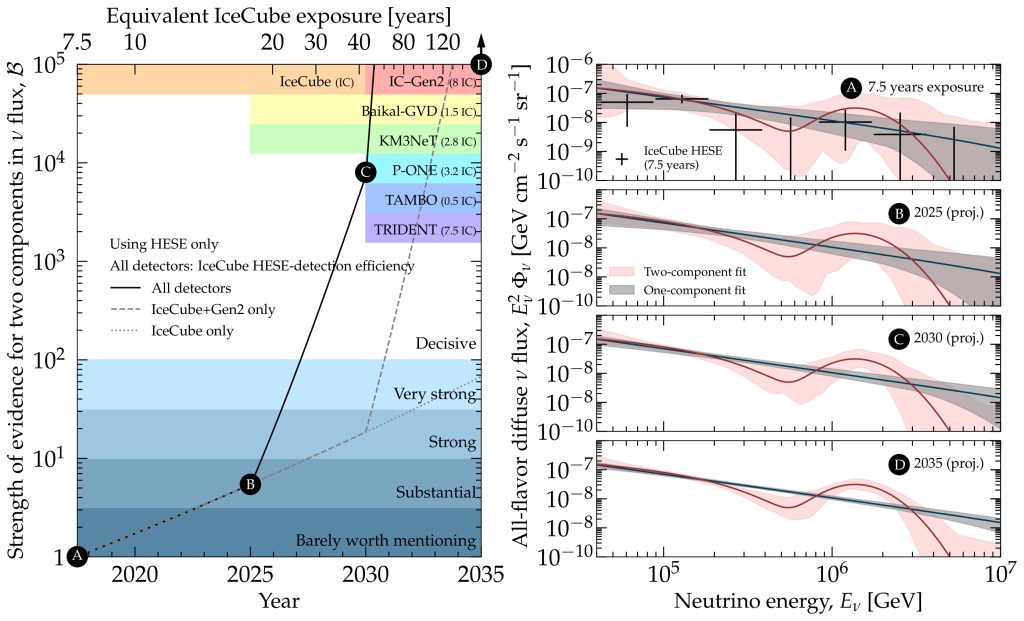
If the high-energy (TeV-PeV) neutrinos discovered by IceCube are made via proton-photon interactions in astrophysical sources, their energy spectrum may have a bump-like feature at a characteristic energy. We search for such a feature in present-day IceCube High-Energy Starting Events (HESE), on top of a power-law spectrum expected from alternative production via proton-proton interactions, and make forecasts using the expected exposure of upcoming neutrino telescopes.

We find no significant evidence of bumps in 7.5 years of HESE data, but a bump centered at ~1 PeV is only marginally disfavored. If the true flux does contain such a bump it could be discovered by 2027 using the combined exposure of IceCube, Baikal-GVD, and KM3NeT:

For more information, including interpreting limits on bumps as limits on the properties of the neutrino source population, see

Bump-hunting in the diffuse flux of high-energy cosmic neutrinos
Damiano F. G. Fiorillo, Mauricio Bustamante
arXiv:2301.00024

Discovering the diffuse flux of UHE neutrinos

Standard

Fifty years ago, Berezinsky first predicted ultra-high-energy (UHE) neutrinos, the most energetic ones expected, about a thousand times more so than those seen by IceCube so far. Today, we have yet to discover them, but this may finally change in the near future!

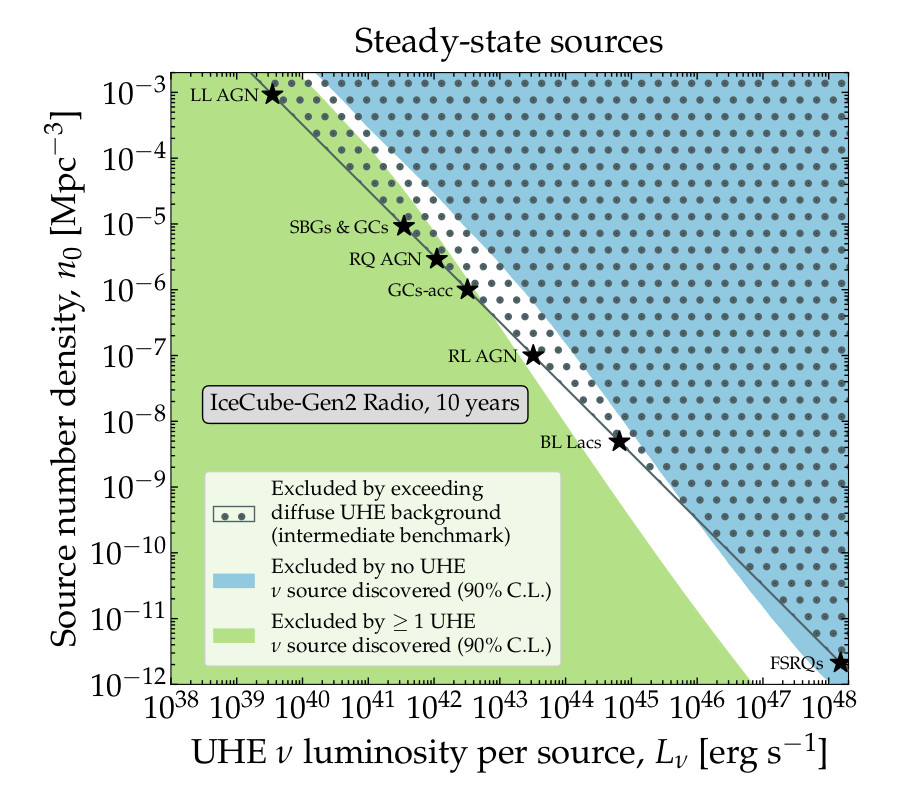
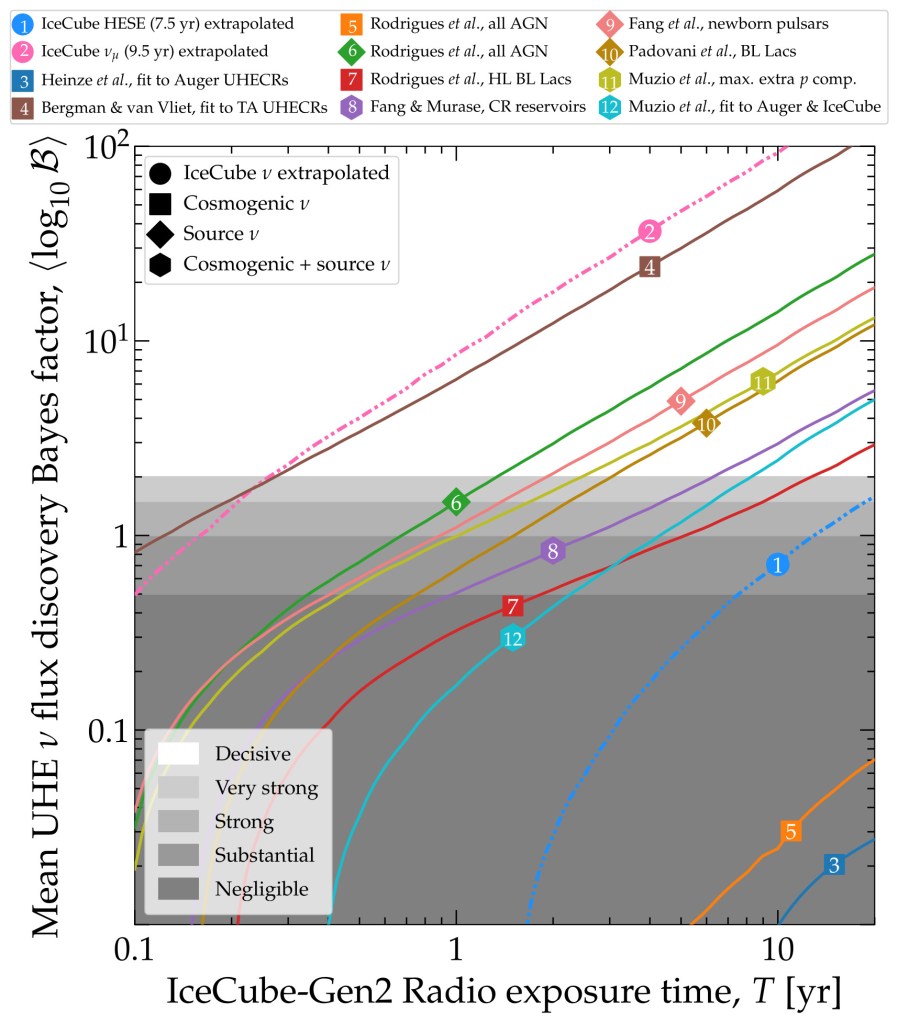
IceCube-Gen2, and other upcoming neutrino telescopes, have a real chance of discovering the long-sought diffuse flux of UHE neutrinos. In a new paper, led by Víctor B. Valera and in collaboration with Christian Glaser, we make detailed, robust, and realistic discovery prospects:

Near-future discovery of the diffuse flux of ultra-high-energy cosmic neutrinos
Victor Branco Valera, Mauricio Bustamante, Christian Glaser
arXiv:2210.03756

Our results are promising: we find that if we are lucky this can happen within only a handful of years of operation! Figures 1 and 14 are the money plots.  Figure 1, reproduced below, shows that most flux models can be discovered within ten years of Gen2 and most within a handful of years. 

Figure 14, in the paper, shows that, in the event of flux discovery, most models can be distinguished from each other.

This paper is a companion to two earlier papers of ours that use the same computational framework that accounts for theory and experimental nuance to make forecasts:

Discovering UHE neutrino point sources

Standard

In the near future, we expect that next-generation neutrino telescopes will provide us with the sensitivity required to discover the first sources of UHE neutrino point sources (> 100 PeV). In a recent paper, led by postdoc Damiano Fiorillo, we provided detailed forecasts for what the radio array of IceCube-Gen2 could achieve by looking for neutrino multiplets:

Read more at:

Near-future discovery of point sources of ultra-high-energy neutrinos
Damiano F.G. Fiorillo, Mauricio Bustamante, Victor B. Valera
arXiv:2205.15985

Measuring the UHE neutrino-nucleon cross section

Standard

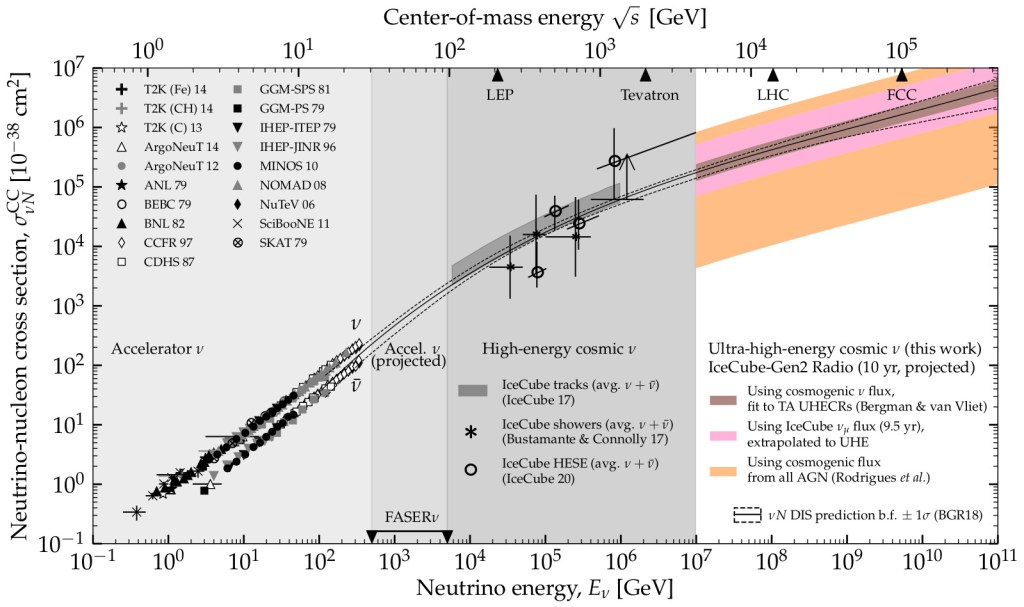
Recently, we put out a paper, led by PhD student Victor Valera, where we present the first complete forecasts of how well the planned radio array of IceCube-Gen2 will be able to measure the UHE (> 100 PeV) neutrino-nucleon cross section. The results are encouraging!

Read more at:

The ultra-high-energy neutrino-nucleon cross section: measurement forecasts for an era of cosmic EeV-neutrino discovery
Victor Branco Valera, Mauricio Bustamante, Christian Glaser
arXiv:2204.04237

NBIA Neutrino Summer School 2022

Standard

Join us in the 2022 edition of the NBIA PhD Summer School on Neutrinos: Here, There & Everywhere. This time it will be mainly an in-person event!

💻nbia.dk/neutrino2022

📌 Where? Niels Bohr Institute, Copenhagen, Denmark

📅 When? July 11-15

🙋 For whom? PhD students and advanced MSc students

👥 Participation mode? In person (unless otherwise advisable)

💵 What’s the damage? No participation fee

❓ Questions? E-mail the local organizers (addresses on the school page)

⏳ Registration deadline: March 31 (register early; limited capacity)