Following the GRAND white paper, Popular Mechanics also wrote about GRAND, with a catchy title:
GRAND featured on Gizmodo
StandardPrompted by the appearance of the GRAND white paper on arXiv, Gizmodo talked to Stephanie Wissel from Cal Poly and me and wrote an article about GRAND:
GRAND White Paper now public
StandardThe white paper of the Giant Radio Array for Neutrino Detection (GRAND) is finally out on arXiv:
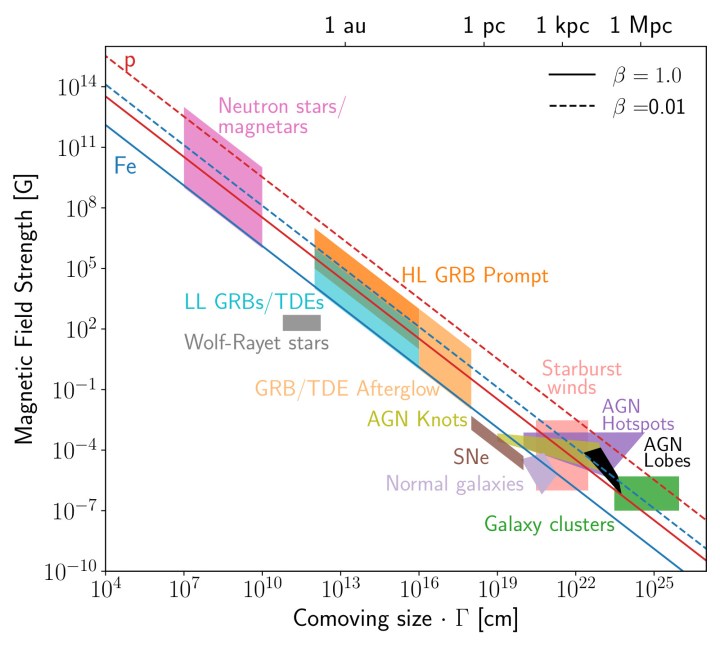
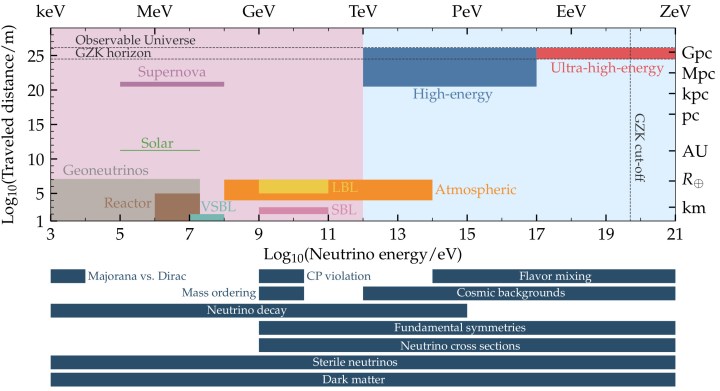
The Giant Radio Array for Neutrino Detection (GRAND): Science and Design, 1810.09994
GRAND Collaboration

I was editor and contributor of this paper — I am part of the GRAND Collaboration. Being editor demanded considerable time investment. So it is personally very satisfying to see the paper finally out!
Unitarity bounds of astrophysical neutrinos
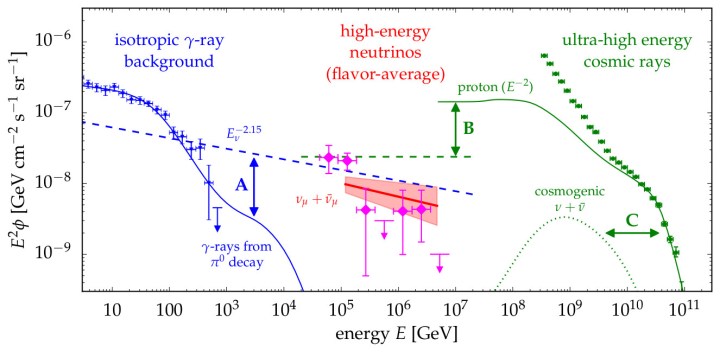
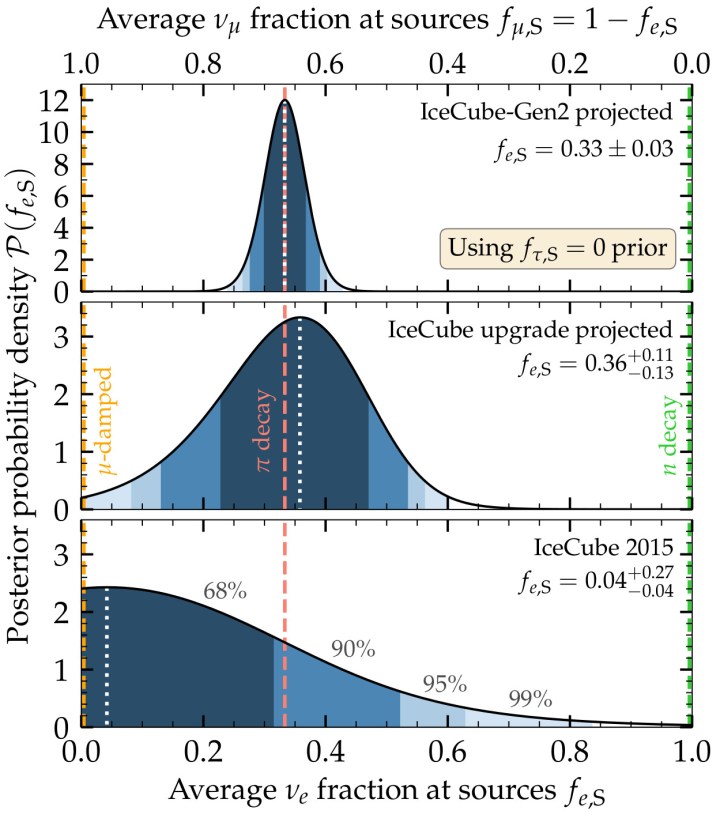
StandardAt high energies, new physics might affect the flavor composition of astrophysical neutrinos. In a large class of new-physics models, the total number of neutrinos of all flavors is conserved. In other words, the connection between the neutrino flavor states and the neutrino propagation states is represented by a unitary mixing matrix, whose elements have unknown or weakly bounded values. The new physics is expected to affected the flavor composition of high-energy astrophysical neutrinos, possibly significantly.
In a new paper, led by Markus Ahlers, we show that it is not necessary to know the values of the elements of the new mixing matrix in order to map the effect of new physics on the flavor composition. Based solely on the unitary of the new matrix, we derive the boundaries of regions that enclose all of the possible flavor compositions expected at Earth.

The regions we derive are refined and generalized versions of earlier work [X.-J. Xu, H.-J. He, and W. Rodejohann, JCAP 1412 (2014) 039, arXiv:1407.3736], and presented in a streamlined formalism that is easy to use. Neutrino telescopes such as IceCube could adopt these regions as priors in their searches for new physics in the flavor composition.
Read the preprint here:
Unitarity Bounds of Astrophysical Neutrinos, 1810.00893
Markus Ahlers, Mauricio Bustamante, Siqiao Mu
Interview about ANITA anomalous events
StandardFollowing the appearance of the preprint
The ANITA Anomalous Events as Signatures of a Beyond Standard Model Particle, and Supporting Observations from IceCube, 1809.09615
Derek B. Fox, Steinn Sigurdsson, Sarah Shandera, Peter Mészáros, Kohta Murase, Miguel Mostafá, Stephane Coutu ,
I was interviewed by Live Science about the ANITA anomalous events. Here is the link to that:
Bizarre Particles Keep Flying Out of Antarctica’s Ice, and They Might Shatter Modern Physics
Neutrinos feeling all of the electrons
StandardIn collaboration with Sanjib Kumar Agarwalla, we recently put out a paper on looking for new flavored long-ranged neutrino-electron interactions, using the flavor composition of the IceCube high-energy astrophysical neutrinos:
For the first time, we reach the ultimate sensitivity to probe these new interactions by considering the aggregated effect of all of the electrons in the local and distant Universe.


Blurb on CERN Courier
StandardOur recent paper on the TeV-PeV neutrino cross section was mentioned in the CERN Courier, together with the analysis performed by IceCube itself: The case of the disappearing neutrinos.
High-energy neutrino cross section paper is out
StandardIt took a while, but our paper — with Amy Connolly — extracting measurements of the neutrino-nucleon cross sections above 10 TeV is now out: 1711.11043.
In our paper, we used only HESE showers to extract the cross section. You might also be interested in the analysis done by IceCube, which used only through-going muons: 1711.08119.
Postdoc at the Niels Bohr Institute started
Standard
On October 01, 2017, I started a new postdoc position a the Niels Bohr Institute (NBI) of the University of Copenhagen. At the NBI, I have joined the Astroparticle Physics research group led by Subir Sarkar and the AstroNu research group led by Irene Tamborra.
TEDx talk now online
StandardIn the 2016 edition of TEDxTukuy, I gave a talk entitled “How do invisible particles reveal secrets of the Universe?”. The video is below. The audio is in Spanish, but you can turn on YouTube’s automatic English subtitling by clicking on the CC button located at the bottom of the video window.