
In the next decade, new neutrino telescopes might discover ultra-high-energy (UHE) neutrinos, with energies above 100 PeV. There is vast potential to test astrophysics and fundamental physics via their flavor composition—the proportion of electron, muon, and tau neutrinos in their flux—but it is still unclear whether these new detectors will have flavor-identification capabilities (though progress is ongoing).
In a new paper led by MSc student Federico Testagrossa, from the University of Padova, and co-authored by NBI postdoc Damiano Fiorillo and myself, we show a new way to measure the UHE neutrino flavor composition that does not rely on the flavor-identification capabilities of single detectors. Instead, we combine the detection of neutrinos of all flavors, more or less indistinctly, by one detector, with the detection of predominantly tau neutrinos by another. We choose the radio array of IceCube-Gen2 for the former and GRAND for the latter.
We show that that combination grants us access to the UHE tau-neutrino content, even for conservative choices of the UHE neutrino flux and of the size of GRAND:
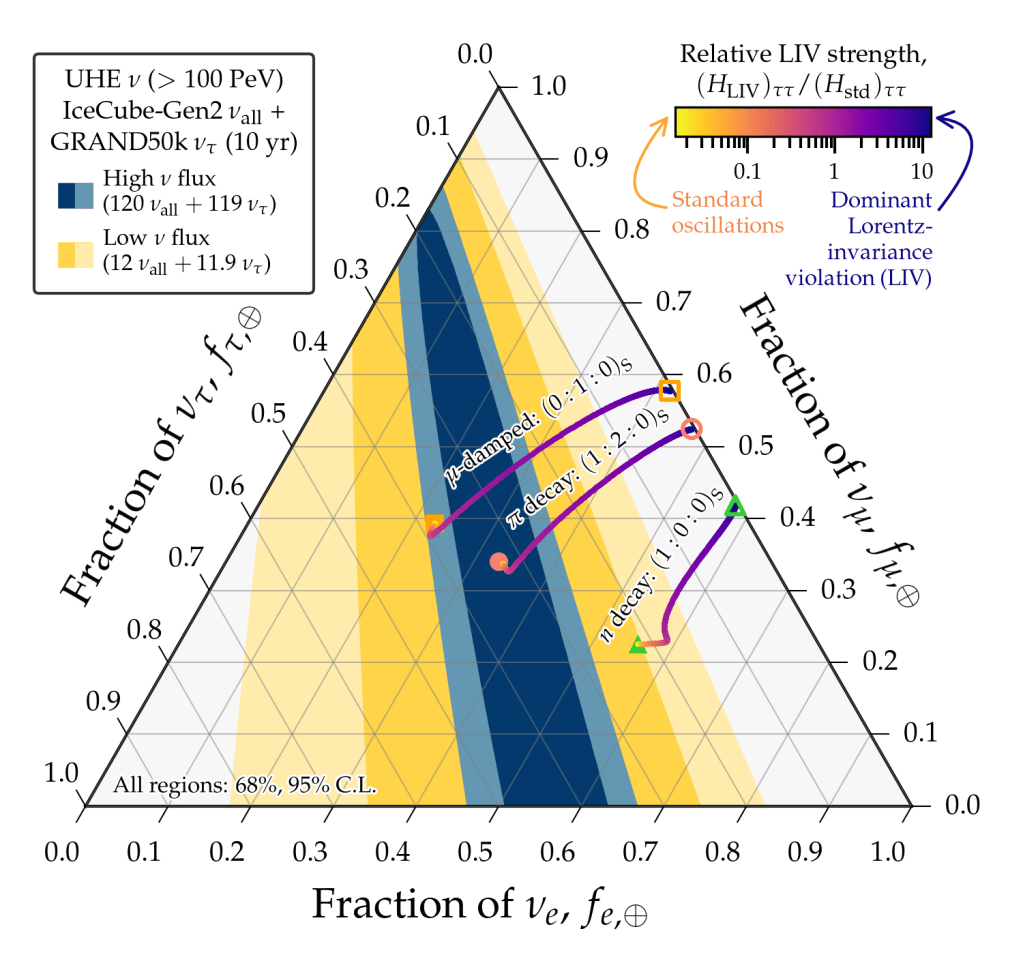
Our projections show that this measurement would allow us to extract important insight into the neutrino production mechanism at their sources and massively improve constraints on new physics that acts during neutrino propagation to Earth (we show examples for Lorentz-invariance violation).
Read more at
Two-detector flavor sensitivity to ultra-high-energy cosmic neutrinos
Federico Testagrossa, Damiano F. G. Fiorillo, Mauricio Bustamante
2310.12215 astro-ph
 Mauricio Bustamante